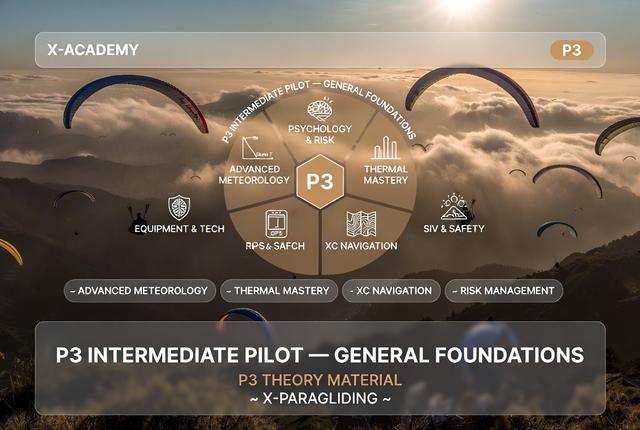
General Foundations for Paragliding P3 (Intermediate Pilot) Level
Moving to the P3 (Intermediate Pilot) level is a significant milestone in a paraglider's journey. It marks the transition from being a "student" to becoming a "pilot of the skies," where the focus shifts from basic mechanics to mastering invisible forces, long-distance navigation, and advanced safety.
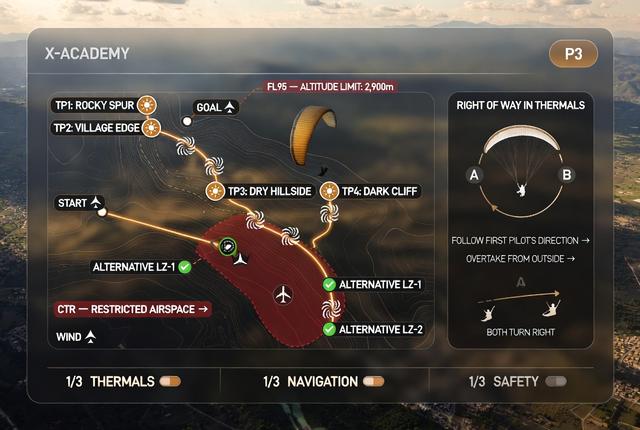
P3 - Cross-Country (XC) Fundamentals and Air Law
Cross-Country (XC) flying is the pinnacle of paragliding, where technical skill, strategic thinking, and respect for aviation law converge. At the P3 level, a pilot learns how to safely transition from "local" flying to long-distance navigation.
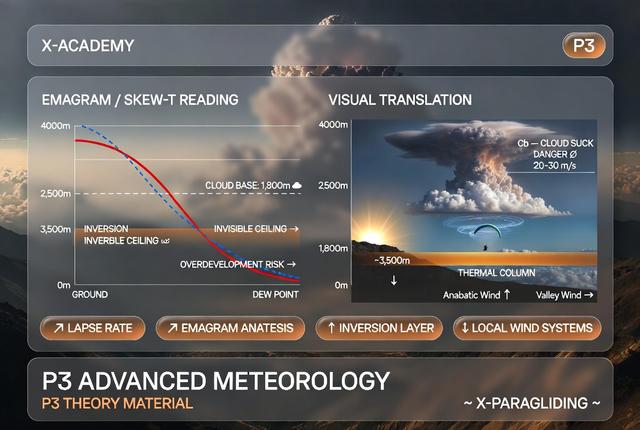
P3 Advanced Meteorology
The pilot must learn in-depth weather forecast analysis to plan safe and long-duration flights.
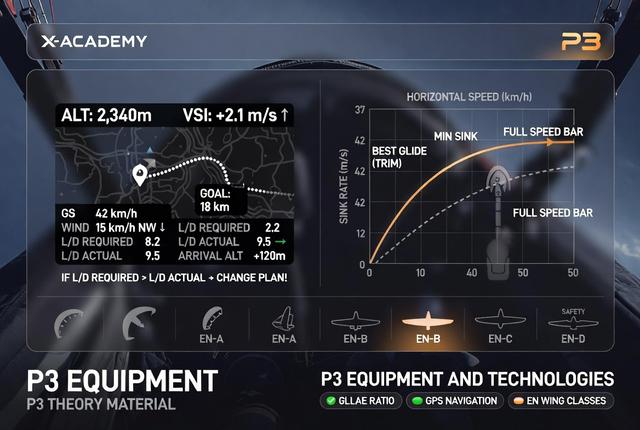
P3 Equipment and Technologies
At the P3 level, a deep understanding of equipment technical specifications is critical, as this is the stage where a pilot begins to maximize flight efficiency and overall performance.
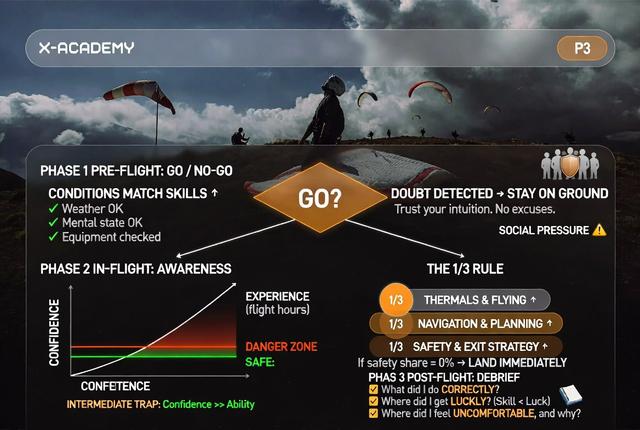
P3 Psychological Preparation
Paragliding is 90% psychology and only 10% physical manipulation. At the P3 level, when a pilot leaves their familiar environment and heads out on a cross-country route, the main challenge is not the weather, but the management of their own decisions.
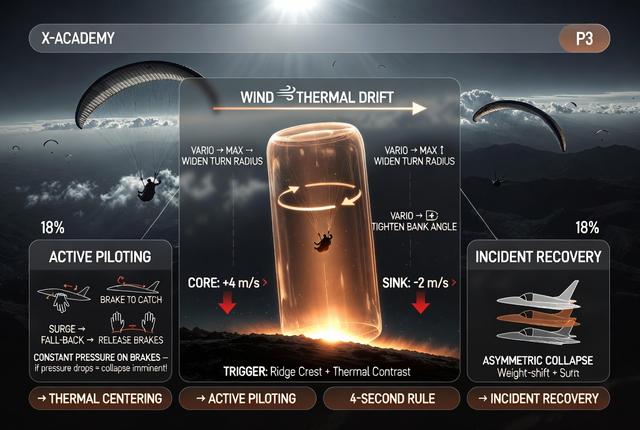
P3 Thermal Flying Theory: Advanced Concepts
Since thermal flying is turbulent, the pilot must theoretically understand the wing's behavior in critical situations.