On this page
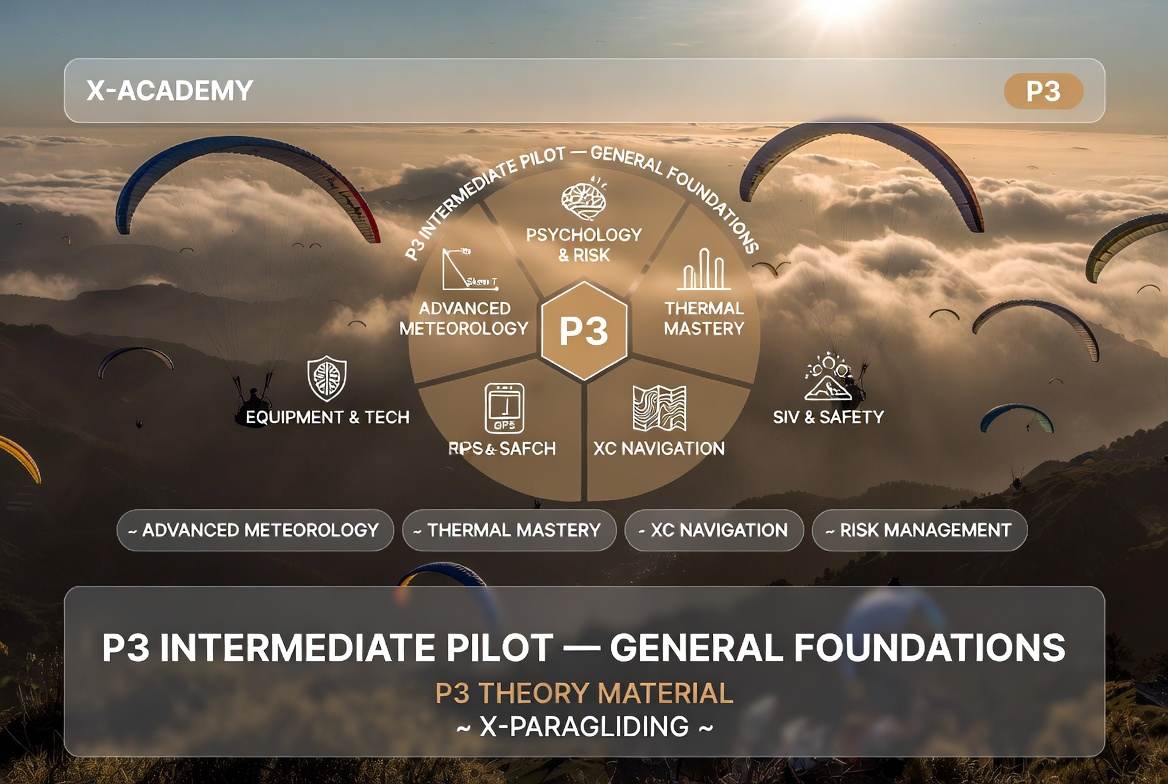
Moving to the P3 (Intermediate Pilot) level is a significant milestone in a paraglider's journey. It marks the transition from being a "student" to becoming a "pilot of the skies," where the focus shifts from basic mechanics to mastering invisible forces, long-distance navigation, and advanced safety.
Here is the comprehensive English breakdown of the P3 Theoretical Syllabus:
1. Advanced Meteorology
At the P3 level, a pilot must look beyond basic wind speed and learn to read the vertical structure of the atmosphere to plan safe, long-duration flights.
Lapse Rate: Understanding the decrease in temperature with altitude. Differentiating between Unstable, Stable, and Inversion layers.
Aerological Diagrams (Emagram / Tephigram): Learning to read skew-T charts to predict cloud base, thermal strength, and humidity levels.
Local Wind Systems: Deep analysis of Valley Winds, as well as Anabatic (up-slope) and Catabatic (down-slope) currents.
Hazardous Phenomena: Recognizing the life cycle of Cumulonimbus (Cb) clouds and the mechanics of "Cloud Suck."
2. Thermal Flying Theory
The primary goal of P3 is the ability to find, enter, and stay within a thermal efficiently.
Thermal Anatomy: Understanding the Core (strongest lift), the surrounding Sink, and how wind shear tilts the thermal column (Thermal Drift).
Trigger Point Analysis: Using terrain features (ridges, spurs, dark rocks) to predict where a thermal will release from the ground.
Centering Techniques: Mastering the "360-degree" turn to stay in the strongest part of the lift.
Cloud Streets: Selecting the optimal flight path by following aligned rows of cumulus clouds.
3. Flight Dynamics and Safety (SIV Theory)
Since thermal flying involves turbulence, the pilot must theoretically master wing behavior in critical situations.
Active Piloting: Proactive wing management to maintain internal pressure during pitch and roll oscillations.
Incident Analysis: Understanding the causes and recovery techniques for Asymmetric Collapses, Frontal Collapses, Deep Stalls, and Spins.
Energy Management: Controlling the wing's movements in the Pitch (forward/backward) and Roll (side-to-side) axes.
Reserve Deployment: Mental rehearsal and the decision-making process for when to pull the rescue parachute.
4. Advanced Equipment and Technology
Vario and GPS Integration: Utilizing advanced data like Glide Ratio (L/D), Ground Speed (GS), and "Arrival Altitude" to reach goals.
Speed Bar Optimization: Understanding the "Polar Curve"—knowing when to use the accelerator to maximize glide efficiency against the wind.
Certification Standards: Understanding the handling differences between EN-A, EN-B, and EN-C class wings.
5. Cross-Country (XC) Fundamentals & Air Law
Route Planning: Selecting a course based on sun orientation and predicted wind; identifying "Out-landing" zones (LZ) in advance.
Airspace Structure: Understanding restricted zones (CTR, TMA) and regulations regarding flight near airports.
Right of Way in Thermals: International rules for circling with other pilots (e.g., the first pilot to enter sets the direction of the turn).
6. Psychological Preparation and Risk Management
Self-Assessment: Honestly evaluating one's skill level versus the current conditions.
Decision-Making: Cultivating a "Safety First" mindset—knowing when to terminate a flight before conditions become dangerous.
Key P3 Vocabulary:
XC (Cross-Country): Flying away from the local site to a distant goal.
Inversion: A layer of warm air that acts as a "lid," stopping thermals from rising further.
G-Force: The physical load on the pilot and wing during high-energy maneuvers.
Laminar vs. Turbulent: Smooth airflow vs. chaotic, swirling air.