On this page
Cross-Country (XC) flying is the pinnacle of paragliding, where technical skill, strategic thinking, and respect for aviation law converge. At the P3 level, a pilot learns how to safely transition from "local" flying to long-distance navigation.
Here is the comprehensive English translation and breakdown of these core topics:
1. Cross-Country (XC) Planning and Strategy
XC flying is not chaotic movement; it is a "point-to-point" progression based on prior calculations.
Task Planning: The pilot must pre-determine the primary trajectory based on wind direction (Downwind, Crosswind).
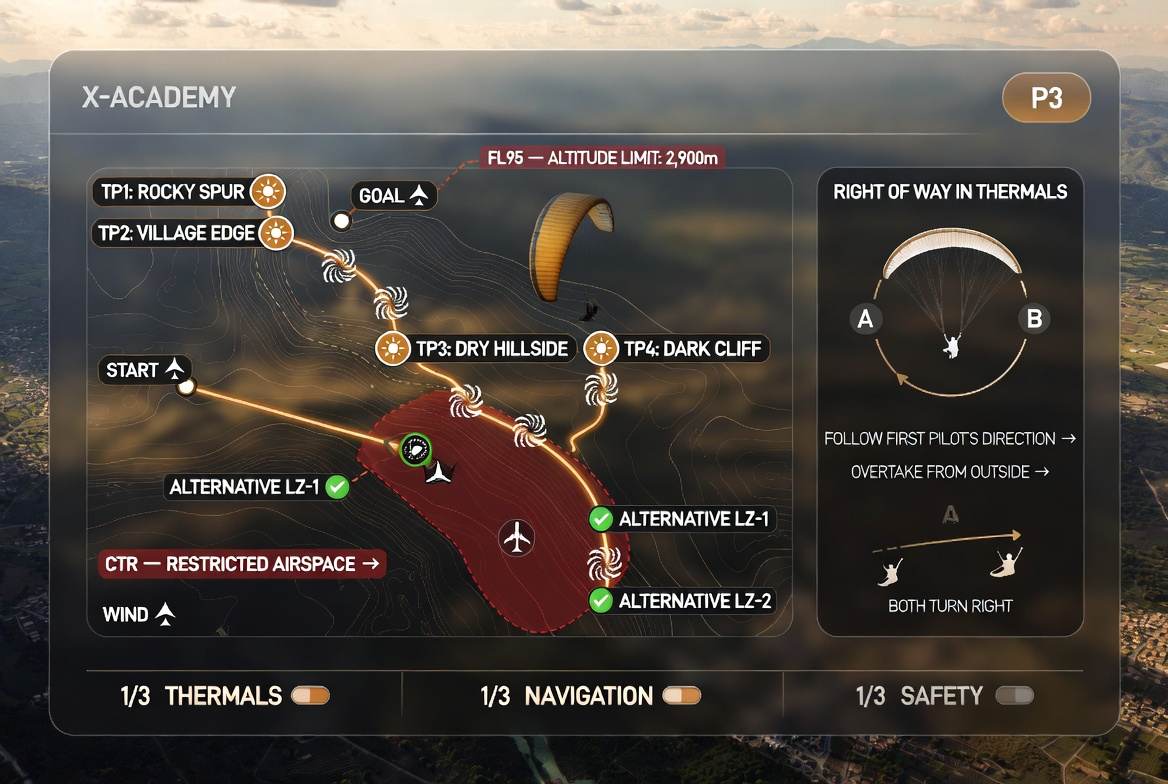
Chain of Trigger Points: The route should be planned so the pilot moves continuously between potential thermal release points (e.g., a rocky spur $\rightarrow$ the edge of a village $\rightarrow$ a dry hill).
Alternative Landing Options (LZ): The golden rule for an XC pilot is to always have two landing options within sight. If altitude falls below a critical threshold, the pilot must stop searching for thermals and enter "landing mode."
Terrain Analysis: Avoid narrow valleys (Venturi effect) and "dead ends" where landing might become impossible if the wind strengthens.
2. Airspace Structure and Law
Airspace is not empty; it is divided into zones where violations can lead to serious safety and legal consequences.
Restricted/Prohibited Areas: Military bases, government residences, or strategic infrastructure.
Controlled Airspace (CTR, TMA): Zones around airports. Paragliders are prohibited from flying here without specific authorization and radio contact.
VFR (Visual Flight Rules): Paragliding is conducted strictly under visual rules—only during daylight and outside of clouds.
Altitude Limits: Many regions have a maximum ceiling (e.g., FL95 — approx. 2,900m) above which commercial aviation corridors begin.
3. Right of Way (Priorities): Safety in Thermals
When multiple pilots occupy a single thermal, following the rules is life-saving:
The First Pilot Rule: The first pilot to enter the thermal and begin circling determines the direction of the turn (clockwise or counter-clockwise). Every pilot who joins afterward must circle in the same direction.
Overtaking: Overtaking within a thermal must be done from the outside radius to avoid crossing the trajectory of the inner (and usually slower) pilot.
Separation: Always maintain visual contact with other pilots. If you are climbing faster than the pilot above you, it is your responsibility to maintain a safe distance.
Head-on Encounters: If two pilots meet head-on (outside of a thermal), both must turn to the right.
4. Psychological Factors in XC Flying
Goal Fixation: This is the greatest danger. A pilot becomes so focused on reaching the goal that they fail to notice deteriorating weather or the disappearance of safe landing spots.
The 1-in-3 Rule: Allocate 1/3 of your mental energy to finding thermals, 1/3 to navigation, and 1/3 to safety and exit strategies.