On this page
Lapse Rate and Atmospheric Stability
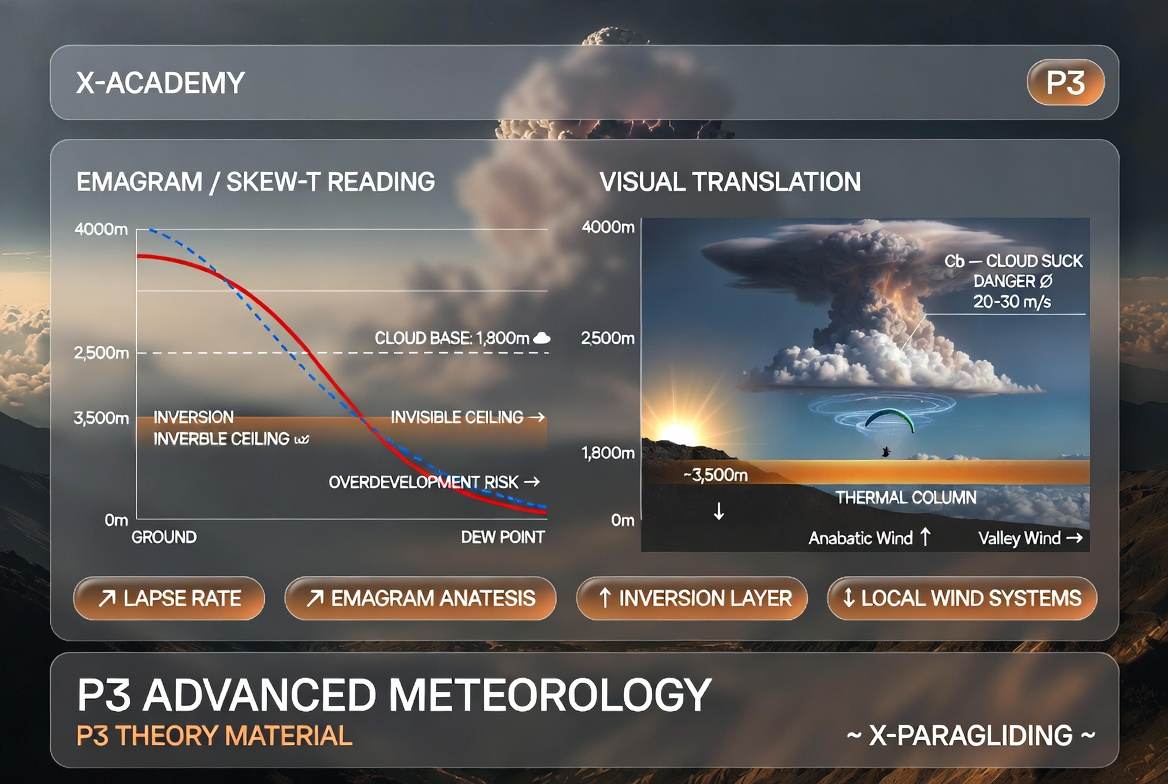
The Lapse Rate is the measurement of how much air temperature decreases for every 100 or 1,000 meters of altitude.
Unstable: Temperature drops rapidly with altitude. This is the primary driver for the formation of strong, punchy thermals.
Stable: Temperature drops slowly, which inhibits or weakens thermal development.
Inversion: A layer where temperature actually increases with altitude. An inversion acts as an "invisible ceiling," effectively stopping thermal currents from rising further.
Emagram / Tephigram Analysis
Reading aerological diagrams allows a pilot to pre-determine critical flight factors:
Cloud Base: The exact altitude where a thermal condenses into a cloud.
Thermal Ceiling: The maximum altitude a thermal can reach before losing buoyancy.
Humidity & Overdevelopment: Assessing the risk of air over-saturation and thunderstorm formation.
Local Winds and Terrain
Anabatic Wind: Air that is heated by sun-drenched slopes during the day and flows upward.
Catabatic Wind: Cold, heavy air that flows down the slopes in the evening or early morning.
Valley Wind: A large-scale movement of air along a valley floor. It is often much stronger than the general meteorological wind and can significantly affect landing and safety.
2. Thermal Flying Theory
Thermal Anatomy and Wind Influence
A thermal is rarely a perfectly vertical column.
Core: The central part where the lift is at its maximum velocity.
Sinking Air: The descending air found immediately surrounding the thermal's perimeter.
Wind Influence: Wind causes a thermal to tilt (Thermal Drift) and can break it apart. In high winds, thermals often become "shredded" or turbulent, making them difficult to locate and center.
Trigger Points
Air pools at the surface until an external factor forces it to break away and rise.
Terrain Triggers: Ridge crests, cliff edges, or the ends of valleys.
Thermal Triggers: Temperature contrasts (e.g., a dry wheat field bordering a cool forest).
Mechanical Triggers: A tractor working in a field or even another pilot taking off nearby.
Thermal Centering Technique
Pilots use a 360-degree circling technique to stay within the lift.
When the variometer indicates an increase in lift, the pilot widens the turn radius (flattens the wing) to push deeper into the core.
When the lift rate decreases, the pilot tightens the bank angle to "hook" back into the strongest part of the thermal.
Cloud Streets
These are rows of Cumulus clouds aligned parallel to the wind direction. Flying under a cloud street allows a pilot to travel long distances in a straight line within continuous lift, without the need for constant circling.
3. Safety Note: Cumulonimbus and Cloud Suck
Cumulonimbus (Cb): A thunderstorm cloud capable of sucking air at velocities of 20–30 m/s. It is extremely dangerous.
Cloud Suck: A condition where the upward lift is so powerful that the pilot cannot descend, even with full brakes. In this situation, the pilot must immediately use Big Ears or a B-Stall and fly toward the nearest clear air to escape the suction zone.