P3 — Flight Theory Test
25 questions5 errors allowed

At this level, the pilot is experienced and begins flying in more challenging conditions. What it includes: Finding and "coring" thermals (warm air currents) to gain altitude, and flying in moderate turbulence. Requirements: Typically requires a minimum of 30 to 60 independent flights at various locations.
6 modules 24 lessons Estimated lesson time: 14 h 30 min
+1 module
View Full Syllabus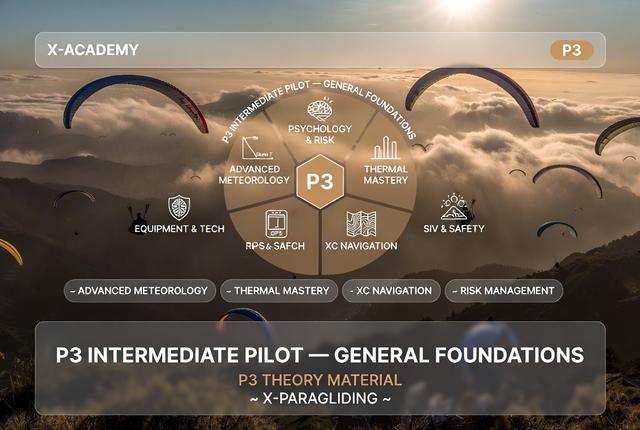 01
01Moving to the P3 (Intermediate Pilot) level is a significant milestone in a paraglider's journey. It marks the transition from being a "student" to becoming a "pilot of the skies," where the focus shifts from basic mechanics to mastering invisible forces, long-distance navigation, and advanced safety.
 02
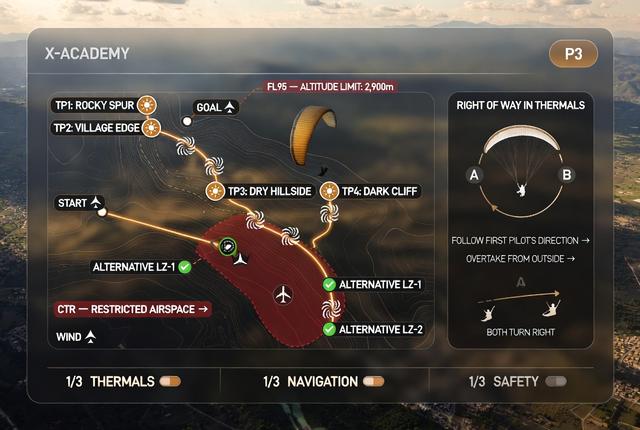
02Cross-Country (XC) flying is the pinnacle of paragliding, where technical skill, strategic thinking, and respect for aviation law converge. At the P3 level, a pilot learns how to safely transition from "local" flying to long-distance navigation.
 03
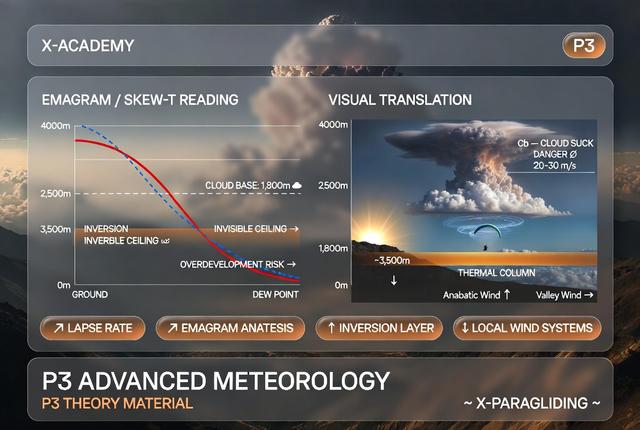
03The pilot must learn in-depth weather forecast analysis to plan safe and long-duration flights.
 04
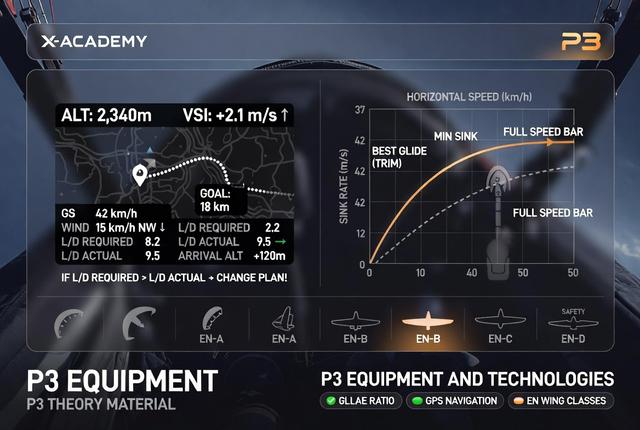
04At the P3 level, a deep understanding of equipment technical specifications is critical, as this is the stage where a pilot begins to maximize flight efficiency and overall performance.
 05
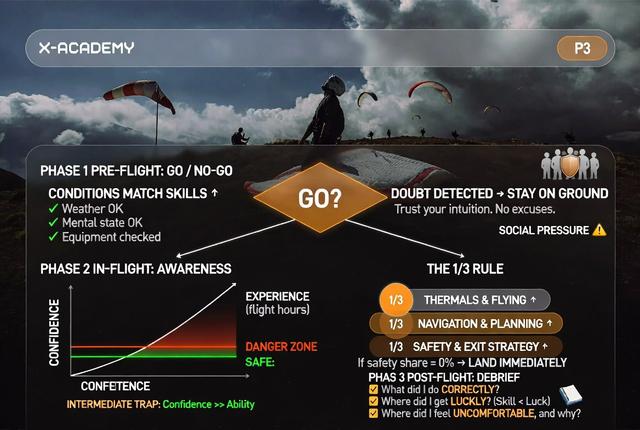
05Paragliding is 90% psychology and only 10% physical manipulation. At the P3 level, when a pilot leaves their familiar environment and heads out on a cross-country route, the main challenge is not the weather, but the management of their own decisions.
 06
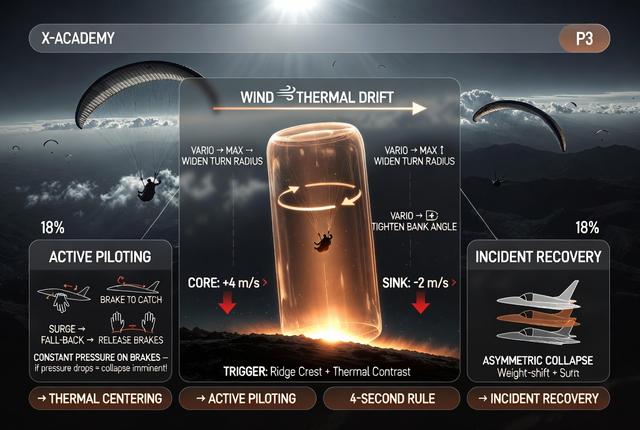
06Since thermal flying is turbulent, the pilot must theoretically understand the wing's behavior in critical situations.
P3 focuses on thermal flying, cross-country navigation, and advanced meteorology. After P2, pilots learn independent XC flight, instrument usage, and flying in diverse aerological conditions.
P3 certification requires minimum 100 independent flights after P2 and 50+ hours of recorded flight time. During the course you will complete an additional 20-30 training flights with an instructor.
Yes, a vario is essential for P3 since thermal flying and XC navigation require instrument use. If you don't have your own, you can rent one from the school during the course.
P3 allows you to fly cross-country (XC) routes, participate in regional competitions, fly in different countries (with IPPI card), and progress to P4 or T1 courses.