On this page
Thermal Anatomy and Environmental Factors
A thermal behaves like a living organism, constantly evolving with altitude and wind:
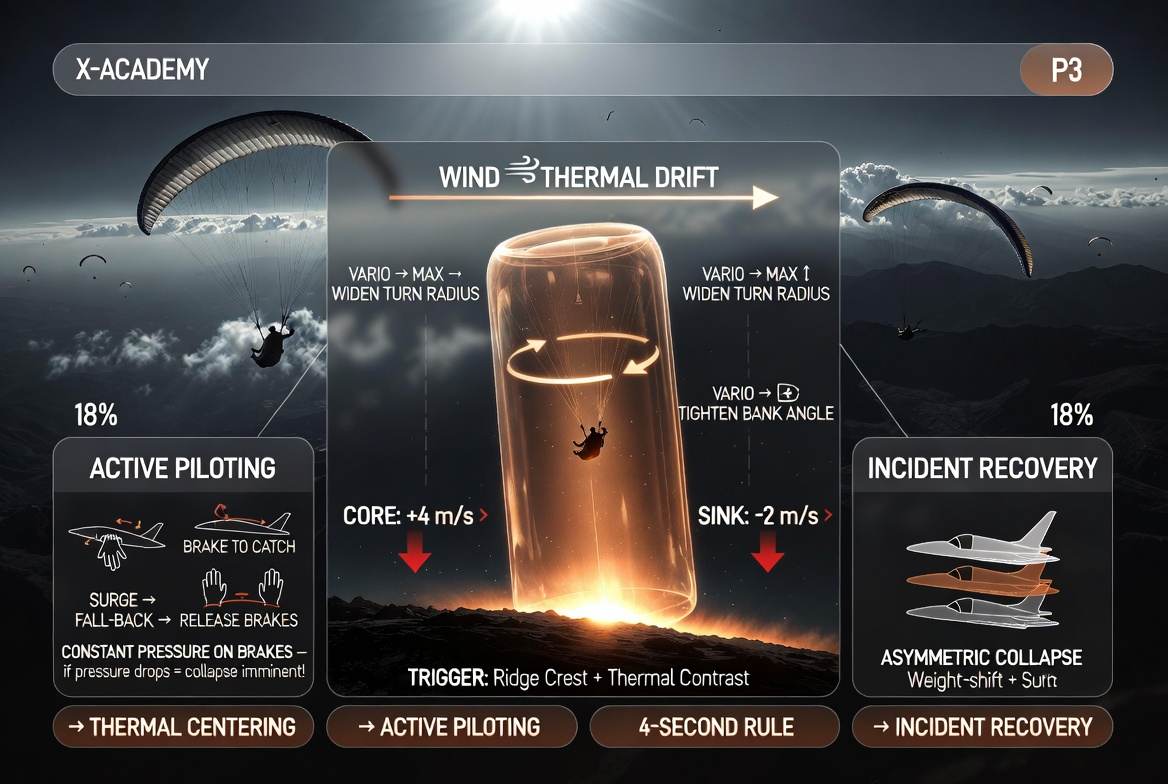
The Core: The central part of the thermal where the upward air velocity is at its maximum. As a thermal rises, it generally expands, though the core may split into several smaller "bubbles."
Sink (Sinking Air): Air at the edges of a thermal is always descending. A pilot must understand that a strong thermal is always accompanied by strong sink around its perimeter.
Thermal Drift: Wind tilts the thermal at an angle. The weaker the thermal and the stronger the wind, the more "laid over" and turbulent the thermal column becomes.
Trigger Points and Terrain
Air is "sticky" at ground level. To release it, a trigger is required:
Mechanical Triggers: Ridge crests, sharp valley confluences, or rocky spurs.
Thermal Contrast: Areas where two different surfaces meet (e.g., a sun-heated field next to a cool forest). Air releases more easily at the edge of a forest due to the temperature differential.
Refined Thermal Centering Technique
Centering is a process of constant micro-adjustment:
The 4-Second Rule: When the variometer indicates maximum lift, count for 2 to 4 seconds (allowing the center of the wing to enter the core) before initiating a steep bank into the turn.
Pressure Control: If the pressure on the inner brake (the side toward the core) increases, you are entering the core. If the pressure drops, the thermal is "pushing" you out.
2. Flight Dynamics and Safety (SIV Theory)
In thermal air, the wing is constantly "alive." A P3 pilot must be proactive rather than reactive.
Active Piloting
This is the "feel" of the wing through the brakes and the harness:
Constant Pressure: The pilot maintains slight tension on the brakes. If pressure suddenly disappears, it indicates an imminent collapse, requiring an immediate "catch" (brake input).
Pitch Control: If the wing "surges" ahead of you, catch it with the brakes. If the wing falls behind, release the brakes to allow the wing to regain its trim speed.
Incident Analysis and Response
Asymmetric Collapse: The priority is maintaining your heading by shifting weight to the opposite side to prevent an auto-rotation.
Frontal Collapse: Requires a symmetrical, short, and sharp brake input to reopen the leading edge and restore airspeed.
Negative Spin: Occurs when turning too slowly and sharply within a thermal. The solution is the immediate and full release of the brakes ("Hands up!").
Energy Management: Pitch and Roll
A P3 pilot must master the wing's inertia. Any sharp movement (Roll) generates energy that must be "dampened" with correct piloting to prevent it from escalating into dangerous oscillations.
Reserve Parachute Deployment
The Golden Rule: "If in doubt, throw it out!" The decision to deploy is made if:
The wing is in an uncontrollable rotation and altitude is being lost rapidly.
A Cravat (lines tangled in the wing) occurs and cannot be cleared after 2 or 3 attempts.
A mid-air collision occurs with another pilot.