

On this page
Paragliding is 90% psychology and only 10% physical manipulation. At the P3 level, when a pilot leaves their familiar environment and heads out on a cross-country route, the main challenge is not the weather, but the management of their own decisions.
Here is the in-depth English analysis of Psychological Preparation:
1. Risk Management: Objective Assessment of Capabilities
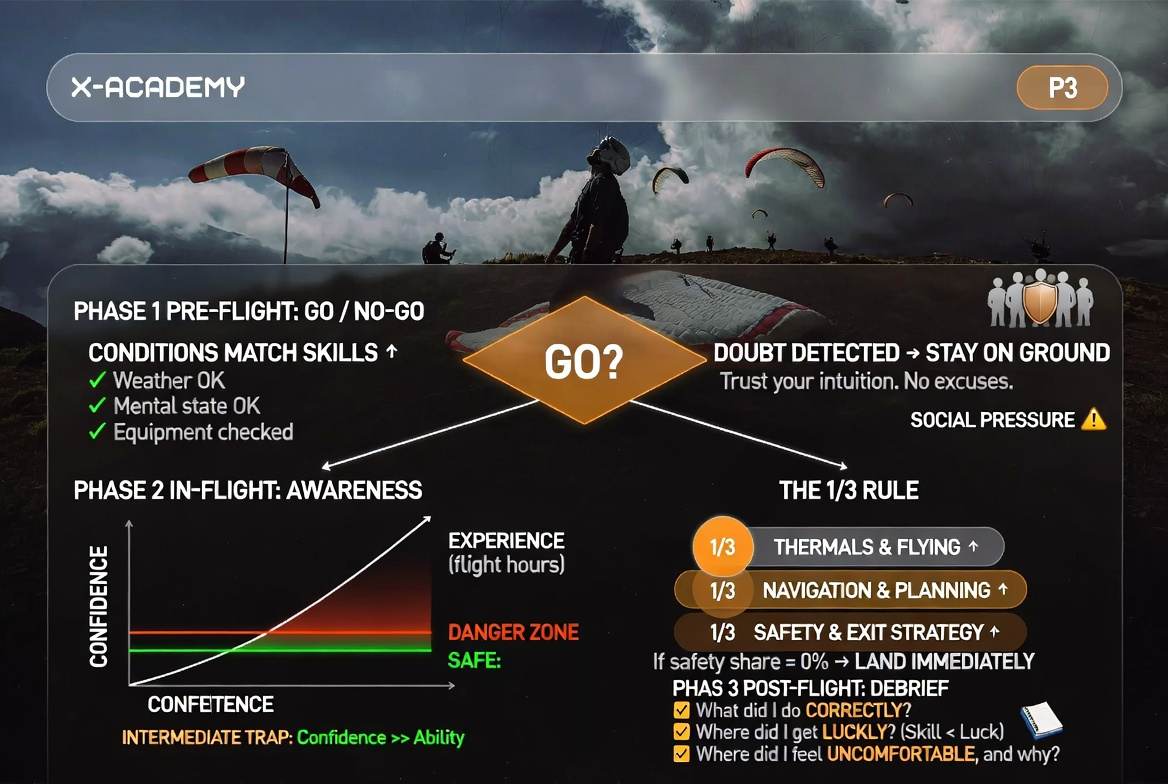
Many pilots fall into the so-called "Intermediate Trap": they have enough experience to feel confident, but they do not yet possess the instinct to recognize real danger from a distance.
The Competence Pyramid: A pilot must always know their place. "I know that I don't know much" is the safest position. Problems arise when a pilot thinks they can do more than their actual practice allows.
Balance of Equipment and Skills: Pilots often upgrade to high-class wings (e.g., EN-C) before their actual skills (SIV courses, active piloting in turbulence) allow for it. Risk management means admitting that "today's conditions are too difficult for me."
Social Pressure (Group Think): This is one of the biggest risks in XC flying. If you see others flying, it does not mean it is safe for you. You must always have your own "red lines."
2. Decision-Making Process
In paragliding, the right decision must be made before the situation becomes critical.
The "Go/No-Go" Model
This process begins before the flight and continues until landing:
At Takeoff: Comparing the weather forecast with reality. If there is something you "don't like" or you feel internal anxiety, do not look for excuses to fly—trust your intuition.
In the Air: Constant monitoring of conditions. If thermals become too "aggressive" or clouds grow rapidly, the decision to terminate the flight must be made instantaneously.
When to Terminate the Flight (Safety First)?
There are moments when landing is the only right choice:
Meteorological Changes: Strengthening wind, sudden change in direction, or the first signs of Cloud Suck.
Physical and Mental Exhaustion: If you are cold, hungry, or losing concentration, your reaction time increases significantly. This is the moment when you must land.
Goal Fixation: This is a "disease" where the pilot is so focused on a specific mileage that they ignore safety norms.
3. The 1/3 Rule
To correctly distribute your psychological resources, use this formula:
1/3 – Enjoyment of the flight and searching for thermals.
1/3 – Navigation and route planning.
1/3 – Safety and the "Exit Way." If there is no room left in your mind for safety, you have exceeded your mental capabilities.
4. Post-Flight Analysis (Debriefing)
A successful XC pilot performs an analysis after every flight:
What did I do correctly?
Where did I get lucky? (It is vital to distinguish skill from luck).
At what moment did I feel uncomfortable, and why?