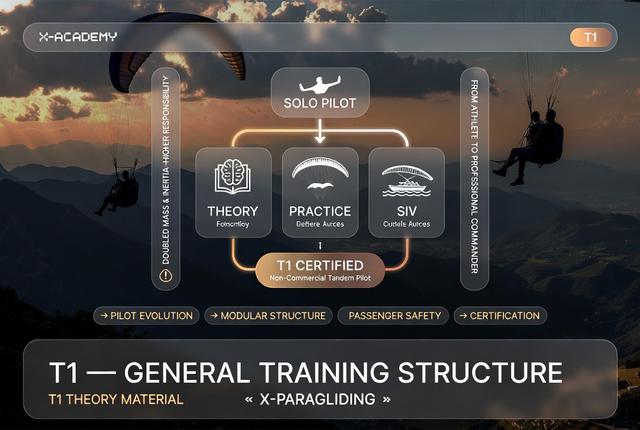
General Training Structure of the T1 (Tandem Pilot Level 1) Course
The T1 (Tandem Pilot Level 1) course is a critical transition stage where a pilot evolves from an individual athlete or hobbyist into a professional with high legal and ethical responsibility. At this level, the primary focus shifts from personal flying enjoyment to the rigorous management of passenger safety.
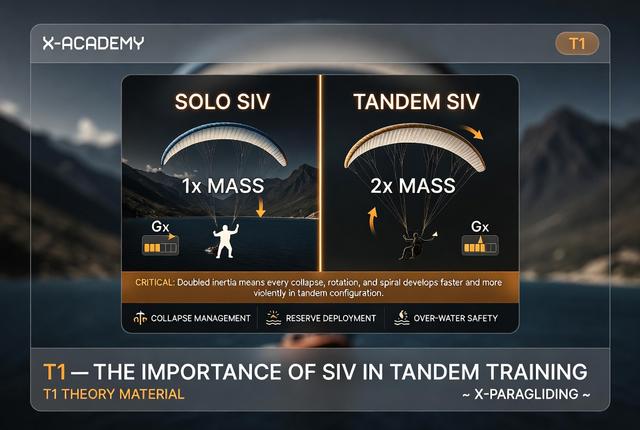
T1 -The Importance of SIV in T1 Training
The role of the SIV (Simulation d'Incidents en Vol) course in T1 retraining is not just additional training—it is the science of survival. In tandem piloting, where the system’s mass and inertia are doubled, any aerodynamic incident (collapse, rotation) develops much more aggressively and rapidly than in solo flight.
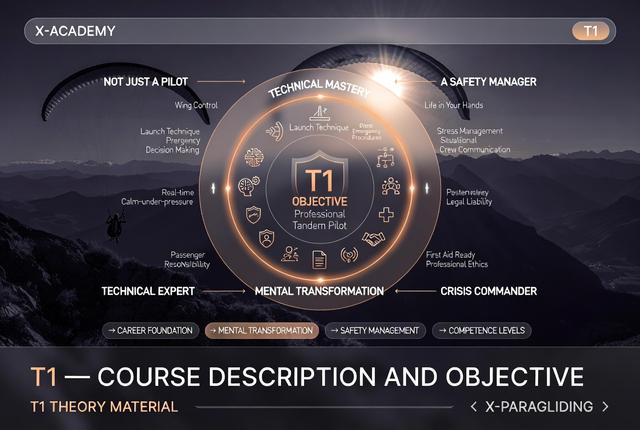
T1 Course Description and Objective
The description and objective of the T1 Course serve as the foundation upon which a professional tandem pilot's career is built. This is not merely an "additional certification"; it is a profound mental and technical transformation of the pilot.
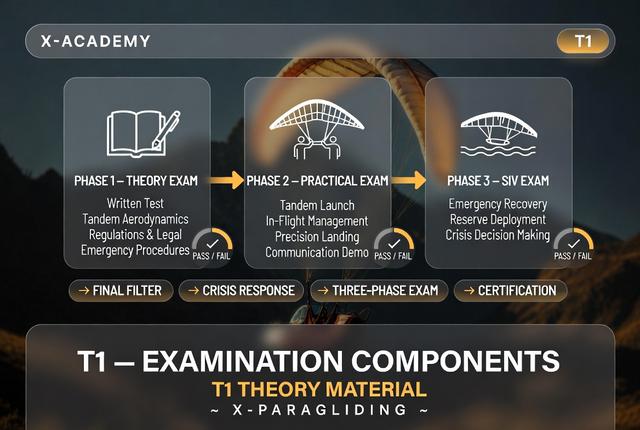
T1 Examination Components
The T1 Category Examination is the final filter that confirms a pilot is ready to take responsibility for another human life. It is not merely a demonstration of skills; it is a test of adequate response under crisis conditions.
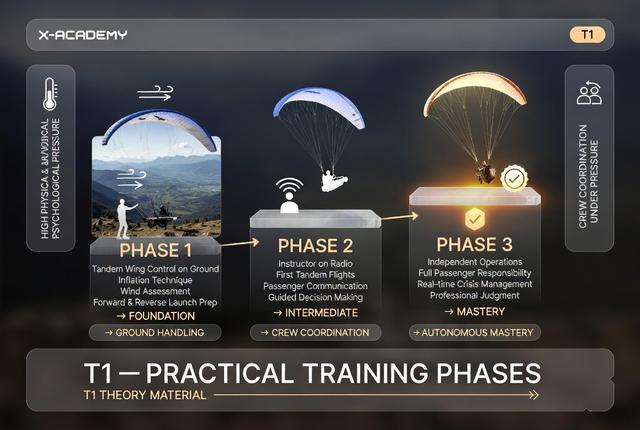
T1 Practical Training Phases
Practical training for the T1 Course is the phase where theoretical knowledge is transformed into real-world skills. Tandem piloting requires not just wing control, but the coordination of a crew under high physical and psychological pressure.
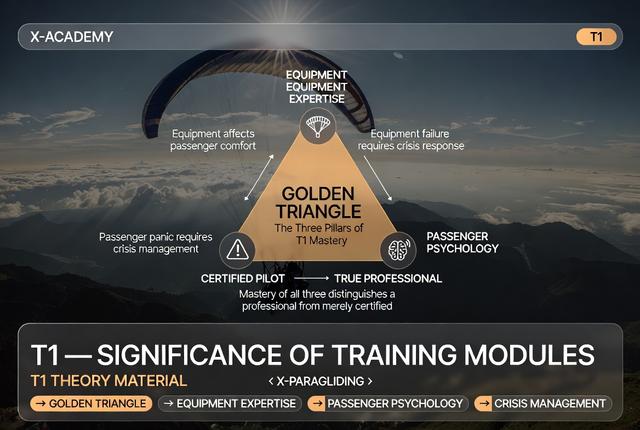
T1 Significance of Training Modules
In the retraining process, these three components form the "Golden Triangle" of tandem piloting. Mastery of these details is what distinguishes a certified pilot from a true professional. Each one is directly linked to the prevention of critical incidents.
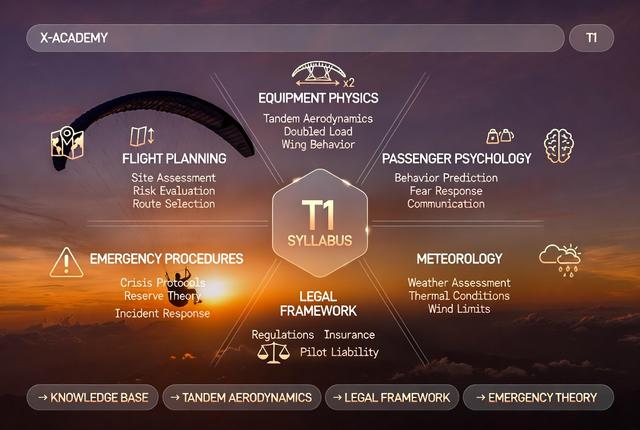
T1 Theoretical Training Syllabus
The T1 Course Theoretical Syllabus is the fundamental knowledge base that transforms a pilot from an individual athlete into a professional aircraft commander. Every detail—from the physics of the equipment to the psychology of the passenger—is directly linked to flight safety.