On this page
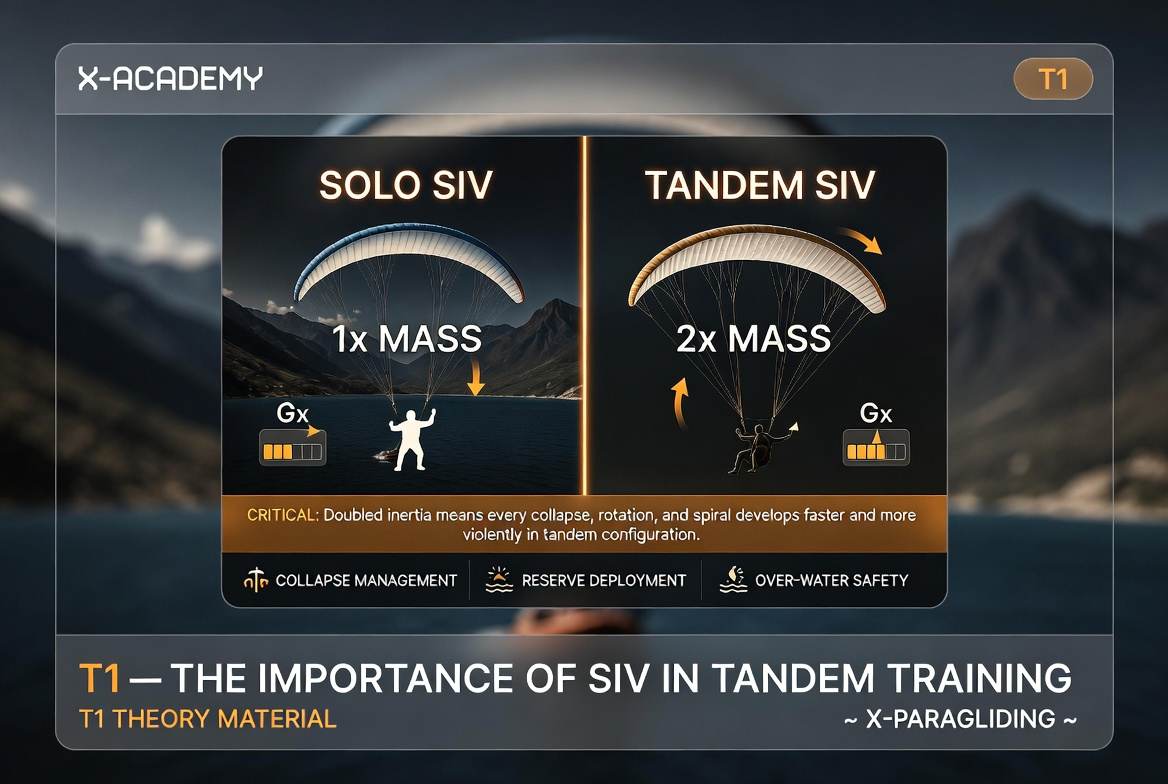
The role of the SIV (Simulation d'Incidents en Vol) course in T1 retraining is not just additional training—it is the science of survival. In tandem piloting, where the system’s mass and inertia are doubled, any aerodynamic incident (collapse, rotation) develops much more aggressively and rapidly than in solo flight.
Here is an in-depth and comprehensive breakdown of the importance of the SIV course in a tandem context:
1. Managing High Inertia During Incidents
A dual-seater wing loaded with 180–200 kg accumulates enormous kinetic energy during an incident.
Energy Retention: While a solo wing might "settle down" shortly after a collapse, a tandem wing continues to dive or rotate due to inertia. The pilot must learn metered energy management to ensure that a secondary, more powerful collapse does not occur when the wing reopens.
Dynamic Shocks: During an SIV course, the pilot practically experiences the physical force generated by an asymmetric collapse. This experience is essential so the pilot "does not freeze" and can maintain heading using weight-shift and control lines.
2. Impact of Passenger Mass on Wing Recovery
The passenger is not a static load; their position and actions critically alter the behavior of the wing.
Automatic Rotation: On a tandem, the large mass causes a faster deviation and entry into rotation during a collapse. The pilot must master Active Piloting under dual-weight conditions, where reaction times are significantly shorter.
The "Frozen Passenger": During SIV simulations, the pilot learns how to manage the wing when the passenger (instructor) leans the wrong way or moves their arms erratically due to panic. This is a school for managing "real-world chaos."
3. Tandem Spiral Dynamics and G-Loading
The spiral dive is the most effective but also the most dangerous maneuver for losing altitude on a tandem.
Impact of G-Force: A tandem reaches high G-loads much faster in a spiral. The pilot must know where the limit is to prevent the passenger (or the pilot themselves) from losing consciousness (Blackout).
Spiral Neutrality: Some tandem wings are prone to "spiral neutrality" (where the wing does not exit the spiral on its own). During SIV, the pilot learns forced exit techniques from this state, which is life-saving.
4. Reserve Deployment Specifics and Psychological Resilience
This is the last resort where an error is fatal.
Speed of Decision: The SIV course builds a pilot's "Decision Altitude." They know exactly at what height to stop "fighting" the wing and deploy the reserve.
Tandem Reserve Management: Pulling a tandem reserve handle requires more force, and the deployment process and passenger positioning under a reserve are specific. SIV provides a full mental and physical rehearsal of this process.
Psychological "Vaccine": A pilot who has completed SIV is much calmer in the air. This composure is transmitted to the passenger, which inherently increases the quality of flight safety.
Summary
The SIV course in T1 retraining is the line between an "amateur" and a "professional" tandem pilot. It is an investment in knowledge that you may only need once in your life, but that one time may save both your life and the life of your passenger.