On this page
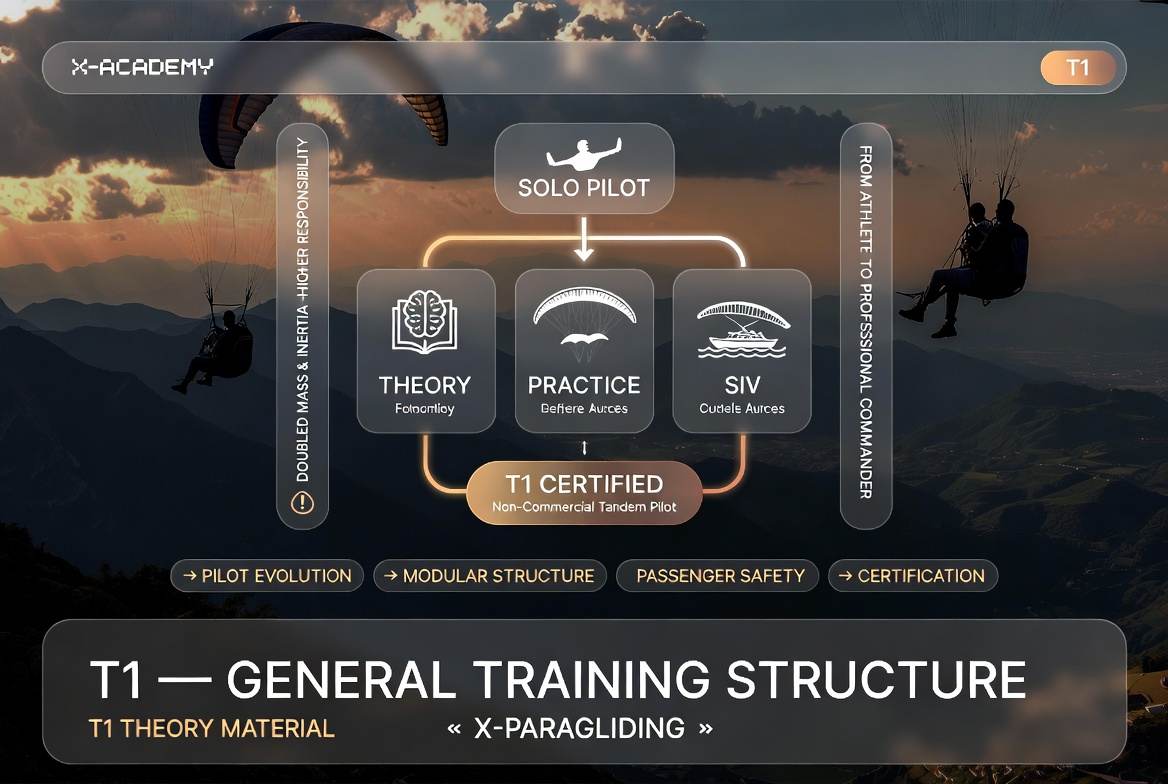
The T1 (Tandem Pilot Level 1) course is a critical transition stage where a pilot evolves from an individual athlete or hobbyist into a professional with high legal and ethical responsibility. At this level, the primary focus shifts from personal flying enjoyment to the rigorous management of passenger safety.
The following is a complete description of the T1 course, the syllabus, and the significance of each module:
1. Course Description and Objective
The T1 course is designed for experienced pilots who wish to transition to tandem operations. The objective is to master the specific handling characteristics of a dual-seater wing, where the top priority is passenger safety and the management of high-inertia flight dynamics.
2. Theoretical Syllabus
A. Tandem Equipment Physics and Construction
Topics: Weight range of the wing, types of spreaders, and the mechanical principles of trimmers.
Significance: Tandem wings are typically rated for 110–220 kg. A pilot must understand how this mass affects the wing’s speed, maneuverability, and structural stability.
B. Passenger Psychology and Management
Topics: The art of briefing, fear management, and anticipating passenger reactions during launch and flight.
Significance: A pilot’s ability to give clear, simple commands ensures a safe takeoff and maintains the passenger’s composure throughout the experience.
C. Aerodynamics and Maneuvering with Dual Mass
Topics: Managing inertia, the specifics of "Big Ears," and spiral dive dynamics on a tandem.
Significance: A tandem wing reacts more slowly than a solo wing. The pilot must master "proactive piloting" and anticipate the wing's momentum.
D. Emergency Protocols
Topics: Deployment of tandem reserves, passenger positioning during emergency landings, and protocols for tree or water landings.
Significance: Being responsible for two lives requires maximum speed and precision in decision-making under pressure.
3. Practical Training Phases
PhaseActivityGoalGround HandlingInflating the wing with a simulated passenger.Refining synchronized running and wing control.Passenger BriefingSimulation of instructions.Providing clear start/landing instructions to the passenger.Instructional FlightsFlights with an instructor.Learning to react to "difficult passenger" factors.Landing PrecisionLanding at a marked target.Mastering the Flare to stop a high-inertia mass accurately.
4. Critical Training Components
Trimmer Usage: Essential for adjusting speed and stability based on specific wind conditions.
Launch Coordination: Ensuring seamless teamwork between the pilot and the passenger during the takeoff run.
Landing Technique (Flare): Ensuring a soft and safe touch-down of the inertial mass.
5. Examination Components
Theory: Knowledge of equipment, meteorology, and legal/liability issues.
Practice: A perfect launch, $360^{\circ}$ turns, rapid descent maneuvers, and a soft landing within a 20-meter radius.
6. The Importance of SIV in T1 Training
Topics: Managing high inertia during incidents, the impact of passenger mass on wing recovery, tandem spiral dynamics, and reserve deployment specifics.
Significance: This is the highest level of safety training. The pilot learns how to harness the aggressive energy of a tandem wing during a collapse and how to manage the situation with a second person in the harness. SIV experience provides the psychological resilience and the skill to make the right split-second decision (e.g., throwing the reserve) at a critical altitude.