On this page
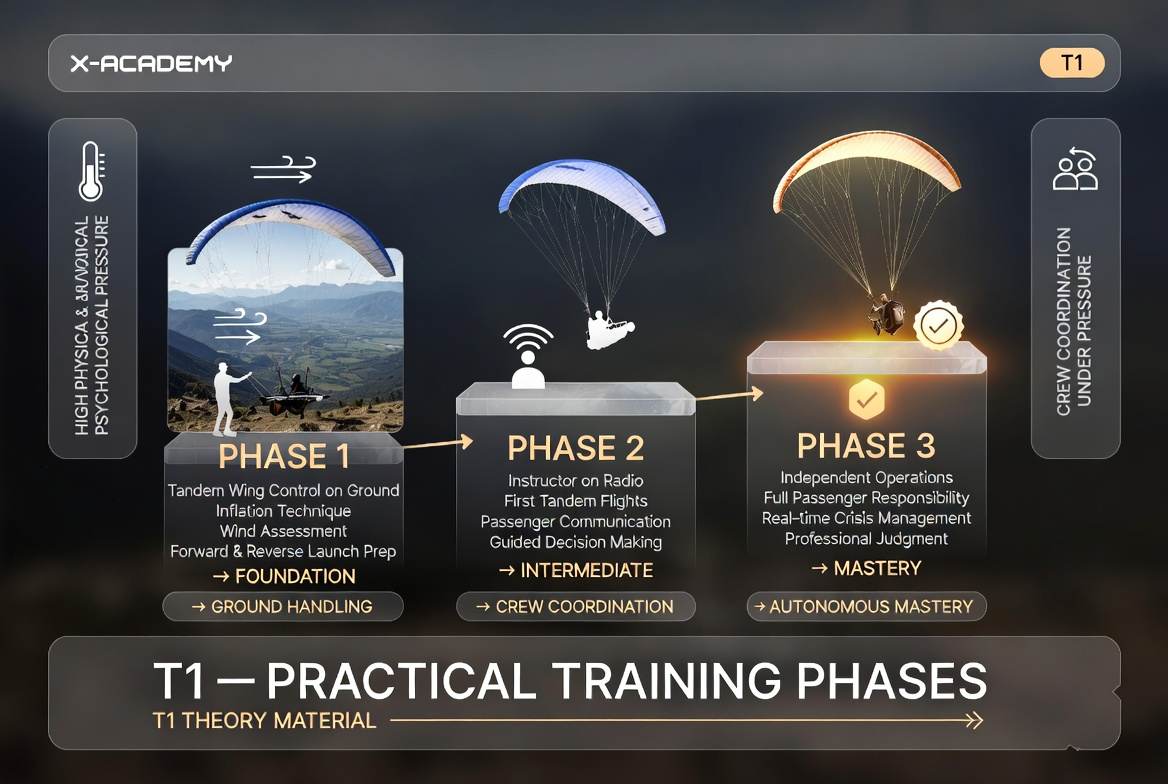
Practical training for the T1 Course is the phase where theoretical knowledge is transformed into real-world skills. Tandem piloting requires not just wing control, but the coordination of a crew under high physical and psychological pressure.
Here is an in-depth and comprehensive breakdown of the practical training phases:
1. Ground Handling (Practice with a Simulated Passenger)
This is the most critical and often underestimated stage. Launch success is 90% dependent on your work on the ground.
Synchronized Running: The pilot must learn to inflate the wing without causing the "passenger" (played by another pilot or instructor) to lose their balance. This requires physical strength and precise wing control.
Wing Stabilization: A tandem wing is large and generates more power in the wind. The pilot must learn to hold it steady at the "zenith" before giving the passenger the final command to run.
Significance: This stage refines automation—the pilot should no longer have to think about the wing; their entire focus must be directed toward the passenger.
2. Passenger Briefing (Instruction Simulation)
This is the art of communication. The pilot learns how to turn a nervous individual into a reliable "teammate."
Clear Commands: The pilot practices short, dynamic instructions. "Do not sit until I tell you" is a critical phrase, as sitting down prematurely is a leading cause of launch accidents.
Checklist (Equipment Verification): Checking helmets, harnesses, and carabiners in the passenger's presence is not only for safety but also a way to build the passenger's trust.
Significance: A proper briefing reduces the risk of panic and ensures the passenger follows your instructions at critical moments.
3. Instructional Flights (Flights with an Instructor)
At this stage, the pilot feels the real dynamics of dual mass in the air for the first time.
The "Difficult Passenger" Factor: The instructor simulates a passenger who stops during the launch run, becomes restless in the air, or sits incorrectly. The pilot must stabilize the flight under these conditions.
Maneuvering and Rapid Descent: The pilot performs "Big Ears" and spirals to feel how G-load increases and how much more physical strength is required to control a tandem.
Significance: This serves as a "safety cushion"—the pilot makes mistakes in an environment where the instructor can immediately correct the situation.
4. Landing Precision (Accuracy and Flare)
Landing is the most difficult element for a tandem due to its high inertia.
Inertia Calculation: The pilot must learn where to start the "glide" and when to execute a full stop (Flare). A tandem must be "braked" much earlier than a solo wing.
Soft Touch-Down: The goal is for the passenger to touch the ground so gently that they feel no impact on their legs. The pilot learns to land within a marked 20-meter radius in any weather condition.
Significance: Most injuries occur during landing. Mastering precision is the ultimate guarantee of passenger safety.
Why are these stages decisive?
Practical training builds "muscle memory" in the pilot. When a difficult situation arises in the air, the pilot will not become confused because they have already navigated each stage dozens of times during simulation.