On this page
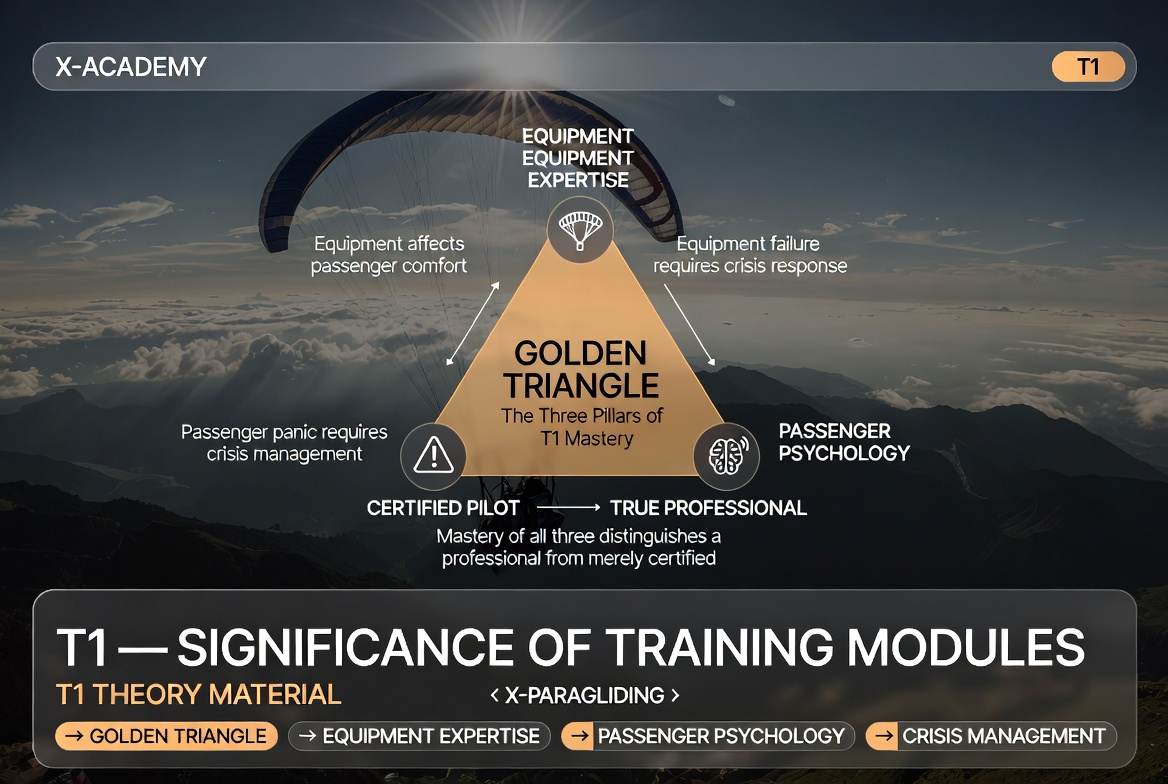
In the retraining process, these three components form the "Golden Triangle" of tandem piloting. Mastery of these details is what distinguishes a certified pilot from a true professional. Each one is directly linked to the prevention of critical incidents.
Here is an in-depth analysis of these topics:
1. Trimmer Usage: Control of Dynamic Stability
Trimmers on a tandem are not just "speed boost" buttons; they are the primary tool for managing the wing's geometry.
Adaptation to Wind Conditions: In strong winds, opening (releasing) the trimmers is essential to prevent the wing from pulling you backward and to ensure sufficient forward speed (Penetration).
The Launch Phase: During takeoff, the correct trimmer position (usually neutral or slightly pulled in) determines how easily the wing rises. Incorrectly set trimmers can cause the wing to "overshoot" or, conversely, hang back.
Thermal Flying: Pulling the trimmers in during thermalling increases the wing’s internal pressure and improves climb efficiency. However, the pilot must know when to release them to maintain stability in turbulent air.
2. Coordination at Launch: Crew Synchronization
A tandem launch is not a pilot running with a passenger; it is a unified, coordinated action between two people.
Center of Gravity Management: The pilot must feel the passenger's weight. If the passenger sits in the harness prematurely, they become "dead weight," which often leads to a failed launch or a fall. Coordination means both parties maintain a vertical position until flight is established.
Timing of Commands: "Go," "Faster," "Run"—these commands must be issued exactly when the wing is at the zenith and ready for takeoff. Any delay results in a loss of energy.
Significance: Lack of coordination at launch is responsible for 70% of tandem incidents. A pilot's mastery is revealed in their ability to anticipate and manage the passenger's actions.
3. Landing Technique (Flare): The Art of Dissipating Inertia
This is the most physical and technical part of the flight, where a 200 kg mass must safely touch the ground.
Two-Stage Landing: The Flare (braking the wing) on a tandem must begin earlier and more aggressively than on a solo wing. The pilot must use their full weight and arm strength to bring horizontal speed to zero.
Passenger Protection: The main goal during landing is to ensure the passenger does not take an impact on their legs. A correct Flare allows the crew to touch down softly, as if stepping off a single stair.
Wind Considerations: In nil-wind conditions, the Flare must be as deep as possible, whereas in strong winds, it must be more cautious to prevent the wing from dragging the crew backward.
Why are these issues critical?
These three elements form a safety chain. If the trimmers are incorrect, the launch will be difficult; if you lack coordination, takeoff becomes risky; if the landing technique (Flare) is weak, the passenger may be injured. Mastering these points during training gives the pilot total control over every second of the flight.