On this page
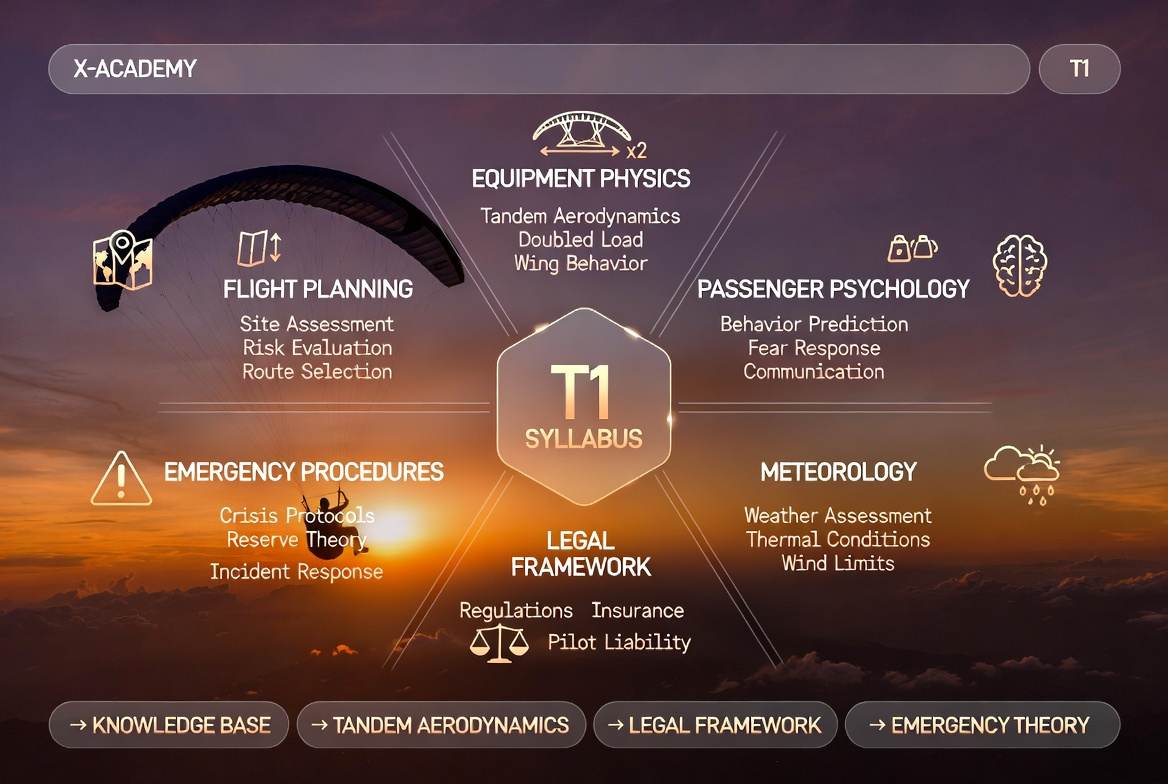
The T1 Course Theoretical Syllabus is the fundamental knowledge base that transforms a pilot from an individual athlete into a professional aircraft commander. Every detail—from the physics of the equipment to the psychology of the passenger—is directly linked to flight safety.
Here is an in-depth and comprehensive breakdown of the theoretical syllabus:
A. Tandem Equipment Physics and Construction
Tandem equipment is not just a "large size" solo wing; it is a specific engineering solution designed for extreme loads.
Wing Loading Range (110–220 kg):
Flying with Light Weight: When the total weight is at the lower end, the wing is less resistant to collapses, and its maneuverability decreases.
Flying at Maximum Weight: The wing becomes very stable and fast; however, landing speed increases, as does the load on the lines and internal structure.
Types of Spreaders: A pilot must understand the differences between Hard, Soft, and Adjustable spreaders. The choice affects the relative positioning of the pilot and passenger, as well as the pilot's field of vision.
Principles of Trimmer Operation: Trimmers on a tandem adjust the wing's angle of attack. Releasing (opening) them increases speed in strong winds, while pulling them in is necessary for climbing in thermals and achieving a soft flare during landing.
B. Passenger Psychology and Management
A tandem pilot must be a capable psychologist. A passenger's mental state directly translates into their physical actions during the critical launch phase.
The Art of Briefing: The pilot must be able to deliver clear, concise instructions within 30 seconds: "Don't sit," "Run until the end," "Don't let go." Excessive information only confuses the passenger.
Fear Management: Fear is natural. A pilot’s calm voice and confident movements are contagious. The pilot must be able to identify a passenger in "silent panic" who might freeze during the takeoff run.
In-Flight Reactions: The pilot must know in advance how to handle air sickness or a panic attack. In such cases, the priority is an immediate but controlled termination of the flight and constant communication with the passenger.
C. Aerodynamics and Maneuvering with Dual Mass
Double the weight means immense inertia. A tandem does not respond to control inputs as instantaneously as a solo wing.
Inertia Management: When initiating any maneuver (e.g., a turn), the wing requires "lead time." The pilot must master Proactive Piloting (Anticipation).
Specifics of "Big Ears": Executing big ears on a tandem requires significant physical strength. The pilot must know how to use weight-shift effectively while the ears are tucked.
Spiral Dynamics: A tandem gains energy much faster in a spiral. The pilot must be skilled at preventing excessive G-loading, which could cause a passenger to lose consciousness.
D. Emergency Protocols
This is the most critical part of the course. When two lives are at stake, there is no room for error.
Tandem Reserve Deployment: The pilot must know exactly when to deploy the rescue parachute. Tandem reserves are larger, and the opening shock is more powerful. Protecting the passenger during deployment is paramount.
Passenger Position during Emergency Landing: The pilot must instruct the passenger to lift their legs so that the pilot’s harness (equipped with a protector) absorbs the primary impact.
Tree or Water Landings:
Water: The pilot must prioritize freeing the passenger from the harness so they are not trapped or pulled under by the wing.
Tree: The main objective is the stable fixation of the passenger within the tree structure until a rescue team arrives.
Why is this theory important?
Theoretical knowledge provides the pilot with an "emergency plan" for every second. When a pilot understands how their equipment functions and how a passenger's psyche works, they no longer simply "react" to events—they manage them.