Advanced SIV – Daily Training Plan
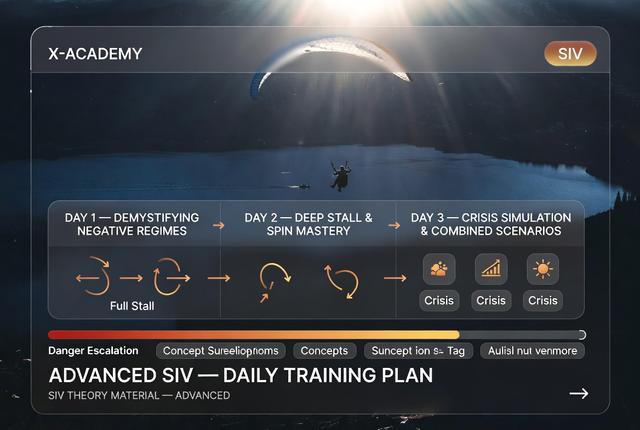
The daily plan for an Advanced SIV course is not just a list of flights—it is a process of psychological and technical transformation for the pilot. Each day is built upon the experience of the previous one to minimize risk and maximize the pilot's control.
Advanced SIV: High-Level Course Overview
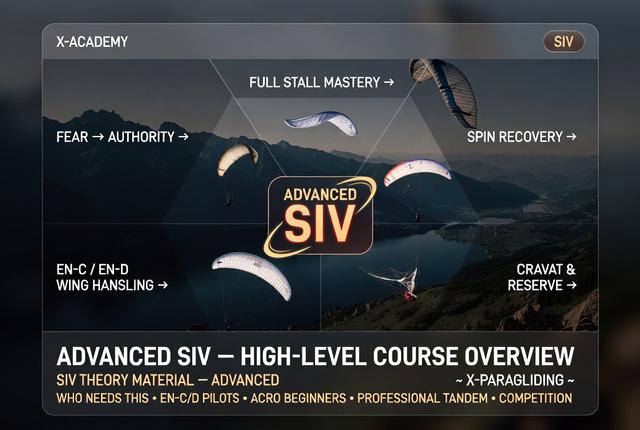
Advanced SIV represents the pinnacle of paragliding safety training. At this stage, a pilot learns not only how to recover from an incident but also how to manage the full deformation of the wing and its subsequent "rebirth" in mid-air. This course is essential for those planning to fly EN-C or EN-D class wings, engage in acrobatics, or pursue professional tandem piloting.
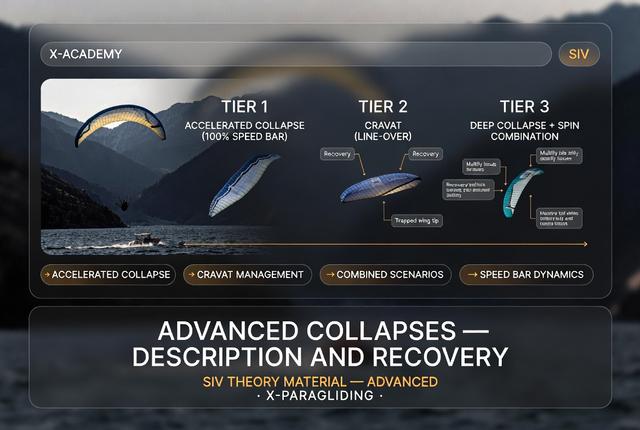
Description of Collapses at the Advanced SIV Level
Handling collapses within an Advanced SIV course is no longer just about pulling one side of the wing. Here, the focus is on simulating a real crisis, where everything happens at high speed, with high energy, and aggressive rotation.

Detailed Description of Advanced SIV Maneuvers
Maneuvers at the Advanced SIV level represent the "higher mathematics" of paragliding. At this stage, the pilot learns to command the wing at the exact point where standard aerodynamics cease to function. These are not merely tricks; they are a deep-seated study of wing anatomy.

The Significance of Advanced SIV
In the context of Advanced SIV, mastering the Full Stall is the defining turning point where a pilot transitions from "amateur" to "expert." This is not just another maneuver—it is the moment you gain absolute authority over your wing.

The Significance of Advanced SIV for the Pilot
An Advanced SIV (Simulation d'Incidents en Vol) course is not merely technical training—it is the highest stage of a pilot's mental and professional evolution. While a pilot learns how to "avoid" mistakes in the early stages, at the Advanced level, they learn how to manage an inevitable crisis and turn it into a controlled process.