On this page
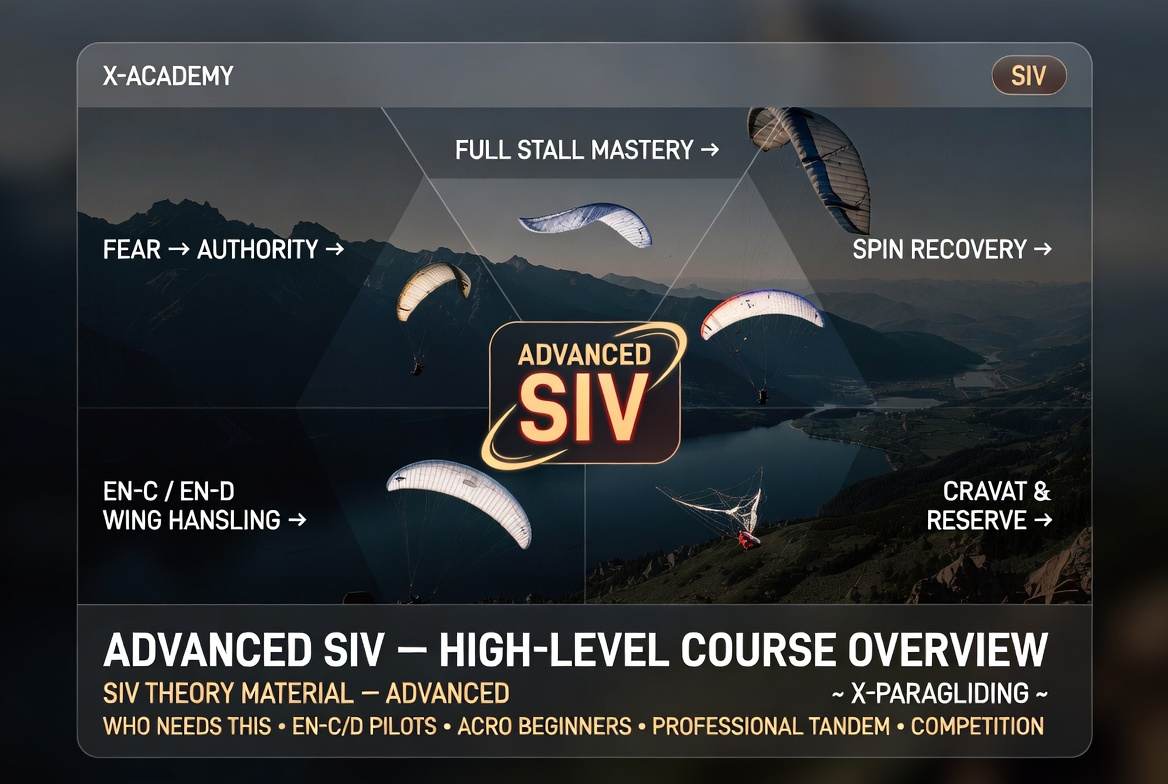
Advanced SIV represents the pinnacle of paragliding safety training. At this stage, a pilot learns not only how to recover from an incident but also how to manage the full deformation of the wing and its subsequent "rebirth" in mid-air. This course is essential for those planning to fly EN-C or EN-D class wings, engage in acrobatics, or pursue professional tandem piloting.
Below is a detailed overview of Advanced SIV:
1. The Significance of Advanced SIV
At this level, the pilot shatters their greatest fear: the Full Stall.
Crisis Management: If a wing becomes so entangled (Cravat) that standard methods cannot clear it, the only solution is to fully stall the wing and redeploy it.
Reconfiguring Instincts: The pilot learns to resist the panic-driven urge to release the brakes when the wing falls behind them, preventing the most severe types of surge-related injuries.
2. Detailed Description of Maneuvers
A. Full Stall
The pilot pulls the brakes to their maximum extent, causing the wing to stop flying, collapse, and fall behind the pilot.
Significance: This is the "Reset Button" of paragliding. Recovery from almost any complex configuration is possible through a Full Stall.
Detail: You learn the stabilization phase (when the wing "flails" above your head) and controlled recovery to ensure the wing does not surge violently in front of you.
B. Negative Spin
Burying one brake while the other remains at trim speed, causing one side of the wing to stall while the other continues to fly.
Significance: This often happens during improper turning in a thermal or during landing flares. A pilot must be able to recognize and stop it instantly.
Detail: You learn to release the brake at the exact moment the wing is positioned back in front of you.
C. Search for Backfly
This is the "sweet spot" between a Full Stall and flying. The wing maintains its shape but moves slowly backward.
Significance: This is the safest state for resolving any major incident.
Detail: The pilot learns to hold their hands in the specific position where the wing is stable and does not perform aggressive surges.
D. Deep Stall (Parachutal)
The wing is not collapsed, but it has no forward airspeed—it only descends vertically.
Significance: This occurs frequently with old or wet wings. The pilot must know how to "reactivate" flight using the speed bar or risers.
3. Collapses at the Advanced Level
At this stage, collapses are performed dynamically rather than in calm air:
Accelerated Collapses (100% Speed Bar): Collapses at full speed. The wing reacts with lightning speed and high aggression.
Cravat (The "Tie"): Clearing an artificially induced cravat using a Full Stall or the stabilo line.
4. Daily Training Plan (Advanced SIV)
The Advanced course requires maximum concentration and typically lasts 3–4 days.
Day 1: Introduction to Negative Regimes
Theory: Phases of a Full Stall (Entry, Stable phase, Exit).
Flight 1: Searching for the Stall Point and performing short stalls.
Flight 2: First Full Stalls under strict instructor supervision.
Flight 3: Initiating a Negative Spin and stopping it instantly.
Day 2: Stabilization and Control
Theory: The importance of the Backfly point.
Flight 1: Sustained Full Stall (remaining in the stabilization phase).
Flight 2: Finding Backfly and steering the wing within it.
Flight 3: Various techniques for exiting a Full Stall.
Day 3: Complex Regimes
Theory: Methods for clearing a Cravat.
Flight 1: Collapses on full speed bar.
Flight 2: Cravat simulation and clearance via Stall.
Flight 3: Elective program / Working on weak points.
Significance for the Pilot
After Advanced SIV, the pilot and the wing become one. You no longer fear the wing collapsing or stopping because you know exactly how to "rebuild" the wing in any situation. This is true freedom in the air.