

On this page
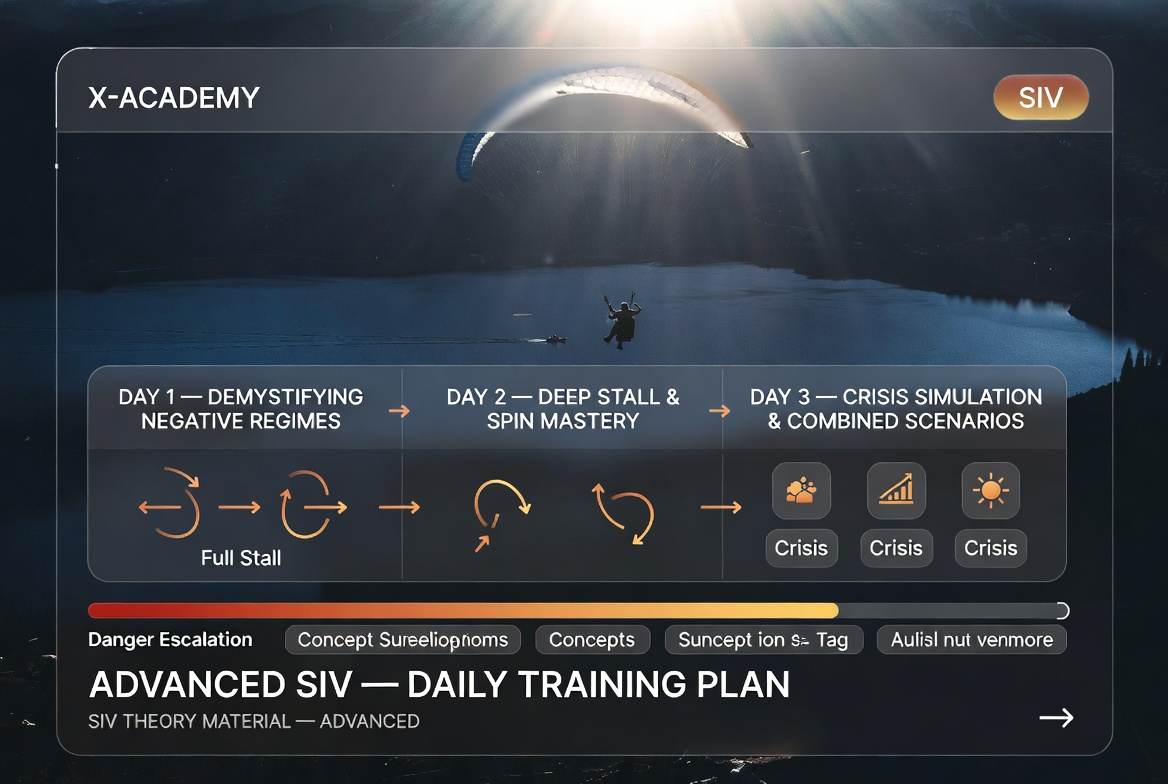
The daily plan for an Advanced SIV course is not just a list of flights—it is a process of psychological and technical transformation for the pilot. Each day is built upon the experience of the previous one to minimize risk and maximize the pilot's control.
Here is a comprehensive and in-depth overview of the Advanced SIV training plan:
Day 1: Demystifying Negative Regimes
The primary goal of the first day is for the pilot to realize that stopping the wing does not mean a catastrophe; rather, it is a manageable state.
Theoretical Preparation: A detailed discussion on the phases of a Full Stall. Special emphasis is placed on "battling instinct"—the pilot must learn to keep their hands down even when the body feels like it is falling backward.
Practice (Flights 1 & 2): The first stalls are brief, allowing the pilot to feel the exact moment the wing loses pressure. The instructor monitors every millimeter via radio to prevent a dangerous forward surge (Surge).
Negative Spin (Flight 3): This is the first encounter with an asymmetric negative regime. The pilot learns that instantly releasing the brake at the start of a spin immediately returns the wing to its flight regime.
Day 2: Stabilization and "Backfly" – The Edge of Mastery
On the second day, the pilot transitions from "passenger" mode to "active commander" mode. Here, the goal is not just to enter a stall, but to remain in it.
Theory: Finding the Backfly point. This is the "Holy Grail" of Advanced SIV. The pilot learns that by slightly raising the hands after a stall, the wing takes shape and flies backward with stability.
Practice (Flights 1 & 2): During a sustained stall, the pilot habituates to the wing "flailing" overhead and learns to hold it symmetrically. While in Backfly, the pilot makes minor brake corrections, which grants immense confidence.
Recovery Technique (Flight 3): You learn to exit a stall such that the wing produces no forward surge at all. This is a soft and controlled transition from a static regime back to a dynamic one.
Day 3: Crisis Scenarios and Real Survival
The third day is the most challenging and "combative." This is where the knowledge gained over the previous two days is put into practice.
Theory: Cravat (The Tie). All methods for clearing an entangled wing are discussed, especially when it is pulling the pilot into a rotation.
Accelerated Collapses (Flight 1): Collapses at 100% speed. This is the most dynamic moment of the course. The pilot learns to instantly kick off the speed bar (accelerator) and stabilize the wing.
Cravat Simulation (Flight 2): A cravat is artificially induced. The pilot must stop the rotation and use either the stabilo line or a Full Stall to clear it. This is the moment a pilot truly "saves" themselves.
Free Program (Flight 3): The pilot repeats the maneuver they struggled with most to ensure the course concludes with total self-confidence.
Why is this Plan Significant?
This 3-day intensive course provides a new level of safety for the pilot. You no longer rely on luck; you rely on your muscle memory.
Automaticity: Reactions become subconscious.
Technical Precision: You understand the significance of every centimeter of brake travel.
XC Readiness: You are prepared for EN-C/D class wings and demanding meteorological conditions.