On this page
Handling collapses within an Advanced SIV course is no longer just about pulling one side of the wing. Here, the focus is on simulating a real crisis, where everything happens at high speed, with high energy, and aggressive rotation.
Here is why Advanced-level collapses are so critical and how they are managed:
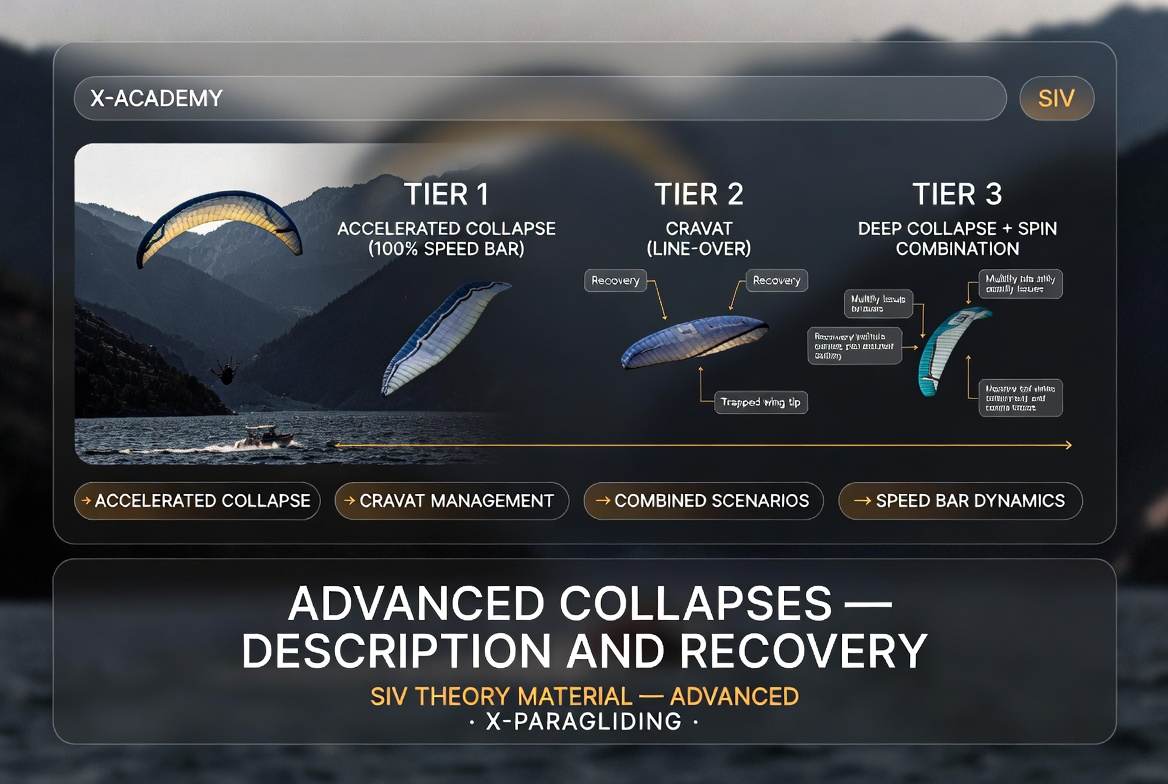
1. Accelerated Collapses (100% Speed Bar)
When a pilot is flying cross-country (XC) on an EN-C or EN-D class wing, they are almost always using the accelerator. A collapse at this moment is radically different from one during trim flight.
Aggression Dynamics: At maximum speed, the wing's angle of attack is minimal. At the moment of collapse, the wing doesn't just fold; it instantly "throws" the pilot into a rotation. The energy is so immense that a Twist (riser crossover) can occur within fractions of a second.
Pilot Reaction: The main challenge is the instantaneous release of the accelerator. Advanced SIV teaches you that your leg must instinctively "kick off" the speed bar at the very first sign of a collapse. Only after releasing the bar does the pilot begin correcting the wing with the brakes.
Significance: This maneuver prepares the pilot for real-world XC flying, where moving at high speeds through turbulent air is a common occurrence.
2. Cravat (The "Tie") – The Most Dangerous Scenario
A "Cravat" is a condition where the wingtip (Stabilo) becomes entangled in the lines. This is one of the most stressful but necessary parts of Advanced SIV.
Rotation Danger: A cravat almost always triggers a strong spiral dive. If the pilot fails to stop the rotation, the centrifugal force will increase to a point where they may be physically unable to pull the brakes.
Removal Methods:
Stabilo Line: The pilot learns to sharply pull a specific line (usually the stabilo) to "flick" the wingtip back out.
Full Stall: If the cravat is large and the stabilo line doesn't work, the pilot resorts to the ultimate measure—the Full Stall. During the stall, internal pressure is lost, and the entangled section usually frees itself.
Significance: This is a life-saving skill. The pilot must know exactly when to try the stabilo line and when to stop wasting time and go straight to a Full Stall.
3. Preventing the "Cascade"
At the Advanced level, the pilot learns how to prevent a single incident from escalating into a catastrophe.
Risk of Over-Correction: Often, when a collapse occurs, pilots brake the opposite side so hard that they stall that side, entering a Spin. Advanced SIV teaches "measured braking"—steering just enough to maintain direction without forcing the wing into a negative regime.
Summary: Why is this "Significant"?
Basic SIV teaches you how to reopen a wing. Advanced SIV teaches you how to survive when the wing is aggressive and the situation intensifies in seconds. After these exercises:
You no longer fear using the accelerator in strong thermals.
You have a clear algorithm for clearing a "cravat."
Your muscle memory works faster than your fear.