On this page
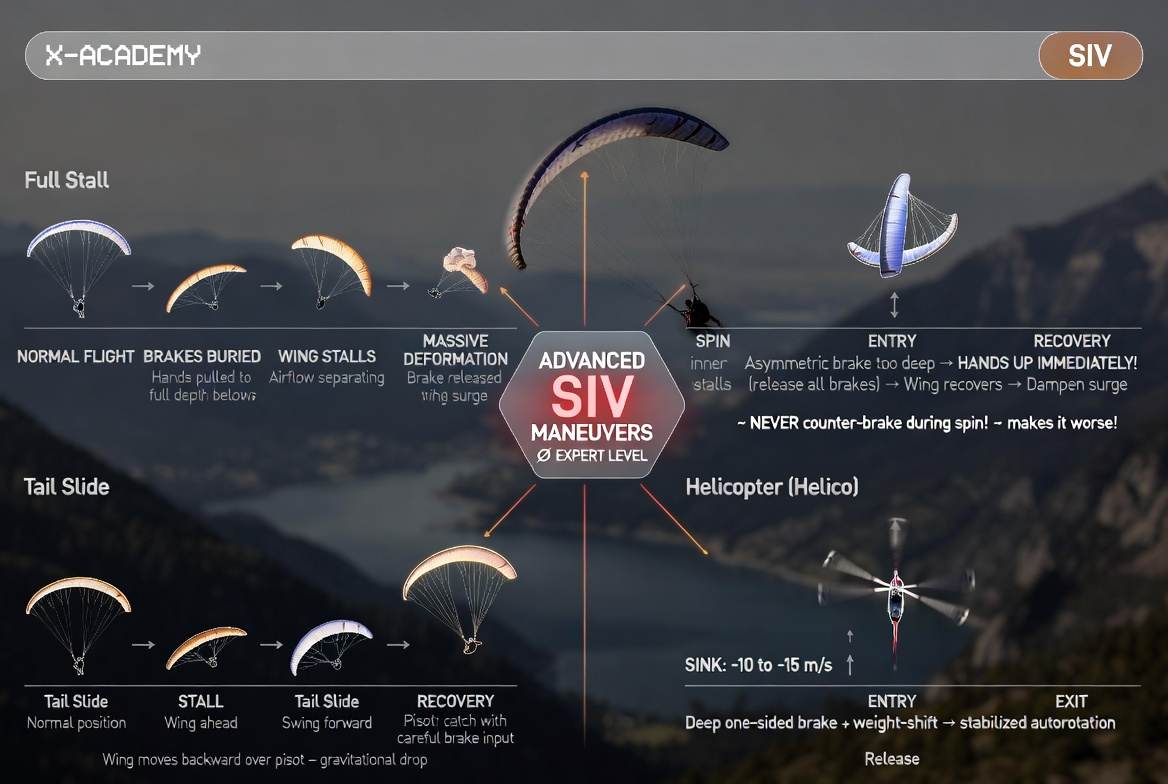
Maneuvers at the Advanced SIV level represent the "higher mathematics" of paragliding. At this stage, the pilot learns to command the wing at the exact point where standard aerodynamics cease to function. These are not merely tricks; they are a deep-seated study of wing anatomy.
Here is a comprehensive and structured analysis of Advanced-level maneuvers:
A. Full Stall (Complete Wing Stall)
This is the moment the pilot forces the wing to stop flying. Airflow over the wing's surface is completely detached, internal pressure is lost, and the wing undergoes massive deformation.
Technique: The pilot symmetrically and sharply buries the brakes (hands below the seat). The wing falls behind the pilot. In this moment, fixing the hands in position is vital—any panic-driven release will cause the wing to surge dangerously forward (Surge).
Significance: This is the "Reset Button." If the wing becomes so entangled that you lose control, a Full Stall is the only way to "format" the wing and redeploy it in mid-air.
Critical Detail: The Stabilization Phase. The pilot learns not to release the brakes until the wing "stabilizes" above the head (even in a collapsed state). A gradual, phased release of the brakes ensures a smooth recovery.
B. Negative Spin (The "Flat Spin")
This is a state where one half of the wing flies forward while the other half stalls (stops) and begins to rotate backward.
Technique: The pilot keeps one brake up at trim speed while pulling the other to the maximum. The wing instantly begins to rotate around its vertical axis.
Significance: Negative regimes most often occur during overly aggressive turning in a thermal or during a pre-landing flare. A pilot must learn to recognize it instantly (loss of brake pressure) and stop it immediately.
Critical Detail: Exit Timing. If you release the brake at the wrong moment, the wing will perform a violent asymmetric surge, which can lead to riser crossovers (Twist).
C. Search for Backfly (Finding the Reverse Flight Point)
This is the most sophisticated and "intelligent" maneuver in Advanced SIV. it is the razor's edge between a Full Stall and normal flight.
Technique: Following a Full Stall, the pilot slowly raises their hands until the wing takes on a "horseshoe" shape. The wing is no longer collapsed, but it is not moving forward—it is flying backward with stability.
Significance: This is the "Island of Safety." During Backfly, the internal pressure is low, allowing you to easily clear any entanglement (Cravat) without aggressive rotation.
Critical Detail: Millimeter precision. The pilot learns the exact brake point where the wing remains "obedient." This is the peak of piloting mastery.
D. Deep Stall (Parachutal Stall)
This is an aerodynamic trap where the wing maintains its shape, but the airflow no longer moves across it.
State: The pilot descends vertically (like a parachute), the brakes feel soft/mushy, and the sound of the wind in the ears vanishes.
Significance: Deep Stall often occurs with old, porous, or wet wings, or after exiting turbulence. If a pilot fails to recognize this, they risk hitting the ground with high vertical velocity.
Recovery Technique: The pilot must push the wing forward. This is achieved by either pushing the Speed Bar (accelerator) or applying brief pressure to the A-risers.
Summary: What Does This Knowledge Provide?
Mastering Advanced SIV maneuvers grants a pilot "Aerodynamic Immunity." You no longer fear the wing collapsing or stopping because you know that:
The solution to any chaos is the Full Stall.
The way to clear any "tie" (cravat) is the Backfly.
Your reactions are no longer based on panic, but on technical calculation.