

On this page
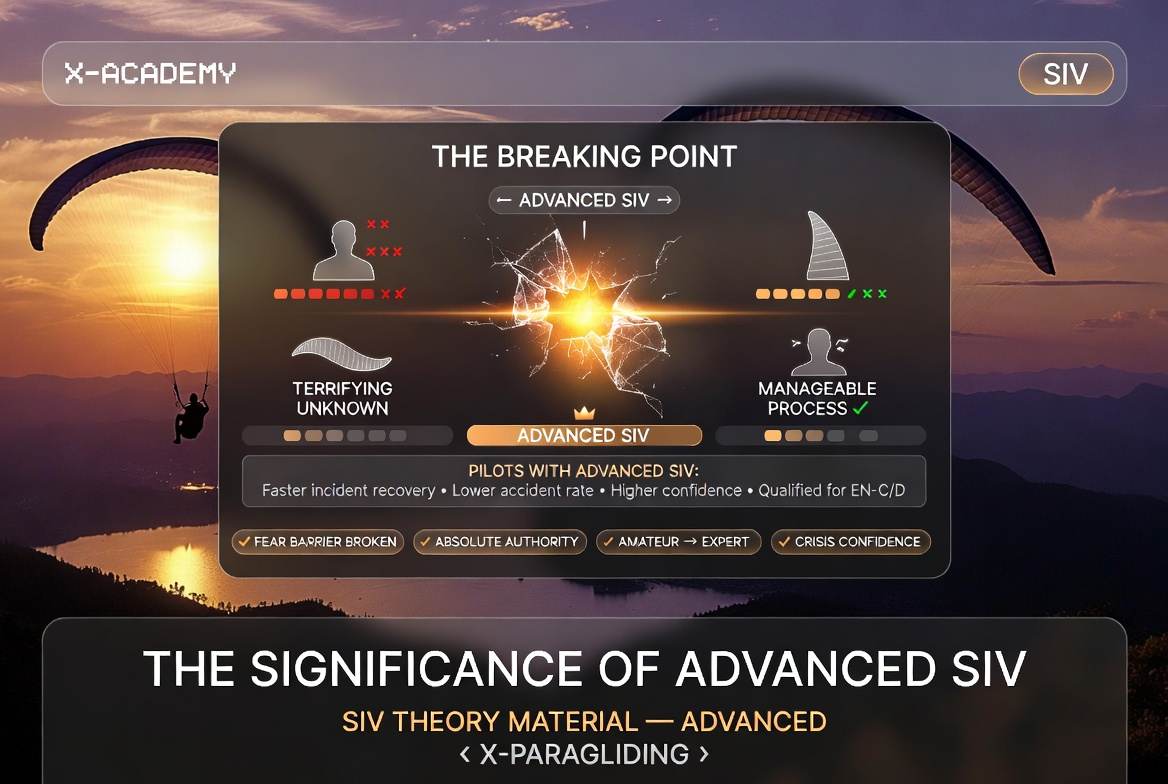
In the context of Advanced SIV, mastering the Full Stall is the defining turning point where a pilot transitions from "amateur" to "expert." This is not just another maneuver—it is the moment you gain absolute authority over your wing.
Here is why this topic is so fundamental and critically important:
1. Breaking the Fear Barrier and Psychological Fortitude
The greatest subconscious fear for any paraglider pilot is the wing stopping and losing its internal pressure.
Fear Control: By intentionally and repeatedly entering a Full Stall, the pilot becomes habituated to the chaotic movements and sounds that accompany deformation. Fear is replaced by technical calculation.
Composure: In a crisis, panic is the enemy. Mastery of the Full Stall gives a pilot the confidence that even in the face of the most severe entanglement, there is always a way out.
2. The "Reset Button" – The Only Way to Survive
There are situations where a wing enters an "unmanageable" state.
Massive Cravat (The "Tie"): If a part of the wing becomes entangled in the lines and causes a strong rotation, controlling it with standard brake input is often impossible. During a Full Stall, the internal pressure drops to zero, airflow stops, and the cravat simply falls out.
Cascading Incidents: When one collapse leads to another and the pilot can no longer react fast enough, a Full Stall is the only way to "format" the wing and allow it to be reborn in a clean state.
3. Radical Reconfiguration of Instincts
The natural human instinct when falling is to either grab something or let go. In Advanced SIV, this instinct is replaced by a professional reflex:
Preventing Panic Releases: At the moment of entry, the wing falls behind the pilot. A beginner’s reaction is to throw the hands up. This is the most dangerous mistake, as the wing will surge forward with massive inertia, potentially causing the pilot to fall into their own wing.
Controlled Recovery: Advanced SIV teaches you to keep your hands locked down until the wing stabilizes above your head. This "battle against instinct" protects the pilot from the most severe surge-related injuries.
4. Transitioning to High-Performance Wings (EN-C, EN-D)
If you plan to fly faster and more "aggressive" wings:
These wings are less forgiving. Recovering them after a collapse often requires the pilot to forcefully stall the wing to regain control.
Moving to a high-class wing without Full Stall proficiency is an unjustifiable risk.
Summary: What does this mean in practice?
After Advanced SIV, you are no longer a "passenger" of the wing, hoping it will open on its own. You become the Captain, capable of:
Stopping the flight at any second if it becomes dangerous.
Clearing the wing of any entanglement or "tie."
Managing the wing even when it is flying backward (Backfly).
This is true mastery, where the pilot stops fighting the wing and starts commanding it.