On this page
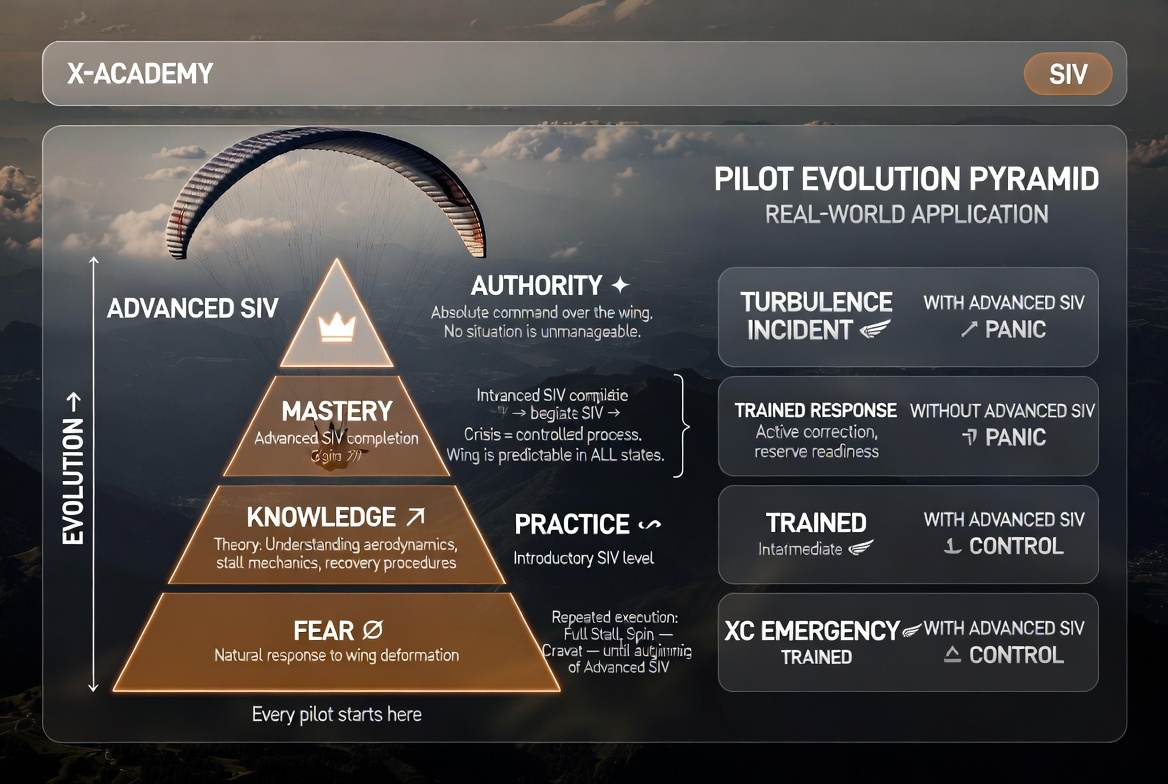
An Advanced SIV (Simulation d'Incidents en Vol) course is not merely technical training—it is the highest stage of a pilot's mental and professional evolution. While a pilot learns how to "avoid" mistakes in the early stages, at the Advanced level, they learn how to manage an inevitable crisis and turn it into a controlled process.
Here is why this course is so fundamental and how it transforms a pilot's life:
1. Breaking the Psychological Barrier: From Fear to Mastery
In paragliding, the greatest danger is not the incident itself, but the pilot's panic response.
Fear Control: During Advanced SIV, the pilot shatters the myth of the "Full Stall." When you realize that stalling or collapsing the wing does not mean falling, but is rather a temporary "Reset," fear is replaced by cold calculation.
Reconfiguring Instincts: Human instinct is to grab onto something when falling. In a stall, this is disastrous. The course teaches you to keep your hands locked down even as your body feels like it is falling backward. This "anti-instinct" is critical for survival.
2. In-Depth Maneuver Analysis: Wing Anatomy
At the Advanced level, maneuvers go beyond simple tricks:
Full Stall (The Reset Button): This is the ultimate tool in paragliding. In the event of any "entanglement" (Cravat) or loss of control, the Full Stall is the only way to return the wing to its original form. You learn not just to stall, but to stabilize the wing above your head.
Negative Spin: This is a "trap" that pilots often fall into during improper turning in a thermal. Advanced SIV teaches you to identify it instantly by the disappearance of brake pressure and how to stop it immediately before the wing enters a full rotation.
Backfly (Reverse Flight): This is the pinnacle of mastery. You learn the millimeter-precise hand position where the wing flies backward with stability. This is an "island of safety" where you can calmly resolve any issue.
3. Collapses in Dynamics: Preparing for Real XC
During Cross-country (XC) flights, pilots almost always use the accelerator (Speed Bar).
Accelerated Collapses: A collapse at 100% speed is radically different from a standard one. The wing reacts with lightning speed and high aggression. Advanced SIV provides the muscle memory to instinctively kick off the accelerator first and only then begin steering.
Cravat (The Tie): This is the most dangerous scenario, where the wingtip becomes entangled in the lines. You learn to clear it not through hope, but through specific techniques—the stabilo line or a Full Stall.
4. Professional Growth: EN-C, EN-D, and Tandem
If a pilot wishes to move to higher-class wings:
These wings are less forgiving. They require a pilot who can expertly manage Stalls and Spins.
For Tandem Pilots: The responsibility for a passenger’s safety demands that the pilot feels the wing's pressure and the stall point in any level of turbulence.
Summary: What does Advanced SIV provide?
After this course, you are no longer a "passenger" of the wing—you become its Captain. You no longer rely on luck; you rely on your knowledge. This is the moment when the pilot and the wing become one, allowing you to fly higher, longer, and, most importantly, safely.