Theory Materials
T2 - Tandem Commercial Pilot Retraining Course — 12 materials · 48 min read
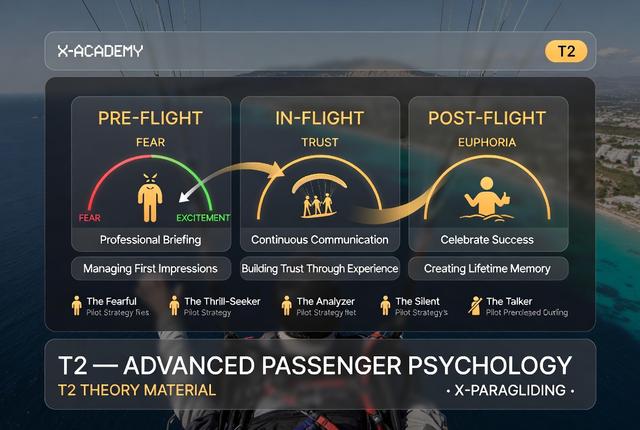
T2 - Advanced Passenger Psychology and Crisis Communication
In commercial flights, a pilot's mastery is not defined solely by wing control. A T2-level pilot is both a leader and a psychologist, responsible not only for the passenger’s physical safety but also for their mental well-being. For many passengers, this is a once-in-a-lifetime experience, and the pilot’s behavior determines whether it remains a traumatic memory or a thrilling adventure.
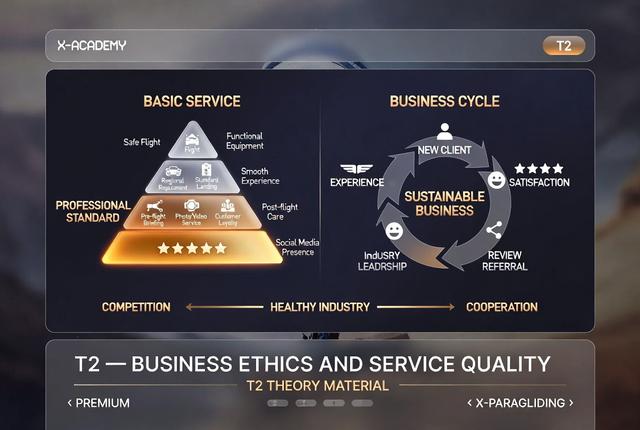
T2 - Business Ethics and Service Quality
In commercial paragliding, a pilot's professionalism is not measured by flying technique alone. A T2-level pilot is a brand ambassador whose behavior determines not only the satisfaction of a specific client but also the touristic reputation of the entire region. Business ethics is the line that separates an "amateur flyer" from an "industry professional."
T2 - Commercial Risk Management and Decision Making (CRM)
In commercial tandem piloting, CRM (Crew Resource Management) is not just a theoretical term; it is a survival mechanism that protects the pilot from the most dangerous enemy: subjective pressure. When flying becomes a business, the decision-making process becomes complicated as financial and social factors begin to interfere.
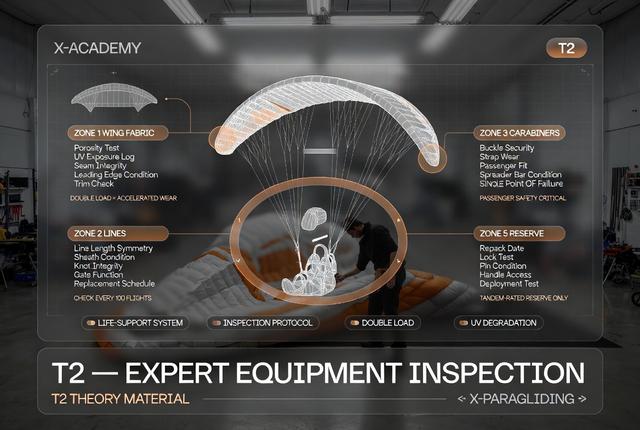
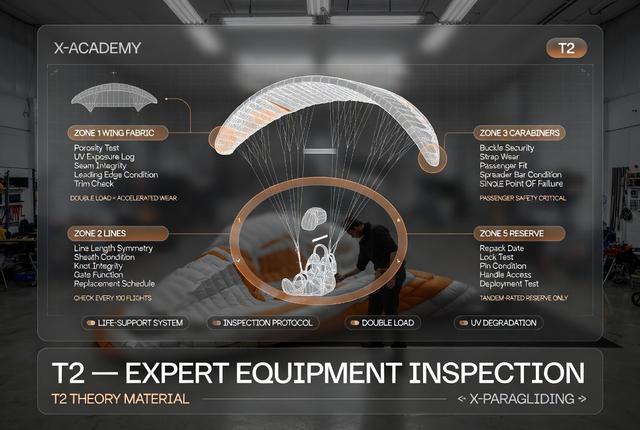
T2 - Expert Equipment Inspection
In commercial tandem piloting, equipment is not just a tool—it is a life-support system. Unlike solo wings, a tandem wing undergoes double the load, frequent takeoffs and landings, and constant exposure to solar radiation (UV). A T2-level pilot must be an expert inspector capable of identifying technical defects before they become critical.
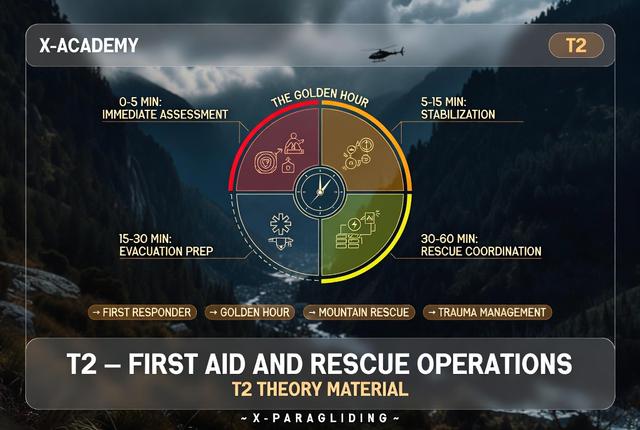
T2 - First Aid and Rescue Operations
When flying in the mountains, especially in difficult terrain, the pilot is more than just the pilot in command—they are a First Responder. In the event of an incident, it can take hours for professional rescuers to reach the site; therefore, the passenger's survival during the "Golden Hour" depends entirely on the T2 pilot's knowledge.
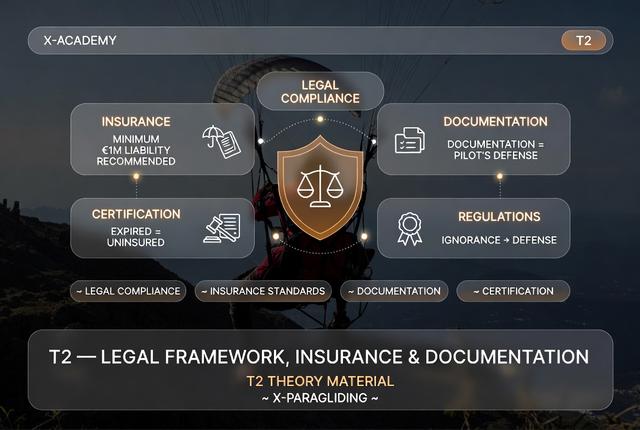
T2 - Legal Framework, Insurance, and Documentation
Professional paragliding is not just about flying in the sky; it is a business associated with high risk. For a T2-level pilot, legal compliance is as important as carrying a reserve parachute. In the event of an incident, it is the documentation that determines the pilot’s future—whether they continue their career or face criminal liability.
T2 - Professional Takeoff and Landing Techniques
For a professional tandem pilot, takeoff and landing are not just the beginning and end of a flight—they are their technical signature. A T2-level pilot possesses the skills that allow them to manage a 200kg system in conditions where others would not dare to fly or would take unnecessary risks.
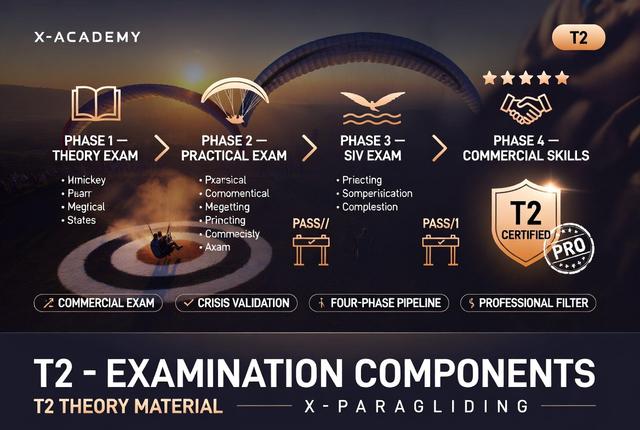
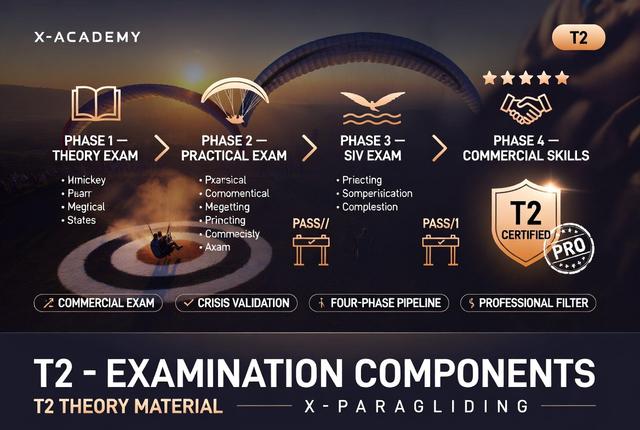
T2 Examination Components
The T2 Category Examination is the final filter that confirms a pilot is ready to take responsibility for another human life. It is not merely a demonstration of skills; it is a test of adequate response under crisis conditions.
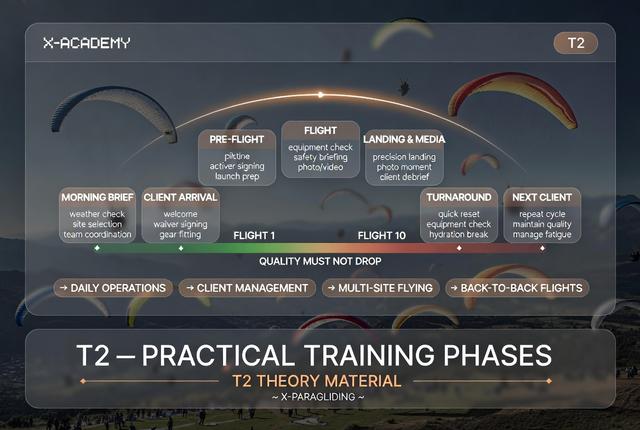
T2 Practical Training Phases
Practical training for the T2 Course is the phase where theoretical knowledge is transformed into real-world skills. Tandem piloting requires not just wing control, but the coordination of a crew under high physical and psychological pressure.
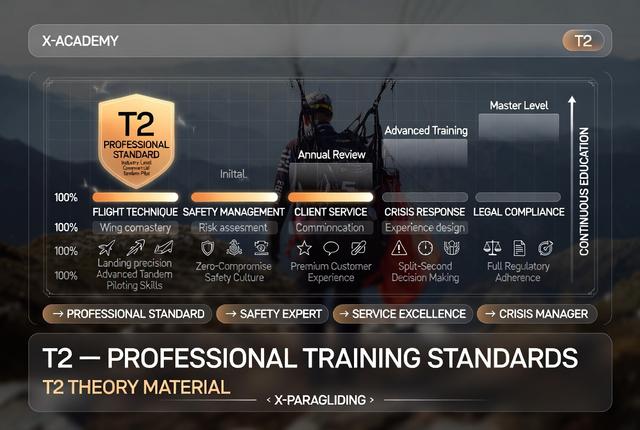
T2 Professional/Commercial Tandem Pilot: General Training Standards
This is the complete, systemic syllabus for the T2 (Professional/Commercial Tandem Pilot) Course. The T2 level represents the professional standard of the paragliding industry, where the pilot moves beyond mere flight technique to become an expert in safety, service, and crisis management.
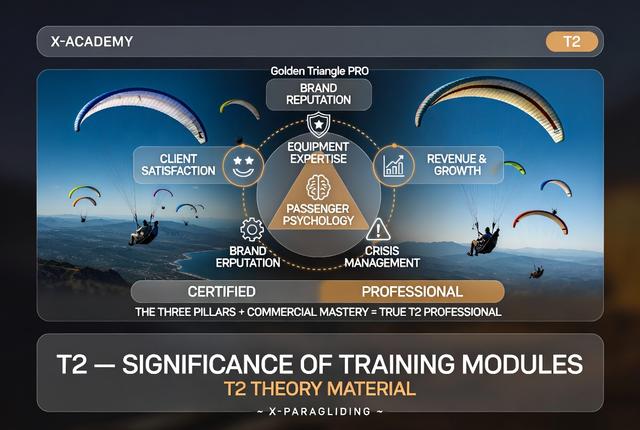
T2 Significance of Training Modules
In the retraining process, these three components form the "Golden Triangle" of tandem piloting. Mastery of these details is what distinguishes a certified pilot from a true professional. Each one is directly linked to the prevention of critical incidents.
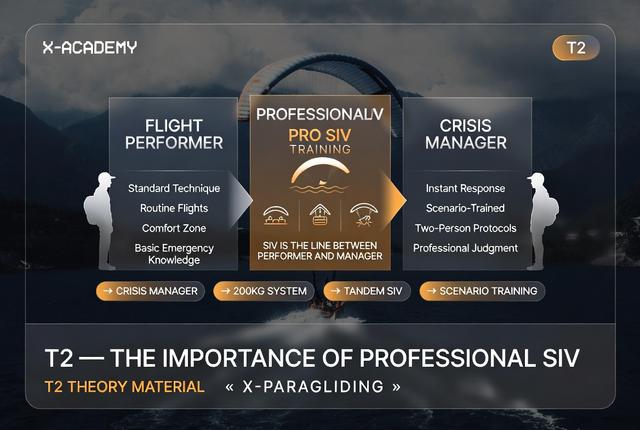
The Importance of Professional SIV Courses (Advanced Safety)
A professional SIV (Simulation d'Incidents en Vol) course for a tandem pilot is not merely additional training—it is the line between being a "flight performer" and a "crisis manager." When you are in the air with a 200kg system and a passenger, any aerodynamic incident (collapse, rotation) can become critical within seconds. For a T2-level pilot, SIV is the guarantee that during a real threat, they will act not on raw instinct, but through a calculated algorithm.