
XC - Sports Progression Courses (Performance/XC Training/Cross-Country - XC)
This course is designed for those who wish to fly long distances (Cross-Country - XC) and participate in competitions. Key Stages: Thermal Flying: Learning how to locate rising air currents, how to "center" within them, and how to reach maximum altitude effectively. Route Planning: In-depth study of meteorology — reading clouds, calculating wind drift, and constantly searching for "escape" options. Using the Accelerator: Learning how to fly fast and safely in turbulent air using the accelerator (Speed Bar). XC Flights: Completing your first 20, 50, or 100 km routes under the guidance of an instructor (via radio communication).
What You'll Learn
- Advanced thermal optimization
- 50+ km cross-country flight planning
- GPS navigation and track analysis
- Convergence zone exploitation
- Competition task flying
- Airspace management
Requirements
Prerequisites
- P3+ certificate
- Minimum 100 flights, thermal flying experience
Equipment
- EN-B/C paraglider, GPS/vario
- XC instruments, reserve parachute, helmet
Physical requirements
- Endurance for 4-8 hour flights, comfort at altitude
Description
Course Curriculum
7 modules 28 lessons Estimated lesson time: 16 h 30 min
+2 modules
View Full SyllabusTheory Materials
 01
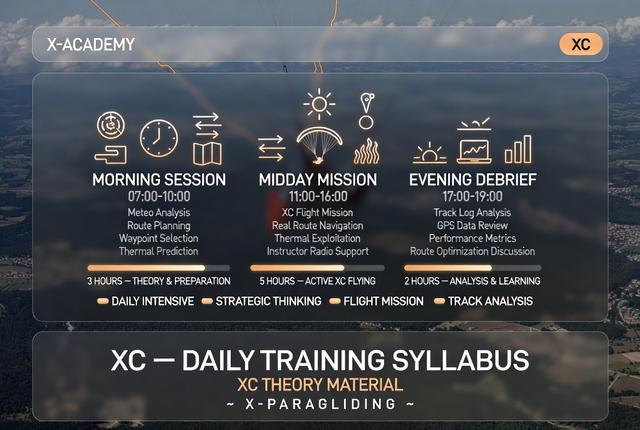
Daily Training Syllabus (XC Performance)
The XC Performance (Cross-Country) course daily schedule is an intensive process where theory, practice, and analysis alternate seamlessly. This is not just flying; it is a full working day aimed at developing a pilot's strategic thinking.
 02
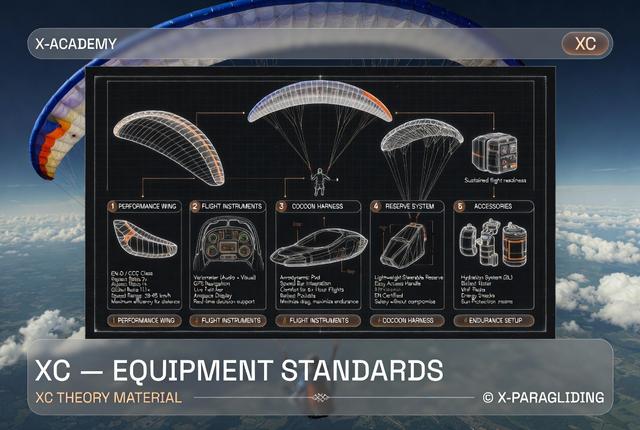
Equipment Standards for XC (Cross-Country) Paragliding
XC (Cross-Country) paragliding requires equipment that allows a pilot to remain in the air for hours, cover vast distances with minimal energy loss, and maintain maximum control in turbulent conditions. For competitive or sport flying, "standard" gear is insufficient—the focus here is on technological superiority.
 03
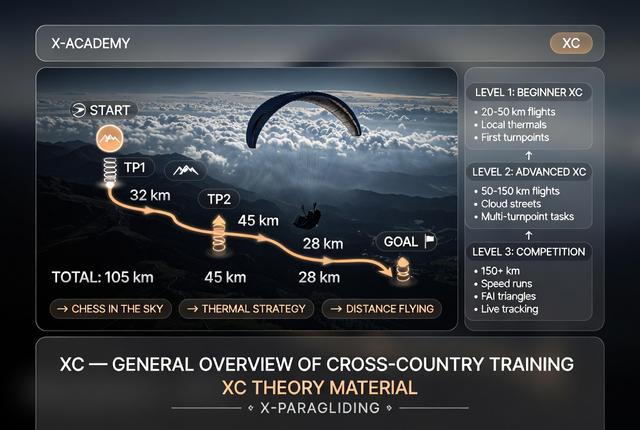
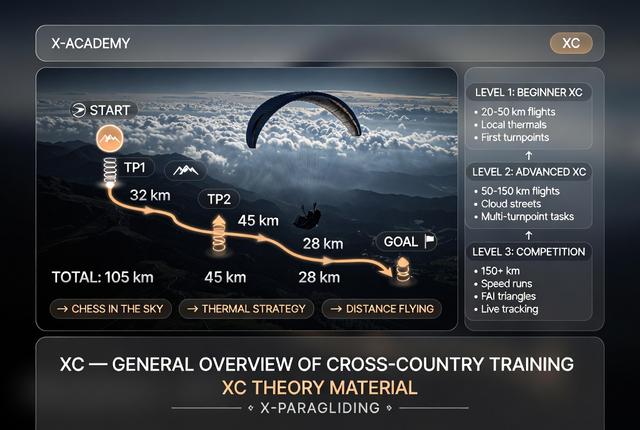
General Overview of Performance/XC (Cross-Country) Training
A Performance/XC (Cross-Country) Training Course is the "intellectual" peak of paragliding. While Acro is about physical dynamics, XC is chess in the sky—a discipline where the pilot learns to harness the energy of nature to cover hundreds of kilometers.
 04
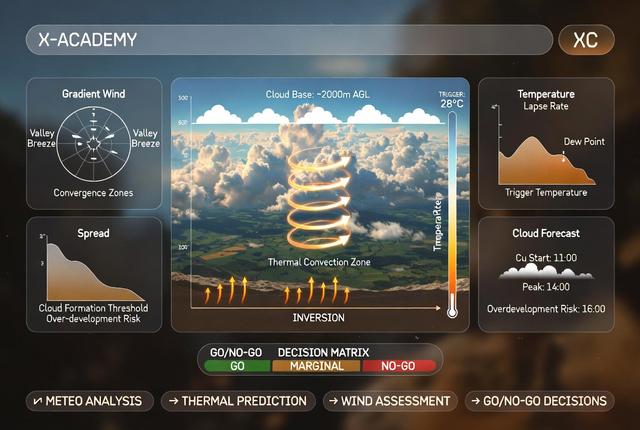
Meteo-analysis for an XC pilot
Meteo-analysis for an XC pilot is not just about gathering information—it is the foundation of safety. A correctly interpreted forecast tells you where and when flight is possible and, most importantly, when you should refrain from taking off.
 05
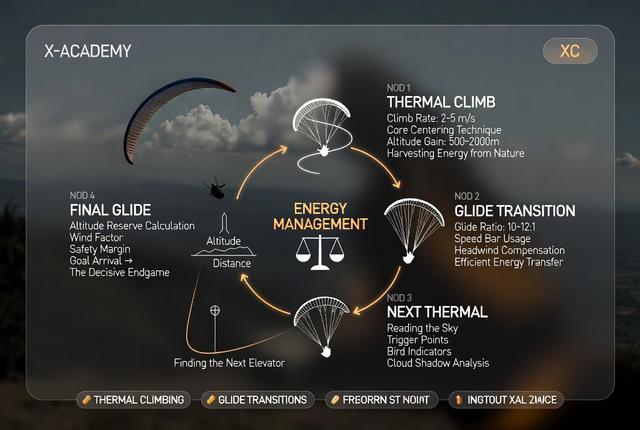
The Core Components of XC Flight and Their Significance
XC (Cross-Country) flight is the most intellectual and strategic dimension of paragliding. While standard flying in a local area is like a "stroll," XC is a true journey where the pilot harnesses the energy of nature to cover hundreds of kilometers.
 06
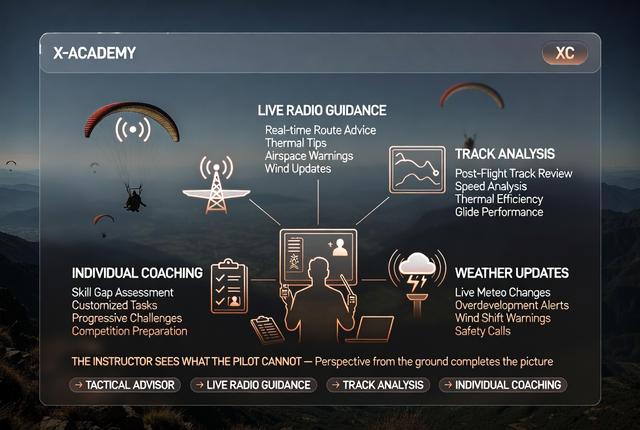
The Role of the Instructor in an XC Course
In a Cross-Country (XC) course, the instructor is no longer just a teacher showing you which buttons to press. They become your tactical advisor and "aerial director." XC flying is a continuous chain of decision-making, where a mistake doesn't just mean the end of the flight (landing), but often results in ending up in a challenging or restricted zone.
 07
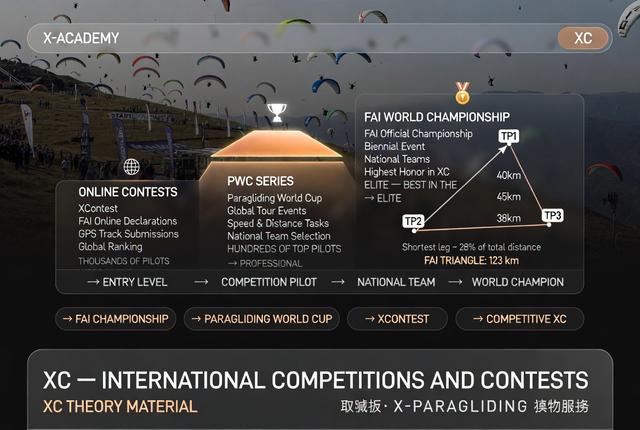
XC (Cross-Country) - International Competitions and Contests
XC (Cross-Country) paragliding is far more than a hobby; it is a high-tech, recognized sporting discipline with its own professional hierarchy. On the international stage, pilots compete not only in courage but in strategic thinking and physical endurance.
 08
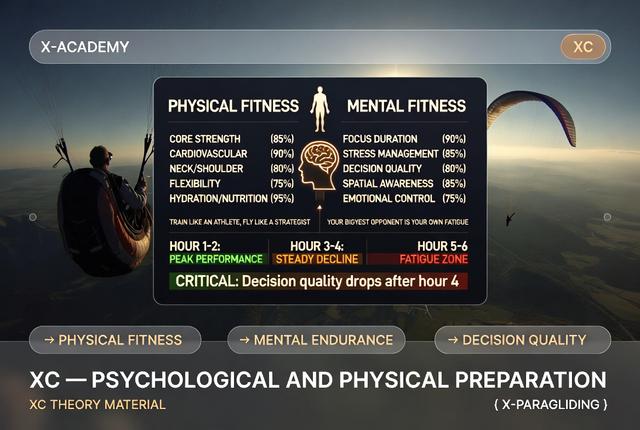
XC (Cross-Country) - Psychological and Physical Preparation for XC
XC (Cross-Country) flying is not just about wing control; it is the ultimate test of a pilot's endurance and mental fortitude. When you spend 4, 5, or 6 hours in the air, your primary opponent is not the weather, but your own fatigue and stress.
 09
XC Pilot’s Pre-Flight Checklist
Who Is This Course For
- Thermal pilots with P3+ certification
- Competition pilots
- Long-distance flying enthusiasts
Instructors
Frequently Asked Questions
What is XC flying and how does it differ from regular flying?
XC (Cross-Country) is route flying — traveling from one point to another using thermals and dynamic lift. Unlike regular flying, XC requires deep meteorological knowledge, navigation skills, and endurance for long flights.
What distances will I fly during the XC course?
Progress during XC is individual. Beginners typically start with 10-20km routes, progressing to 50-80+km routes by course end. The Gudauri region offers ideal XC terrain.
What instruments do I need for XC flying?
XC requires: vario (for thermal detection), GPS tracker (navigation and flight logging), radio, and an XC-optimized flight computer (XCTrack, SeeYou, or similar) is recommended.