On this page
XC (Cross-Country) paragliding requires equipment that allows a pilot to remain in the air for hours, cover vast distances with minimal energy loss, and maintain maximum control in turbulent conditions. For competitive or sport flying, "standard" gear is insufficient—the focus here is on technological superiority.
Here is an in-depth overview of XC equipment standards:
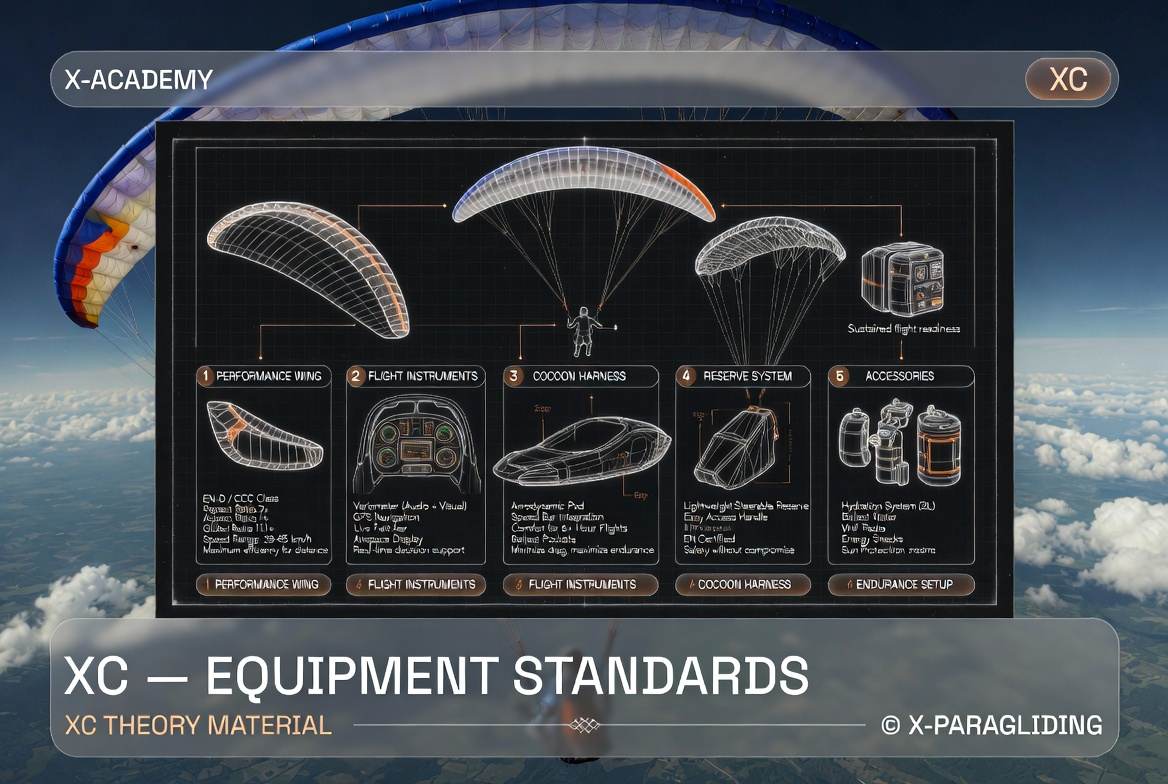
1. Pod Harness (The "Cocoon"): Aerodynamics and Comfort
XC flights often last between 4 and 7 hours. During this time, pilot fatigue is the primary enemy.
Aerodynamic Efficiency: The enclosed shape significantly reduces air resistance (Drag). This means that during "glides" from one thermal to another, you lose much less altitude than you would with an open-seated harness.
Thermal Insulation: On average, the temperature drops by 6.5°C for every 1000 meters of altitude. When flying at 3000–4000 meters, it is freezing up there even if it’s hot on the ground. The pod protects the pilot from hypothermia, which is vital for maintaining fast reaction speeds.
Stability and Feedback: XC harnesses feature geometry that better transmits "wing information" to the pilot's body, helping you feel the core of the thermal more precisely.
2. High-Performance Wing: Your "Machine" in the Sky
XC wings are designed not just for climbing, but for efficient forward progression (Glide).
Classification (EN-B High, EN-C, EN-D): These wings are characterized by a higher Aspect Ratio. The higher the class, the narrower and more aggressive the wing, giving it better "cutting" ability against the wind.
Glide Ratio: Modern XC wings have a ratio of 10:1 or higher (for every 1 km of altitude lost, they travel 10 km horizontally). This is critical when crossing large valleys.
2-Liner Technology: The latest EN-C and EN-D wings use only two rows of lines (A and B). This reduces line drag and allows for B-steering, which lets you control the wing while on the speed bar without losing performance or speed.
3. Vario/GPS (Flight Computer): Navigation and Strategy
Flying XC "blind" is impossible. A pilot needs precise data to make strategic decisions.
Variometer: A high-sensitivity sensor that uses audio and digital cues to inform you of the slightest changes in ascent or descent. It is your primary tool for "staying in" the thermal.
Wind Analysis: The device calculates wind speed and direction based on your flight path. This is critical for determining your Final Glide—calculating whether you will reach your goal with your current altitude.
Airspace Control: The GPS highlights restricted zones (airports, military areas), ensuring you stay legal and avoid interfering with civil aviation.
4. Essential Additional Gear
Rescue Parachutes (often two): XC pilots frequently carry dual rescue systems since they fly in turbulent conditions over high-mountain terrain.
Oxygen Systems: Flying above 4000 meters can cause hypoxia, leading to fatigue and impaired judgment. Professionals often use portable oxygen systems.
Connectivity (Radio & LiveTrack): A radio for contact with the instructor or group, and a GPS tracker (e.g., Garmin inReach) so that ground crews always know your coordinates after landing.
Why Are These Standards Important?
Safety: Properly selected equipment reduces the margin for error in stressful situations.
Efficiency: Technology allows you to "jump" across valleys that would be impossible to cross with standard wings.
Enjoyment: When you aren't cold, are sitting comfortably, and have full information about the air, flight ceases to be a struggle for survival and becomes pure pleasure.