

On this page
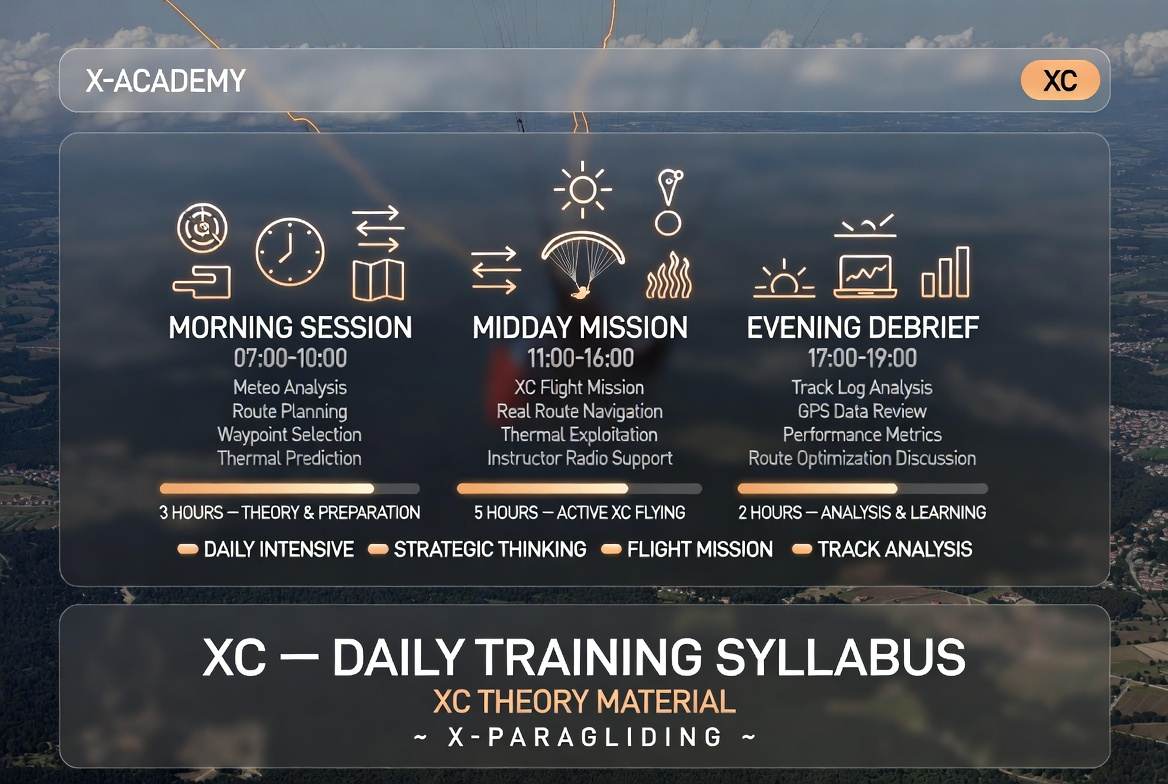
The XC Performance (Cross-Country) course daily schedule is an intensive process where theory, practice, and analysis alternate seamlessly. This is not just flying; it is a full working day aimed at developing a pilot's strategic thinking.
Here is an in-depth and extensive overview of each stage of the 5-day XC course:
1. Morning (09:00 – 11:00): Strategic Planning and Meteo-Analysis
In XC flying, victory begins on the ground. This is when the "script" for the day is written.
Meteo Briefing: Together with the instructor, you analyze Skew-T log-p diagrams. You learn at what altitude thermals are expected to stop (Inversion layer), what the wind speed is at different elevations, and whether there is a risk of storm development (Overdevelopment).
Task Setting: You enter the day's "task" into a GPS device or specialized app (e.g., FlySkyHy). You define turnpoints and goals (Waypoints).
Developing Plan B: You establish a "safety corridor"—identifying areas where landing is prohibited (dense forests, narrow gorges) and locating optimal landing fields.
2. Afternoon (12:00 – 17:00): Practical Flight and "Aerial Tactics"
This is the time when theory transitions into practice. The course is progressive:
Days 1-2: Thermal Efficiency: The focus is not on distance, but on how quickly and cleanly you climb to the cloudbase. You learn to maintain the Core of the thermal even in turbulent conditions.
Days 3-5: Distance Flights (20km, 50km+): The real XC begins. You learn valley crossings, flying against the wind (using the speed bar), and energy conservation.
Radio Coaching: The instructor provides real-time guidance: "Leave this lift now, the cloud ahead is working, push the speed bar!"
3. Evening (19:00 – 21:00): Tracklog Analysis – "Learning from Mistakes"
This is the most critical part of the course. The flight ends, but the learning continues at the computer.
Digital Reconstruction: Your flight path (Tracklog) is uploaded to a 3D map (e.g., Google Earth or SeeYou).
Detailed Diagnostics: The instructor highlights specific points:
"You left the thermal too early here; if you had gained another 200 meters, you would have crossed the valley safely."
"In this spot, the wind drifted you too far, and you ended up on the dangerous side of the terrain (lee side)."
Comparison: Your track is compared with the tracks of the instructor or other pilots. You see who found a better "line" and why they were faster.
4. Why is this Schedule Important?
Automaticity: Repeating the same cycle (Planning-Flight-Analysis) for 5 days builds professional habits and muscle memory.
Mental Endurance: 5-hour flights habituate the body and mind to long-duration concentration.
Safety Culture: The evening analysis clearly demonstrates where risks were present and how to avoid them in the future.
Summary
An XC course is not just "time in the air." It is a systematic approach where every minute flown is deliberate and analyzed. By the end of the course, you are no longer just a pilot; you are an aerial strategist.