On this page
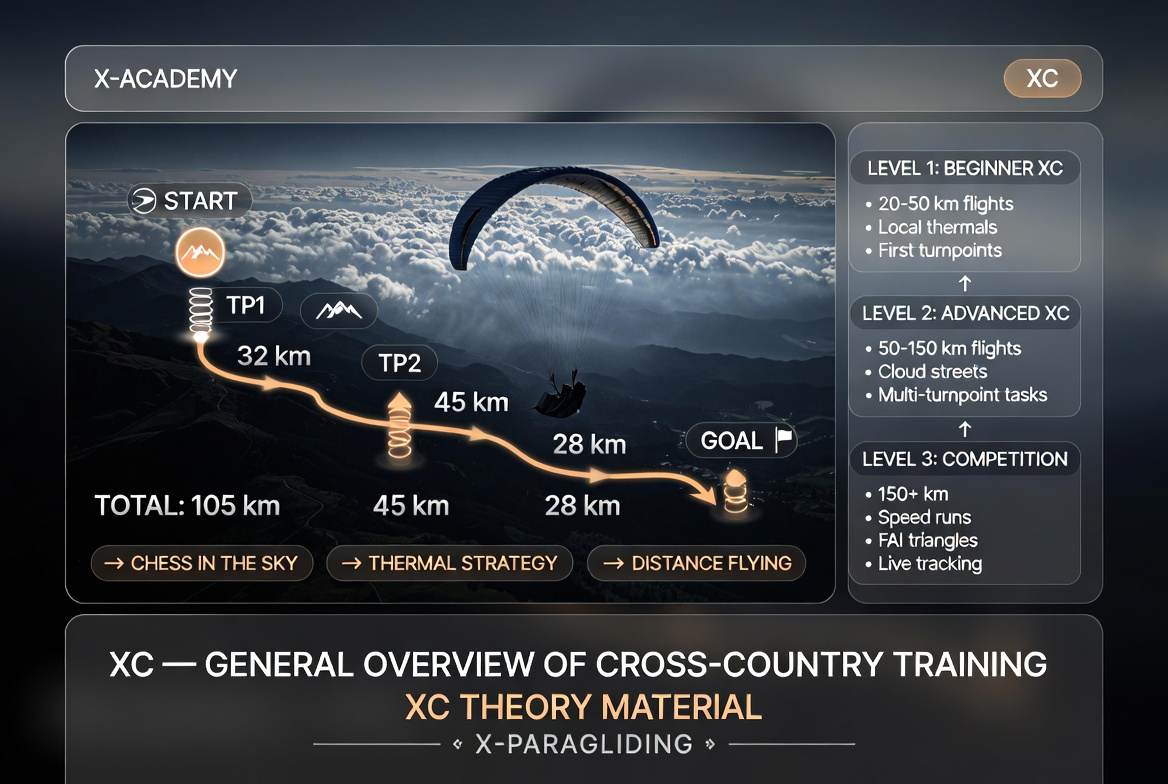
A Performance/XC (Cross-Country) Training Course is the "intellectual" peak of paragliding. While Acro is about physical dynamics, XC is chess in the sky—a discipline where the pilot learns to harness the energy of nature to cover hundreds of kilometers.
Here is a detailed stage-by-stage overview of an XC course:
1. Core Components of XC Flight and Their Significance
Sport flying requires a synthesis of theoretical knowledge and practical intuition:
Thermal Mastery (Centering Up): Finding rising air currents and circling efficiently within them.
Significance: This is your "fuel." You learn to locate the thermal's Core and center yourself within it to reach the cloud base as quickly as possible.
Route Planning and Navigation: Analyzing terrain and weather forecasts.
Significance: You learn to "read the clouds," calculate wind drift, and predict where the next thermal trigger point will be.
Speed Bar Management: Efficient glides between thermals.
Significance: The accelerator increases your airspeed. During the course, you learn to use it safely in turbulent air to lose less altitude while covering more ground.
Risk Management and "Escape" Options:
Significance: Every second, you must have a Plan B—a safe landing field in sight if you fail to find the next thermal.
2. Equipment Standards for XC
Sport flying utilizes specialized gear focused on aerodynamics and long-term comfort:
Pod Harness (Cocoon): A fully enclosed seat that reduces air resistance and protects the pilot from the cold at high altitudes.
Vario/GPS (Flight Computer): A device that indicates climb rates, wind direction, and provides navigational guidance.
High-Performance Wing: Usually EN-B (High), EN-C, or EN-D class wings, which offer superior glide ratios for crossing large valleys.
3. The Role of the Instructor in an XC Course
The instructor acts as your "tactical advisor":
Radio Guidance: The instructor flies with you or monitors from the ground, guiding you toward thermals, explaining wind shifts, and identifying safe valleys.
Meteo-Analysis: During morning briefings, they teach you to read aerological diagrams (skew-T) and define the "flying window" for the day.
Psychological Support: Helping you maintain focus during continuous flights that last 3 to 5 hours.
4. Daily Training Syllabus (XC Performance)
An XC course typically spans 5 days:
Morning (09:00 - 11:00): Analyzing meteorological forecasts and programming the day’s route into the GPS.
Afternoon (12:00 - 17:00): Practical flight. Initial days focus on thermal techniques; later days aim for 20km, 50km, or greater distances.
Evening (19:00 - 21:00): Tracklog Analysis — Reviewing your flight path on a computer to identify where time was lost, where mistakes occurred, and where a better line could have been taken.
5. International Competitions and Contests
XC flying is a recognized official sporting discipline:
PWC (Paragliding World Cup): The elite circuit where the world's best compete to complete a set course in the fastest time.
X-Alps: The world's toughest race—crossing the Alps solely by flying and hiking.
Online Contests (XContest): A global platform where pilots upload their flights to compete for the longest distance throughout the year.
6. Psychological and Physical Preparation
Concentration: XC flights are long. A pilot must remain alert and capable of making critical decisions even when exhausted.
Patience: Sometimes you must wait at a low altitude for a long time until the next thermal "cycles" through.
Nutrition and Hydration: The ability to consume water and energy snacks while piloting in active air.
Summary
An XC course is the journey from being a pilot to becoming a traveler and a strategist. It provides the ultimate sense of freedom, allowing you to cross mountains and valleys using nothing but the power of nature.