

On this page
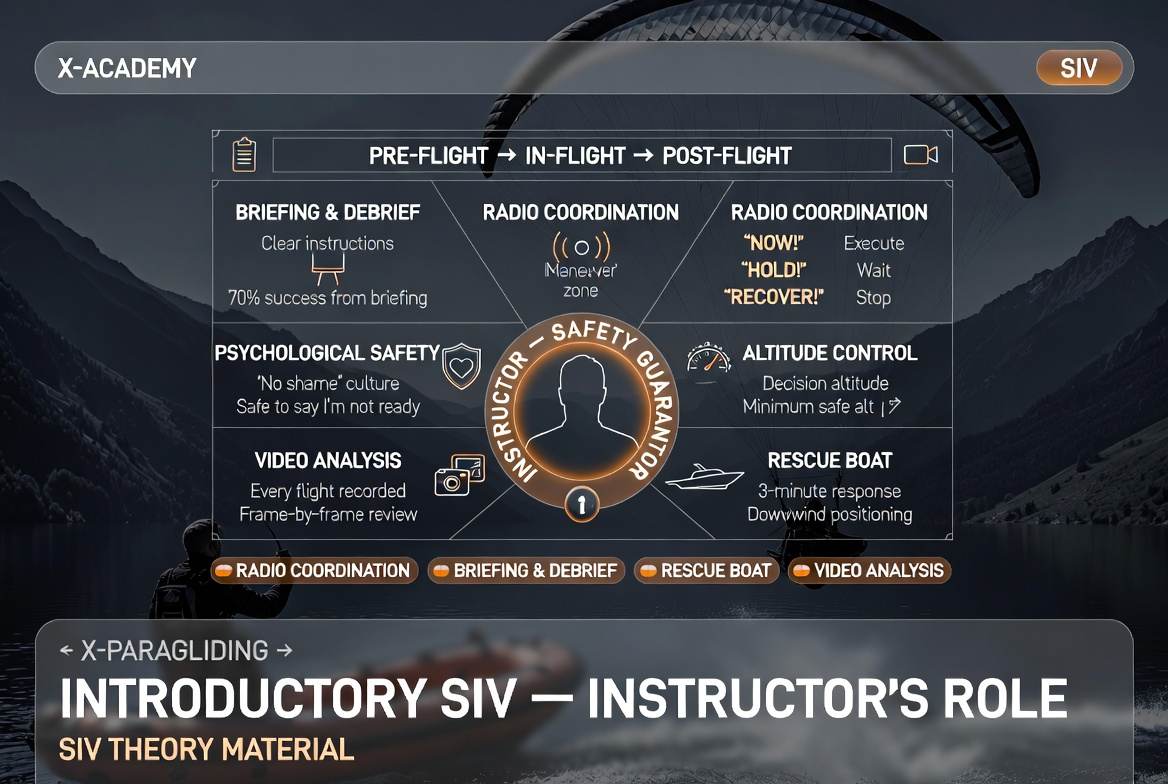
During an SIV course, the instructor is not just a teacher—they are your remote pilot and safety guarantor. During the course, a pilot often loses their sense of space and time (especially during rotations); therefore, the instructor’s "cold mind" and precise commands are the only thread connecting the pilot to safety.
Here is a detailed breakdown of the instructor's functions and responsibilities:
1. Briefing and Debriefing (Theoretical Management)
The success of a maneuver is 70% dependent on how well the pilot understands its essence while still on the ground.
Visual Briefing: The instructor explains the phases of the maneuver in detail, the position of the pilot's hands, and the wing's likely reactions.
Video Analysis (Debriefing): After every flight, the footage is reviewed frame-by-frame. The instructor points out micro-errors (e.g., a reaction delayed by 0.5 seconds) that caused the maneuver to unfold incorrectly.
2. Radio Coordination (Active Management)
In the air, the instructor becomes the pilot's "inner voice." Their commands must be short, specific, and imperative.
Timely Response: The instructor sees the wing's dynamics even before the pilot feels them in the harness. Their command (e.g., "Brake!") helps you prevent a collapse.
Psychological Support: In crisis moments, the instructor's calm voice helps the pilot overcome panic and continue acting adequately.
3. Safety Control and Altitude Management
During SIV, altitude is your most precious resource. The instructor is the chief manager of this resource.
Critical Altitude Limit: The instructor constantly monitors the pilot's distance from the water's surface, either visually or with a laser rangefinder.
The Reserve Command: If a maneuver goes out of control and the pilot approaches a critical altitude, the instructor issues a categorical command: "Throw the Reserve!". At this point, the pilot no longer has the right to continue fighting the wing—they must obey the instructor immediately.
4. Rescue Boat Mobilization
When working over water, the speed of evacuation is decisive because a wet wing and harness pull the pilot toward the bottom.
The Golden Minute: The instructor's team is obligated to reach the pilot within 60–90 seconds of a water landing.
Evacuation Technique: Rescuers know exactly how to extract the pilot so they don't get entangled in the lines and provide first aid if necessary.
Significance: Why is the Instructor Decisive?
Objective Perspective: The pilot only sees the underside of the wing, while the instructor sees the whole picture—the wing's shape, angle, and trajectory.
Distribution of Responsibility: The pilot focuses on the maneuver, while the instructor focuses on the environment (other pilots, wind, altitude).
Rapid Progress: Without an instructor, a pilot would spend years gaining the experience they receive in just 3 days under supervision during an SIV.
Summary
An SIV instructor is not just a prompter—it is a system that safeguards you against error. Their professionalism is the guarantee that the pilot will return from the course not only with new knowledge but unharmed.