SIV Introductory — Theory Test
15 questions3 errors allowed

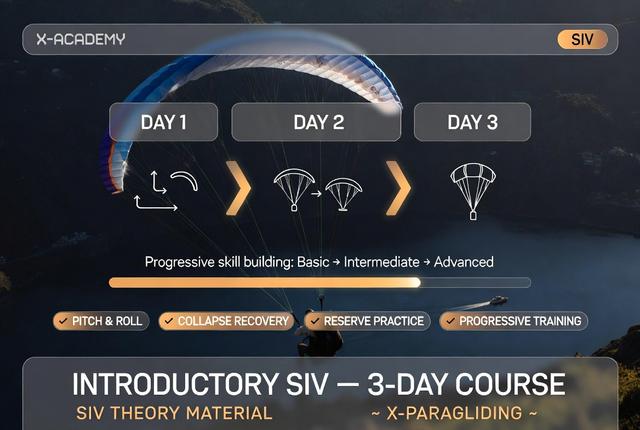
Foundational Manuvers (Introductory) Focuses on wing control and basic collapses. It builds the pilot’s confidence in handling common turbulence. Pitch & Roll Control: Mastering the rhythmic movements of the wing. Big Ears: Learning a controlled rapid descent technique. Asymmetric Collapses: Simulating a 50% side collapse and maintaining direction. Frontal (Symmetric) Collapses: Recovering from a full leading-edge collapse.
4 modules 13 lessons Estimated lesson time: 9 h 15 min
 01
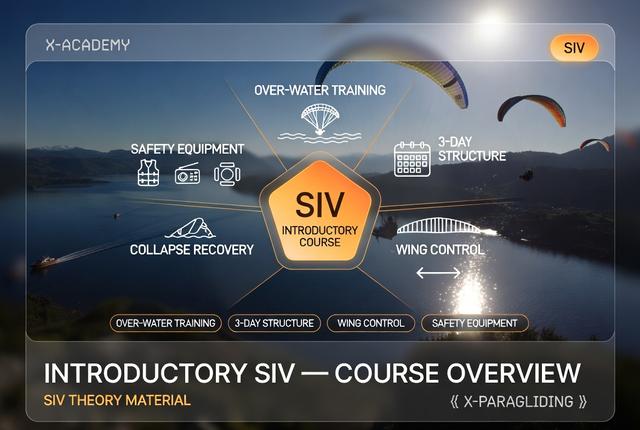
01Introductory SIV is the most critical training stage in paragliding, where a pilot first steps out of their comfort zone and learns to manage the wing in unstable modes. This course is not just about performing "tricks"—it is about understanding wing dynamics and controlling fear.
 02
02Introductory SIV maneuvers are not just simple exercises—they represent the study of the wing's "language" and dynamics. The practical course is typically designed over 3 days to allow the pilot sufficient time to process information and develop muscle memory.
 03
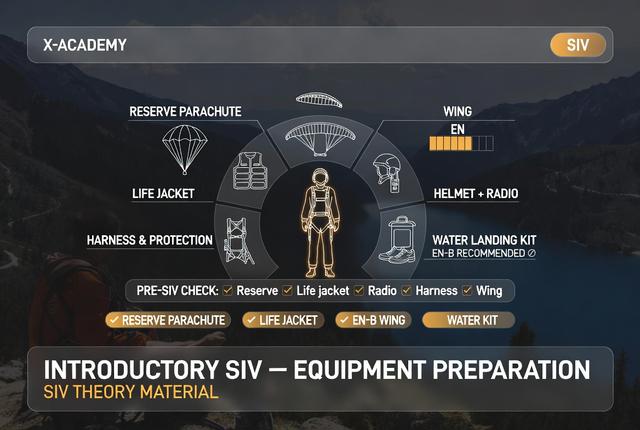
03Preparing equipment for an SIV course is not just a technical routine; it is the construction of your life-support system. Unlike standard flights, equipment during SIV undergoes peak loads, and working over water introduces specific safety requirements. For a T2-level pilot (or future professional), meticulous knowledge of this subject is critical.
 04
04During an SIV course, the instructor is not just a teacher—they are your remote pilot and safety guarantor. During the course, a pilot often loses their sense of space and time (especially during rotations); therefore, the instructor’s "cold mind" and precise commands are the only thread connecting the pilot to safety.
 05
05The phrase "from passenger to pilot" perfectly describes the transformation catalyzed by an SIV course. In turbulent air, where split-second decisions are paramount, knowledge is the differentiator between controlled flight and panic. For a T2-level pilot, this is not just about personal safety; it is a core component of professional ethics.
Because the P2 basic paragliding course involves thermal and dynamic lift flying, during which asymmetric and frontal collapses are common, so the student must have a thorough understanding of safety procedures.