On this page
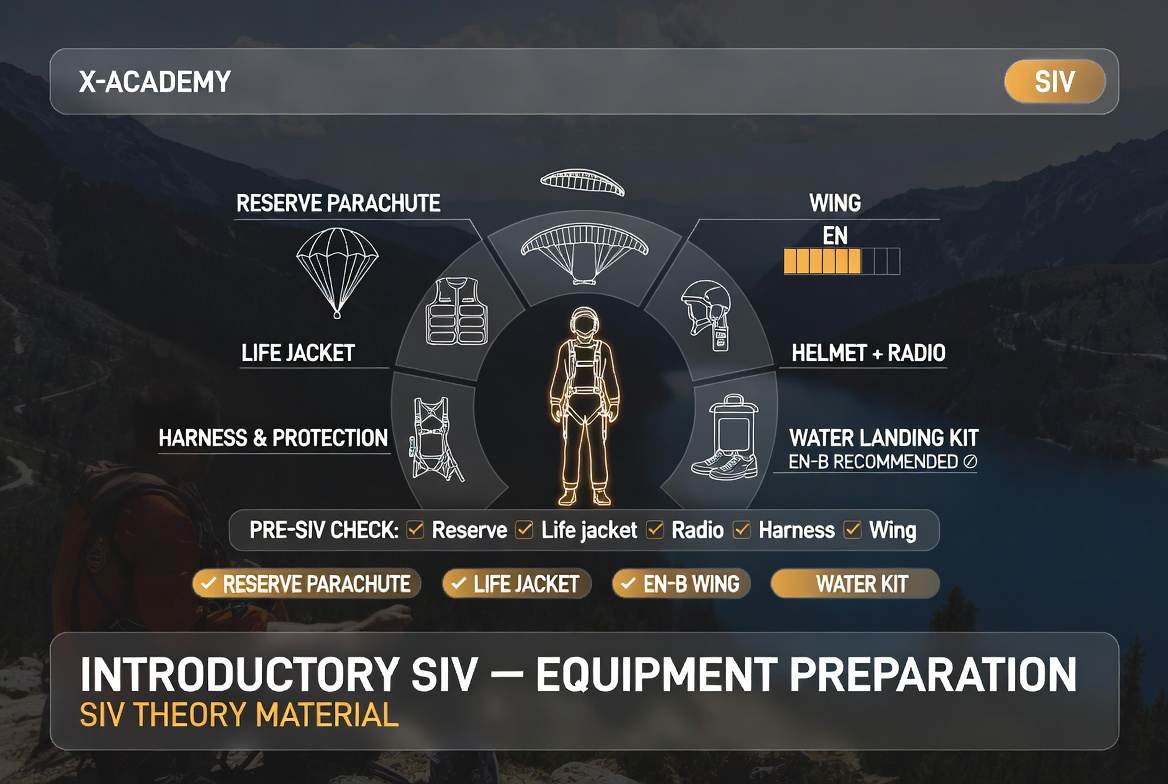
Preparing equipment for an SIV course is not just a technical routine; it is the construction of your life-support system. Unlike standard flights, equipment during SIV undergoes peak loads, and working over water introduces specific safety requirements. For a T2-level pilot (or future professional), meticulous knowledge of this subject is critical.
Here is a detailed and vital analysis of equipment preparation:
1. Reserve Parachute
In the event of an incident, the reserve is your last chance. The probability of using it during SIV increases tenfold.
Repacking Interval: The reserve must have been repacked within the last 6 months. Fabric that is aged or "stuck" due to humidity loses precious seconds during deployment, which can be decisive when over water.
Handle Control: The pilot must be able to find the handle "blindly." Before the SIV, a simulated extraction (under G-force conditions) is performed to ensure the handle is not jammed and releases easily from its housing.
Compatibility: The connection between the reserve and the harness is checked. The container must not be too tight, ensuring a clean deployment.
2. Life Jacket
Landing in the water is a common occurrence during SIV, but being in the water with paragliding gear (harness, wing) is dangerous.
Automatic System: A life jacket that inflates automatically upon contact with water is highly recommended.
Buoyancy: The jacket must be powerful enough to keep the pilot's head above water even if the harness protector (Airbag) is full of air, which can push the pilot upward and potentially flip them face-down.
3. Radio Communication and Electronics
During SIV, the instructor is your only guide. A radio failure during a maneuver creates an unmanaged and dangerous situation.
Double Protection: Two radio stations are necessary. The primary radio should have a headset integrated into the helmet so that wind noise does not drown out commands.
Waterproofing: The radio must be in a specialized waterproof pouch. After a water landing, the pilot must be able to communicate and provide coordinates to the rescue boat.
4. Speed Bar (Accelerator)
Many pilots use the speed bar only for cross-country flying, but during SIV, it is a safety tool.
Adjustment: The speed bar must be set so the pilot can activate 50–100% of it with a single leg movement.
Function: It is essential for stabilization during "Big Ears" and for exiting certain modes, such as a deep stall (parachutal stall).
5. Hook Knife (Safety Knife)
This is a small but life-saving detail.
Purpose: Upon landing in the water, lines can become entangled around the pilot, creating a drowning risk. A hook knife allows you to cut through lines or harness straps in seconds.
Location: It should be mounted where it can be reached with either hand (e.g., on the shoulder strap or the chest strap).
Significance: Why is this Critical?
Psychological Peace of Mind: When you know your equipment is in perfect condition, fear is reduced, allowing you to focus entirely on the maneuver.
Risk Minimization: 90% of injuries during SIV occur not in the air, but in the water due to improper evacuation or faulty rescue equipment.
Professional Standard: For a T2 pilot, this is a test of discipline. You must demonstrate that you are prepared for any scenario.
Summary
Equipment preparation is the first and most important maneuver of an SIV course. If you make a mistake here, even a perfect flight in the air cannot safeguard you.