On this page
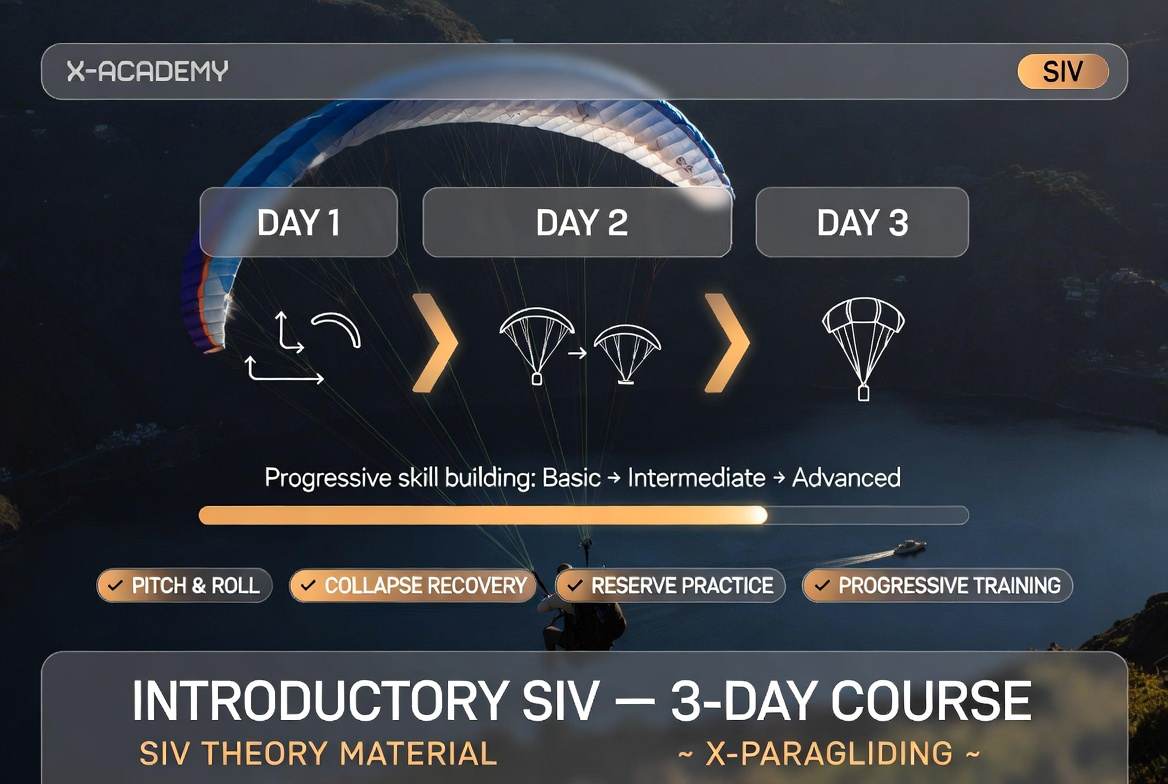
Introductory SIV maneuvers are not just simple exercises—they represent the study of the wing's "language" and dynamics. The practical course is typically designed over 3 days to allow the pilot sufficient time to process information and develop muscle memory.
Here is an in-depth breakdown of the maneuvers and the training plan by day:
Day 1: Feeling Wing Dynamics and Stabilization
The first day is dedicated to wing control and "subduing" the glider in active air.
A. Pitch & Roll Control (Active Piloting)
Practice: The pilot rhythmically pulls and releases the brakes. When the wing is behind you—release; when it surges forward—apply brakes.
Significance: This is the foundation of preventing any incident. If you learn to stop the wing at the moment of its forward surge, you will likely never experience a frontal collapse in real flight.
Critical Detail: "Catch the surge"—the brake input must be precise and fast, followed immediately by returning the hands to the "hands-up" position.
B. Big Ears + Speed Bar (Rapid Descent)
Practice: Pulling the outer A-lines while simultaneously using 50% of the speed bar.
Significance: This is the primary way to descend quickly from a cloud while maintaining forward airspeed.
Critical Detail: Never use brakes while holding "Big Ears"—this can push the wing into a parachutal stall.
Day 2: Incident Simulation and Management
On the second day, we move to real collapses so the pilot can overcome fear and learn to maintain course.
C. Asymmetric Collapse
Practice: The pilot sharply pulls one A-riser, causing 50% of the wing to collapse.
Significance: In real-world flying, 90% of collapses are asymmetric. The pilot must learn that straight flight is possible even with a collapsed wing.
Critical Detail: Counter Weight-shift. The first reaction must be shifting body weight to the open side. Only after this do we use the brake to correct the course.
D. Symmetric (Frontal) Collapse
Practice: A sharp pull and immediate release of both A-risers.
Significance: This simulation teaches you that the wing reopens on its own if you do not interfere with its management.
Critical Detail: Hands up! Many pilots instinctively pull the brakes during a collapse, which prevents the wing from reinflating and causes a dangerous "roll-back."
Day 3: Critical Modes and Psychological Readiness
The third day is the most critical—we search for the point where the wing loses its structural integrity.
E. Search for Stall Point
Practice: The pilot very slowly, centimeter by centimeter, pulls the brakes until they feel the pressure on the wing vanish and the glider begin to fall back.
Significance: This is the study of the wing's "anatomy." The pilot must know exactly how low they can safely pull their hands in critical situations (e.g., landing in strong winds).
Critical Detail: As soon as you feel the wing "break" or stall, you must immediately release your hands fully to the top.
F. Spiral Dive (Initial Stage)
Practice: Using weight-shift and brake to transition the wing into a tight rotation.
Significance: Extreme loss of altitude. The pilot must experience the G-force and learn how to exit the spiral gradually and safely.
Significance: Why is this plan important?
Progression: The pitch control learned on Day 1 helps you stop the wing's surge when recovering from a frontal collapse on Day 3.
Deconstruction of Fear: When you break a maneuver into parts, it no longer feels like a catastrophe.
Automaticity: The goal of SIV is for your hands to act faster than your brain can begin to panic during a real incident.
Summary
After a 3-day SIV course, a pilot is no longer a "hostage of the weather." They become an active manager who knows the limits of both themselves and their wing.