On this page
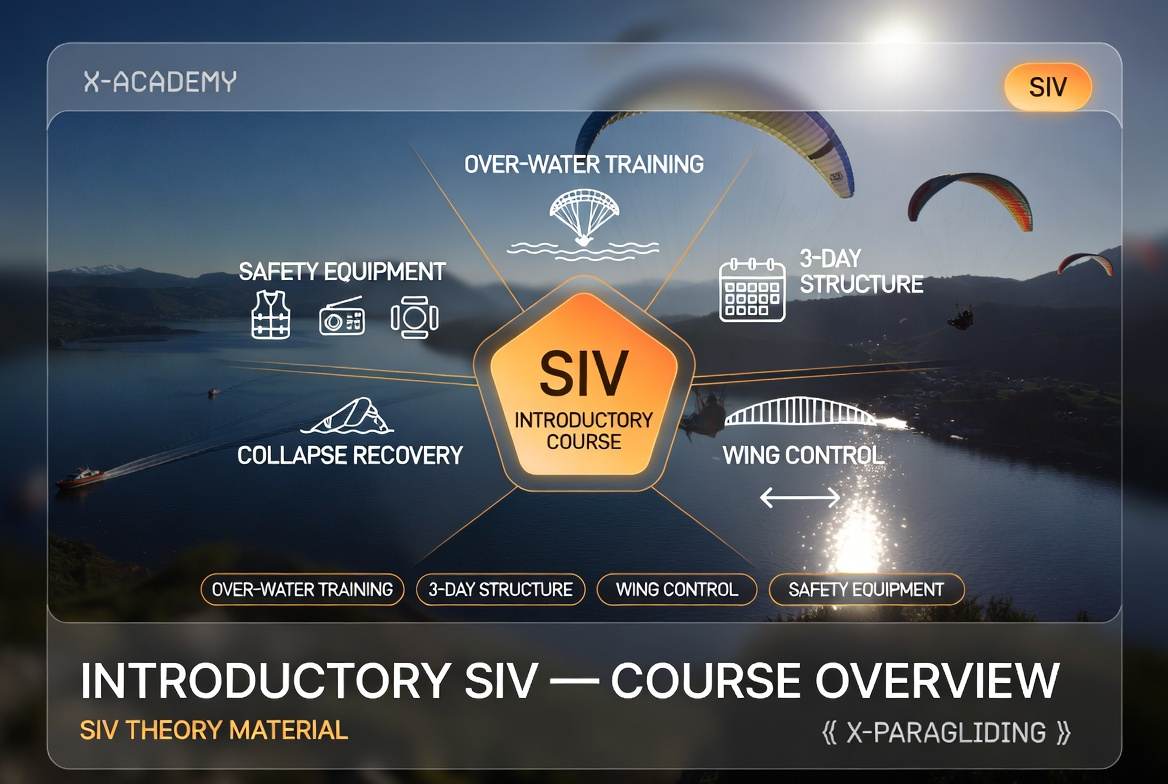
Introductory SIV is the most critical training stage in paragliding, where a pilot first steps out of their comfort zone and learns to manage the wing in unstable modes. This course is not just about performing "tricks"—it is about understanding wing dynamics and controlling fear.
Here is a detailed overview of Introductory SIV:
1. Equipment Preparation and Requirements
Before being cleared for SIV, equipment undergoes strict inspection because the loads are significantly higher than during normal flight.
Reserve Parachute: Must be freshly repacked (within the last 6 months). The handle must be easily accessible.
Life Jacket: An automatic or semi-automatic life jacket is mandatory in case of a water landing.
Radio Communication: Two radios (primary and backup) are required, preferably with waterproof cases and a helmet headset so the pilot can hear the instructor clearly during maneuvers.
Speed Bar: The accelerator must be functional and adjusted so it can be used instantly during a frontal collapse or "Big Ears."
Hook Knife: A specialized knife attached to the harness for cutting lines in case of entanglement or a water landing.
2. The Instructor’s Role and Responsibilities
The instructor at an SIV clinic is your "eyes from the ground." Their role is pivotal:
Briefing and Debriefing: Before each flight, the instructor explains the maneuver in detail; after the flight, they analyze the video footage to correct mistakes.
Radio Coordination: The instructor gives real-time commands in the air (e.g., "Pull," "Release," "Weight-shift right").
Safety Control: The instructor monitors your altitude. If a maneuver becomes dangerous, they will command you to deploy the reserve or abort the maneuver.
Rescue Boat: The instructor's team must have a boat mobilized on the water, capable of reaching the pilot within 60–90 seconds of a water landing.
3. Detailed Description of Maneuvers
A. Pitch & Roll Control
This is the foundation of all maneuvers. The pilot uses the brakes to artificially swing the wing back and forth (Pitch) or side to side (Roll).
Goal: To learn how to stop the wing when it "surges" ahead of you and prevent collapses.
Detail: You must feel the exact moment to apply the brakes to dampen the energy.
B. Big Ears
The pilot pulls the outer A-lines, folding the wingtips.
Goal: Achieving a stable descent at a rate of 3–5 m/s.
Detail: At the introductory level, you learn to combine "Big Ears" with the speed bar to maintain forward airspeed and avoid a parachutal stall.
C. Asymmetric Collapse
The pilot sharply pulls down one side of the A-risers, collapsing half of the wing.
Goal: To learn how to maintain course with a collapsed wing.
Detail: The key is counter-weight shifting to the open side and applying slight brake to prevent the wing from entering a rotation (spiral).
D. Symmetric (Frontal) Collapse
A sharp pull on both A-risers, collapsing the entire leading edge of the wing.
Goal: Proper recovery without "over-braking."
Detail: During a frontal, the wing falls behind you. The pilot must release the hands fully, wait for the wing to surge forward, and briefly "catch" it with the brakes if necessary.
E. Search for Stall Point
Slowly pulling the brakes until the wing begins to lose airspeed and "break."
Goal: To identify the critical limit of your wing beyond which it no longer flies.
Detail: This is a high-responsibility moment that prepares the pilot for the Full Stall.
Significance: Why is this Important?
Without an introductory SIV, a pilot in turbulent air is merely a "passenger." After this course, you become an active pilot capable of recognizing an incident and correcting it within seconds.