On this page
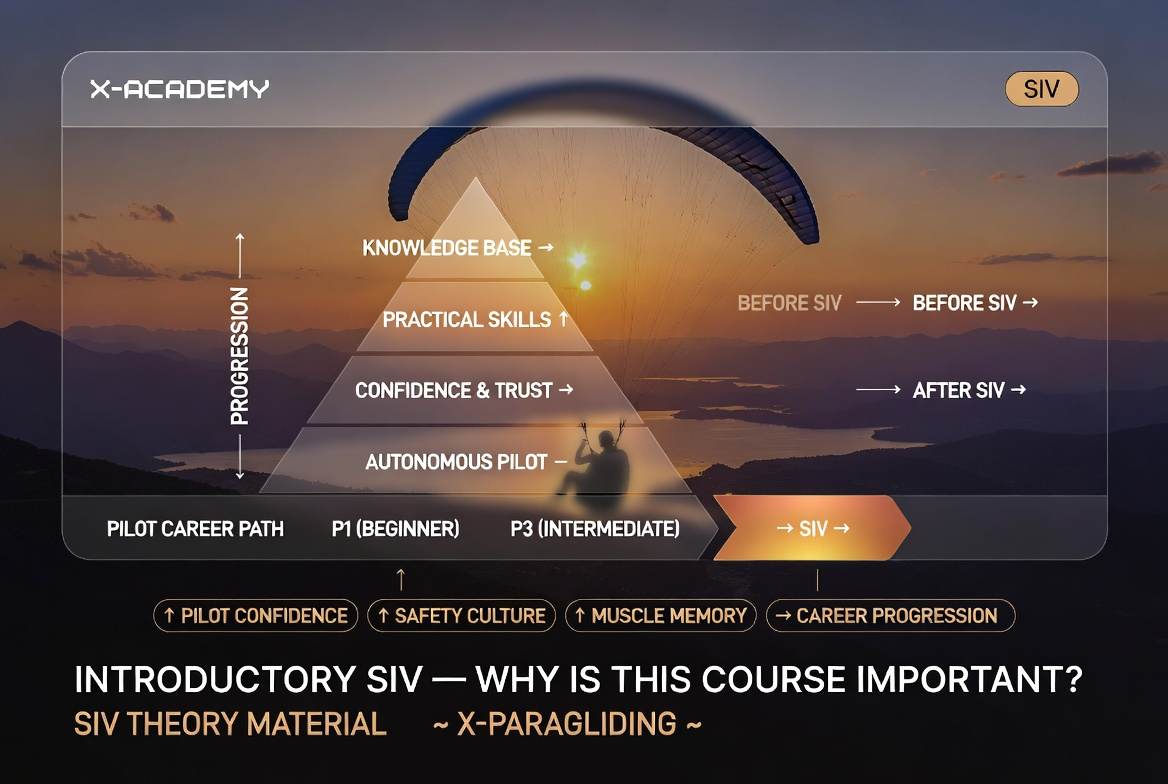
The phrase "from passenger to pilot" perfectly describes the transformation catalyzed by an SIV course. In turbulent air, where split-second decisions are paramount, knowledge is the differentiator between controlled flight and panic. For a T2-level pilot, this is not just about personal safety; it is a core component of professional ethics.
Here is a detailed analysis of why completing an SIV course is critically important:
1. Overcoming the "Passenger" Syndrome
Many pilots without SIV experience manage their wings well in stable conditions, but during their first serious collapse, they become a "passenger."
Passive State: The pilot freezes, waiting for the wing to reopen and hoping there is enough altitude. This inaction often leads to an incident.
Active Piloting: After SIV, you know how the wing will react. You no longer wait to see "what happens"—you manage the process yourself. Your reactions (weight-shift, brake correction) become automated.
2. Recognizing Incidents in the "Cradle"
SIV teaches you the "language" of the wing. Before a wing collapses, it sends signals to the pilot (loss of brake pressure, changes in tension).
Prevention: An experienced pilot feels the wing "soften" and performs a short, sharp brake input (a "catch"), preventing the collapse from occurring entirely.
Buying Time: SIV grants you those precious 1-2 seconds that, in a crisis situation, can be the difference between safety and a crash.
3. Fear Management and a "Cold Mind"
Fear is natural in paragliding, but insurmountable fear causes paralysis.
Deconstruction of Fear: When you perform an asymmetric collapse 20 times during SIV, your brain stops perceiving it as a catastrophe. Instead, it views it as a "technical task" to be solved.
Adrenaline Control: You learn to act under high-stress conditions, allowing you to maintain logical thinking even in difficult meteorological environments.
4. Understanding Equipment Limits
Every wing is unique. SIV is the only place where you can truly learn the "character" of your specific paraglider.
Finding the Limits: You discover exactly how deep the "stall point" is for your wing and how aggressively it behaves during rotation. This knowledge prevents you from accidentally entering a dangerous flight mode during a standard flight.
Significance: Why is this the "Industry Standard"?
Professionalism: In the commercial sector (T2), you have a passenger behind you. You do not have the right to be a "passenger"—you must be the captain who manages any chaos.
Safety Culture: The number of SIV-trained pilots is directly proportional to the safety level of a region. The more pilots know about crisis management, the lower the risk of severe incidents.
Economic Aspect: Even a single incident damages the reputation of not just the pilot, but the entire location. SIV is the best investment for the long-term stability of the business.
Summary
An SIV course is about taking responsibility for yourself and your passenger. It is the transition from intuitive flying to scientific and controlled piloting.