On this page
Thermal flying is considered the "Masterclass" of paragliding. It is the art of seeing the invisible and utilizing solar energy to gain altitude. This part of your theoretical course teaches pilots the "anatomy" of thermals and their behavior across different terrains.
Here is the detailed English breakdown of the thermal course:
1. Thermal Currents — The Fundamentals
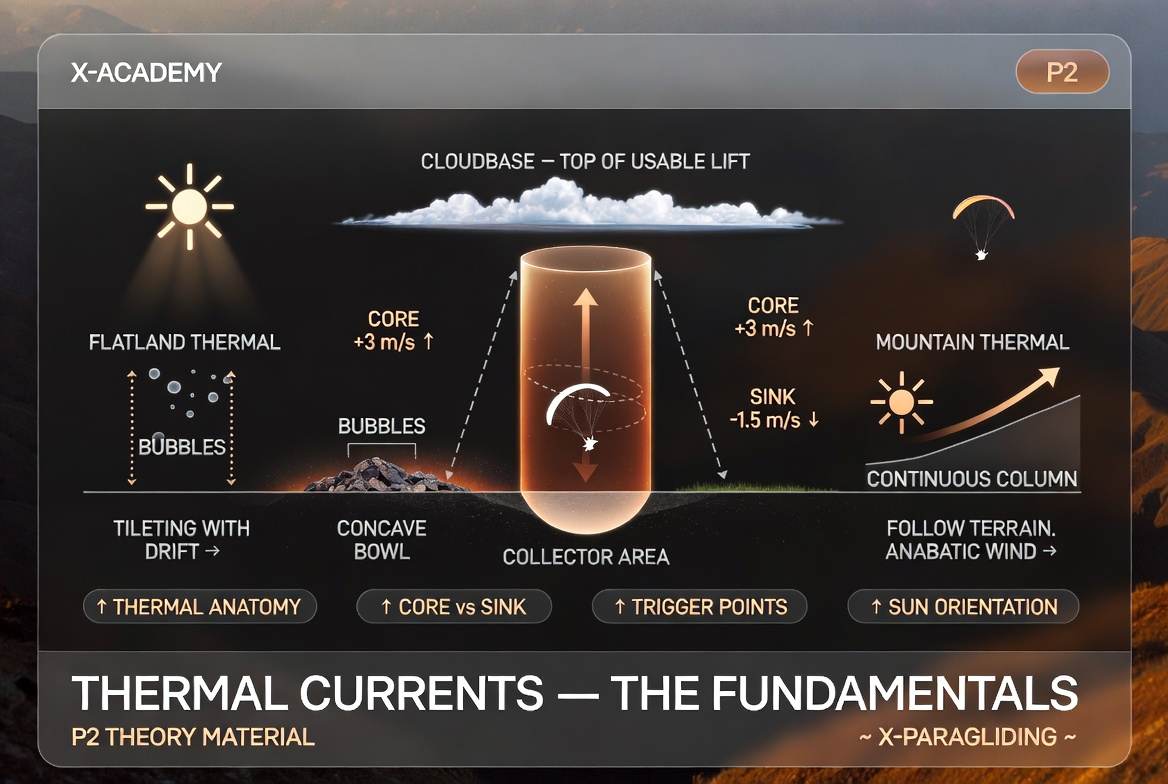
A Thermal is a rising mass of warm air.
Formation: The sun heats the Earth's surface, the surface heats the air above it, and the warm air—being lighter—begins to rise.
Structure: A thermal consists of a Core, where the lift is strongest, and Sinking Air (Sink) surrounding it as the air cools and descends.
2. Differences Between Flatland and Mountain Thermals
FeatureFlatland ThermalMountain ThermalFormationAir collects in one spot and "breaks away" from the surface (Trigger point).Air follows the slope upward due to heating (Anabatic wind).DynamicsOften rises as a series of disconnected "Bubbles."Usually a more stable and continuous column of air.OrientationTilts significantly in the direction of the wind (Drift).Follows the terrain shapes (gullies, spurs, and bowls).How to FindCloud development, dust devils, or circling birds.Sun-drenched rocks, dark cliffs, and "bowls" in the ridge.
3. Thermo-Dynamics
This is a combined lifting force most commonly found in mountainous regions.
Principle: This occurs when a thermal current merges with Dynamic (Ridge) Lift.
Advantage: The thermal "boosts" the ridge lift, allowing the pilot to climb significantly higher than the ridge itself.
Risk: Strong thermals can disrupt the smooth laminar flow of the ridge lift, causing localized turbulence.
4. Local Thermal Analysis
When analyzing a specific location (e.g., in Georgia—Tbilisi Sea, Gudauri, or Marneuli), a pilot must consider:
Trigger Points: Specific spots where the thermal leaves the ground (e.g., asphalt roads, dry wheat fields, rocky outcrops).
Collector Areas: Concave terrain or "pockets" where warm air gathers before eventually releasing upward.
Sun Orientation: East-facing slopes are active in the morning, South-facing at midday, and West-facing in the evening.
5. Safety During Thermal Flying
Active Piloting: The air inside a thermal is turbulent. The pilot must constantly manage the wing to prevent Collapses.
The Spiral: When circling in a thermal, it is vital to maintain a constant lookout to keep a safe distance from other pilots.
Exit Strategy: If a thermal becomes too strong or dangerously turbulent, you must know how to exit it safely (e.g., flying upwind or using "Big Ears").
Key Technical Terminology:
Core: The center of the thermal with the highest lift.
Trigger Point: The physical feature that causes the warm air to release from the ground.
Lapse Rate: The rate at which air temperature decreases with altitude.
Thermal Drift: The horizontal displacement of a thermal caused by the wind.