

On this page
Correct installation and knowledge of how to use the Reserve Parachute (often called the "Reserve" or "Rescue") are critically important. It is your last resort in cases where the main wing becomes uncontrollable.
Below are the essential rules for the installation and deployment of the reserve parachute:
1. Installation of the Reserve Parachute
The reserve parachute is placed inside a dedicated compartment in the harness. The process involves several key steps:
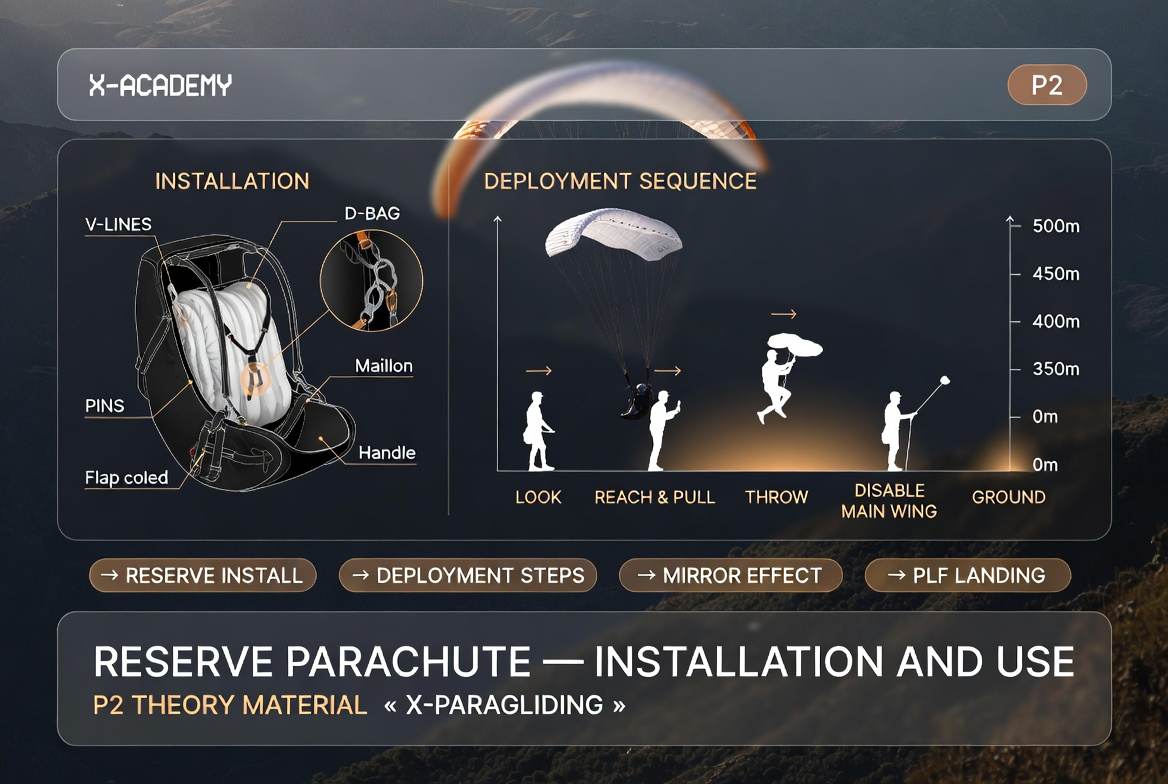
Bridle Connection: The reserve's strap (Bridle) is connected to the harness's shoulder loops (V-lines) using specialized metal connectors known as Maillons or Shackles.
Handle Attachment: The deployment handle must be securely attached to the Deployment Bag (D-Bag).
Placement in the Container: The parachute is placed in the harness pocket so that the handle is on the side most accessible to the pilot.
Closing: The container is closed with specialized Pins. These must be positioned so that they release easily when the handle is pulled.
2. Rules of Use: Step-by-Step Instructions
If you decide that deploying the reserve is necessary, act according to the following sequence:
Look: Visually locate the reserve handle.
Reach & Pull: Firmly grasp the handle and pull it energetically outward/sideways to release the pins and extract the parachute.
Throw: Throw the parachute (still inside its D-bag) as hard as possible away from your body into clear air (away from the main wing). Throw the entire bag!
Disable the Main Wing: Once the reserve opens, try your best to disable the main wing (by pulling the lines/B-risers) to prevent it from interfering with the reserve, which avoids the dangerous "Mirror Effect."
PLF (Parachute Landing Fall): Keep your legs together and knees slightly bent during landing to distribute the impact across your whole body.
3. General Safety Rules
Repacking: You must remove, air out, and professionally repack the reserve parachute at least once a year with a certified specialist.
G-Force Considerations: Remember that during a high-energy rotation (like a Spiral Dive), centrifugal force can make it difficult to reach the handle. Practice (simulation) on the ground is essential.
The Critical Moment: Deploy the reserve immediately once you realize the altitude is critical and you cannot recover the wing. Altitude is time.
4. International Terminology
These terms are essential for your training materials:
Reserve Parachute: Your secondary safety canopy.
Deployment Bag (D-Bag): The inner bag containing the folded parachute.
Bridle: The high-strength webbing connecting the parachute to the harness.
Maillon / Shackle: The metal link used to connect the bridle to the V-lines.
Mirror Effect: A dangerous situation where the main wing and reserve fly against each other, increasing the descent rate.