On this page
The SIV course (Simulation d'Incidents en Vol) is a fundamental milestone in paragliding. Before advancing to the P3 (Intermediate) level, grasping the theoretical concepts of SIV is essential. At this stage, pilots begin active thermal flying, where turbulent air increases the risk of wing collapses.
Here is the professional English breakdown of the theoretical importance of the SIV course:
1. Understanding Wing Mechanics
The theoretical portion teaches the pilot what happens from a physics perspective when a part of the wing stops functioning correctly.
Angle of Attack (AoA): Understanding how turbulence changes the angle and triggers a collapse.
Energy Management: Learning how altitude is converted into speed and vice versa (Pitch and Roll control).
2. Theoretical Analysis of Key Incidents
During an SIV course, a pilot theoretically prepares for the following maneuvers:
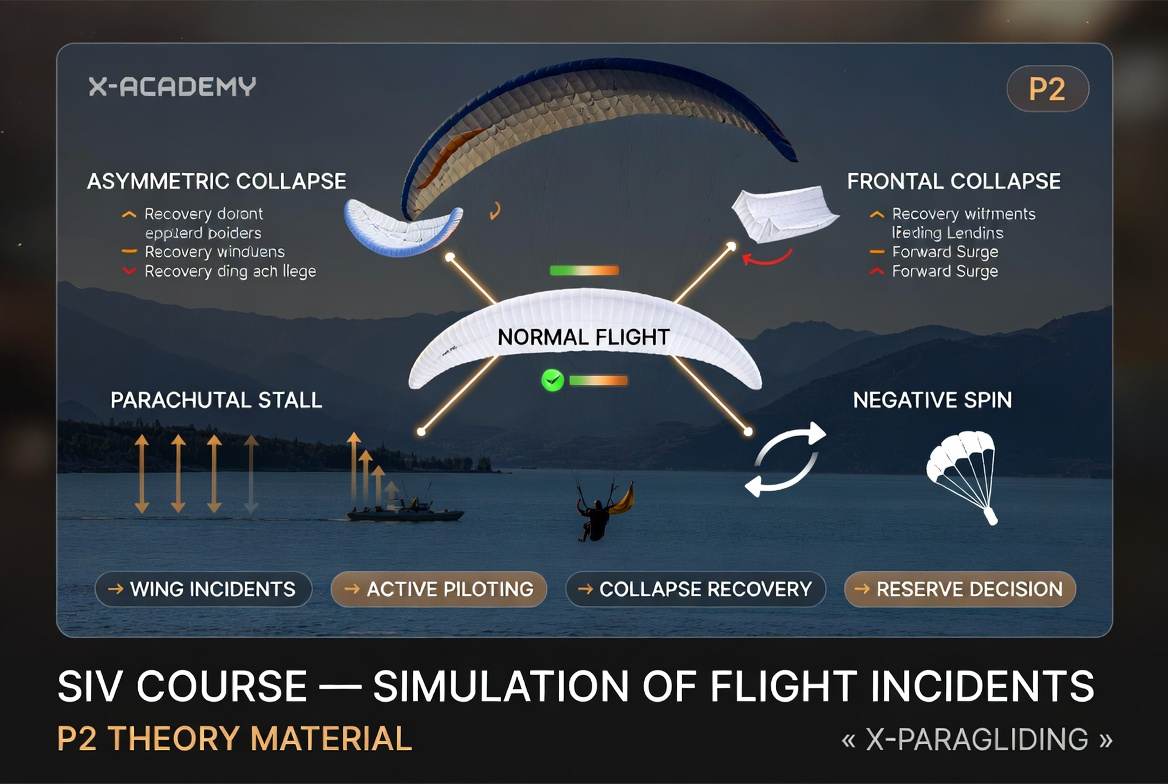
Asymmetric Collapse: When one side of the wing collapses. Theory teaches maintaining course using "weight-shift" to the open side and controlled braking.
Frontal Collapse: A full collapse of the leading edge. It is vital to know when to "release" the brakes to allow the wing to regain airspeed.
Parachutal Stall: When the wing stops moving forward and descends vertically.
Negative Spin: When one side of the wing stalls while the other flies, causing a rapid rotation.
3. Developing "Active Piloting" Reflexes
Theoretical preparation trains the pilot's brain for correct reactions in critical situations:
Incident Recognition: Learning to feel through the harness and toggles when the wing loses internal pressure before it actually collapses.
Correction vs. Over-reaction: Many incidents are worsened by a pilot’s incorrect, overly aggressive pull (Over-correction). Theory teaches precise dosing of input.
4. Psychological Stability and Fear Management
SIV theory significantly reduces the "panic factor."
Sense of Control: When a pilot knows exactly how to recover from a collapse, they fly more calmly and effectively in turbulent thermals.
Safety Margin: The pilot learns the real limits of both their own skills and their equipment.
5. Reserve Parachute Deployment Theory
A core part of SIV is determining the exact moment when a wing recovery is no longer possible.
Decision Making: Establishing the critical threshold of altitude and time, after which the pilot is obligated to "throw" the reserve.
International Terminology for Students:
SIV (Simulation d'Incidents en Vol): Simulation of flight incidents.
Active Piloting: Constant management of the wing to counteract turbulence.
Collapse Recovery: The process of returning the wing to normal flight after a collapse.
Stall Point: The point at which the wing loses lift due to lack of airspeed.
Configuration: The current shape and state of the flying wing.