On this page
The Pre-flight Check is the most critical moment in paragliding. Statistically, the majority of incidents occur due to small details that were not verified before takeoff.
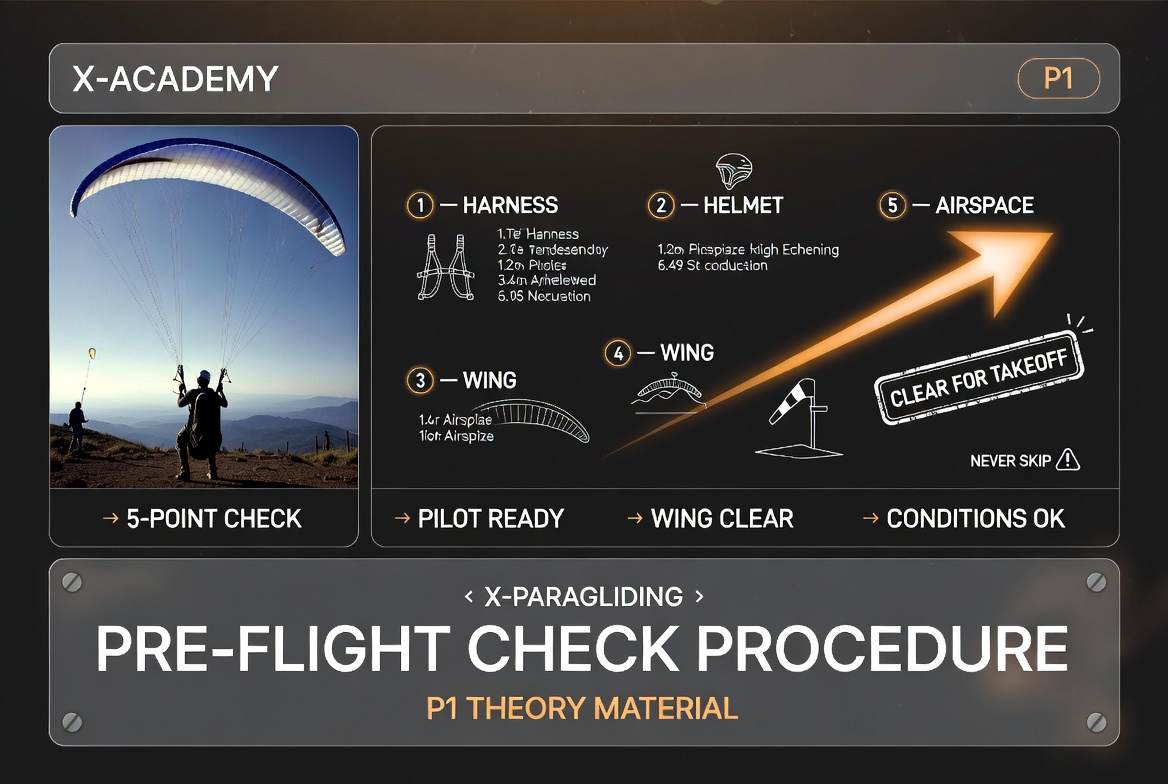
In international practice, a 5-point check system is established, which every pilot must perform before launching:
1. Harness & Helmet Check
This is the most vital step to ensure the pilot and equipment function as a single unit.
Helmet: Fastened and sitting snugly on the head.
Harness Buckles: Pay special attention to the leg straps. Unfastened leg straps are a primary cause of falling out of the harness after takeoff.
Carabiners: The risers must be correctly seated, and the carabiners must be fully locked.
2. Canopy & Lines Check
A visual inspection of the entire wing system:
Line Check: Lines should not be knotted, tangled, or caught on external objects.
Canopy: Spread in a "crescent" shape; the cells should be clear of snow, grass, or rocks.
Leading Edge: Open and ready to be inflated with air.
3. Weather & Wind Conditions
A final assessment of the environment before committing to the launch:
Wind Direction: The wind should be blowing directly onto the slope (Face-on).
Wind Strength: Must correspond to the pilot's skill level and the wing's specifications.
Airspace: Ensure the launch corridor is clear of other pilots or obstacles.
4. Controls & Reserve Check
Brakes (Toggles): Held correctly, not tangled with other lines, and moving freely.
Reserve Parachute: The handle must be in place, secured, and ready for immediate deployment by the pilot.
Speed Bar: If connected, it must be properly routed so it does not interfere with the launch process.
5. Psychological Readiness and Decision
The final second before takeoff:
Flight Plan: The pilot knows exactly where they are headed after takeoff and has a clear alternative (backup) plan.
Go/No-Go: If the pilot feels uncomfortable or has any doubts, the best decision is not to fly.
Remember the Mnemonic: R.I.D.E.R.
This is an easy way to memorize the essential checks:
Reserve — (Handle is secure and reachable)
Instrument/Helmet — (Helmet is fastened)
Director/Wind — (Wind direction and strength are correct)
Equipment/Buckles — (Harness buckles, especially leg straps, are locked)
Risers/Lines — (Lines are clear and risers are properly attached)