On this page
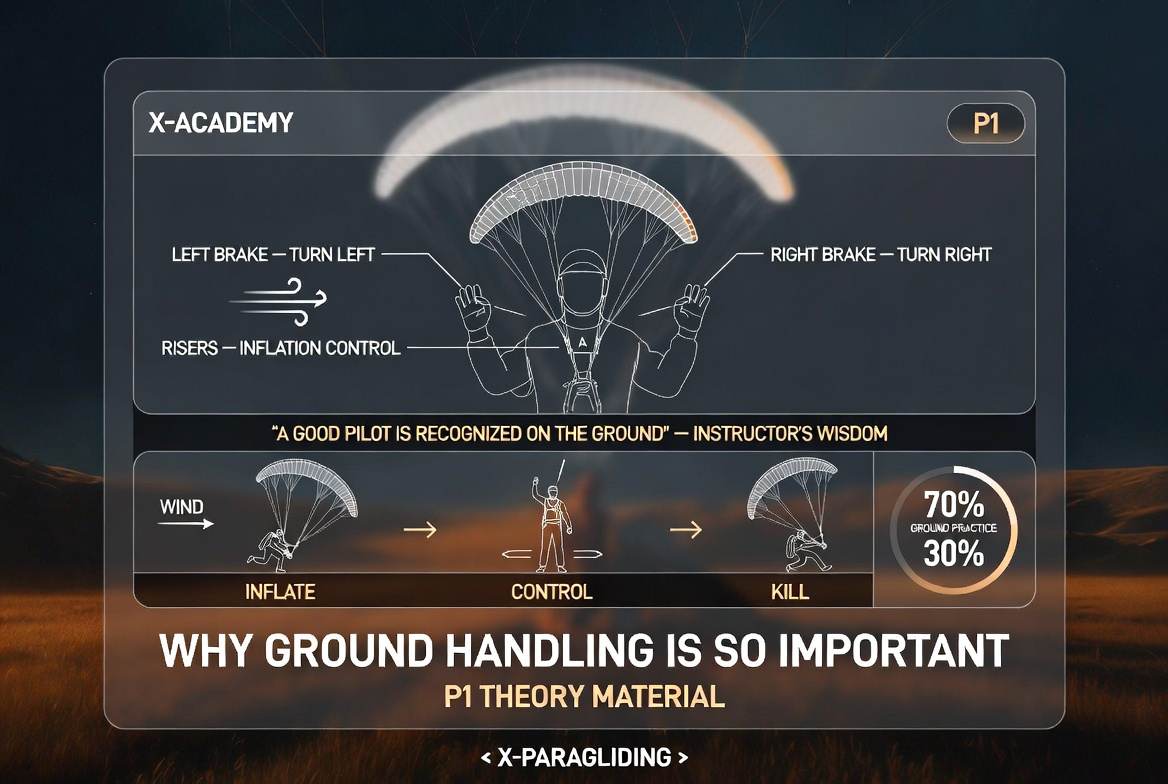
In paragliding, ground training—internationally known as Ground Handling or Kiting—is of decisive importance. Experienced pilots often say, "A good pilot is revealed on the ground." The more confidently you manage the wing on the ground, the safer and smoother your takeoff and flight will be.
1. Why is Ground Handling Important?
Muscle Memory: You learn the wing's reactions so thoroughly that you no longer need to think about them while in the air.
Takeoff Safety: Statistically, most incidents occur during takeoff. Ground practice minimizes this risk.
Feeling the Wing: You learn how wind variations and gusts affect the canopy in real-time.
2. Main Stages of Training
A. Preparation and Pre-flight Check
Before starting your practice, you must learn:
Properly spreading the wing in a "Crescent" shape.
Line Check: Sorting the lines to ensure there are no tangles or knots.
Connecting the Risers correctly to the harness.
B. Inflation
There are two primary methods for bringing the wing up:
Forward Launch: Used in light or nil wind. The pilot faces away from the wing and runs forward to create relative airflow.
Reverse Launch: Used in moderate to strong winds. The pilot faces the wing, allowing for a direct visual check of the canopy during inflation.
C. Kiting (Keeping the wing at Zenith)
This is the core of ground practice. The goal is to keep the wing directly above your head (at the Zenith) for as long as possible. During this, you practice:
Pitch Control: Correcting the wing’s tendency to surge forward or fall backward.
Roll Control: Correcting the wing’s side-to-side tilt using body movement and weight-shift.
3. Safety Rules During Ground Handling
Location: Choose a flat area free of obstacles like trees, power lines, or buildings.
Wind Speed: For beginners, a wind speed of 2–4 m/s is optimal. Avoid strong or turbulent winds.
Gear: Always wear your helmet and gloves while kiting.
Kill the Wing: Learn how to quickly collapse the wing by pulling the brakes (toggles) or the C-risers if the wind starts to drag you.
4. International Terminology (For Students)
Ground Handling: Practice on the ground.
Inflation: Filling the wing with air and bringing it up.
Kiting: Flying the wing while staying on the ground.
Leading Edge: The front opening of the wing where air enters.
Toggles / Brakes: The handles used for steering and stopping the wing.
Zenith: The position directly above the pilot's head.