On this page
Introduction
Safety in paragliding is the number one priority. Every flight begins with proper preparation and thorough checks.
Pre-Flight Check
Before every flight, completing a full pre-flight inspection is mandatory. Use the ABCDE system:
A — Airworthiness
The wing is fully laid out with no tangles
Lines are not crossed or knotted
Carabiners are locked
B — Buckles
All harness buckles are secured
Leg, chest, and shoulder straps are checked
Footwear is secure
C — Controls
Brakes are correctly attached
Left brake in left hand, right brake in right hand
Speed bar system is functional
D — Direction
Wind direction is verified
Takeoff direction is established
Flight plan is clear
E — Emergency
Reserve parachute pin is checked
Reserve handle location is confirmed
Emergency procedure is mentally rehearsed
Reserve Parachute
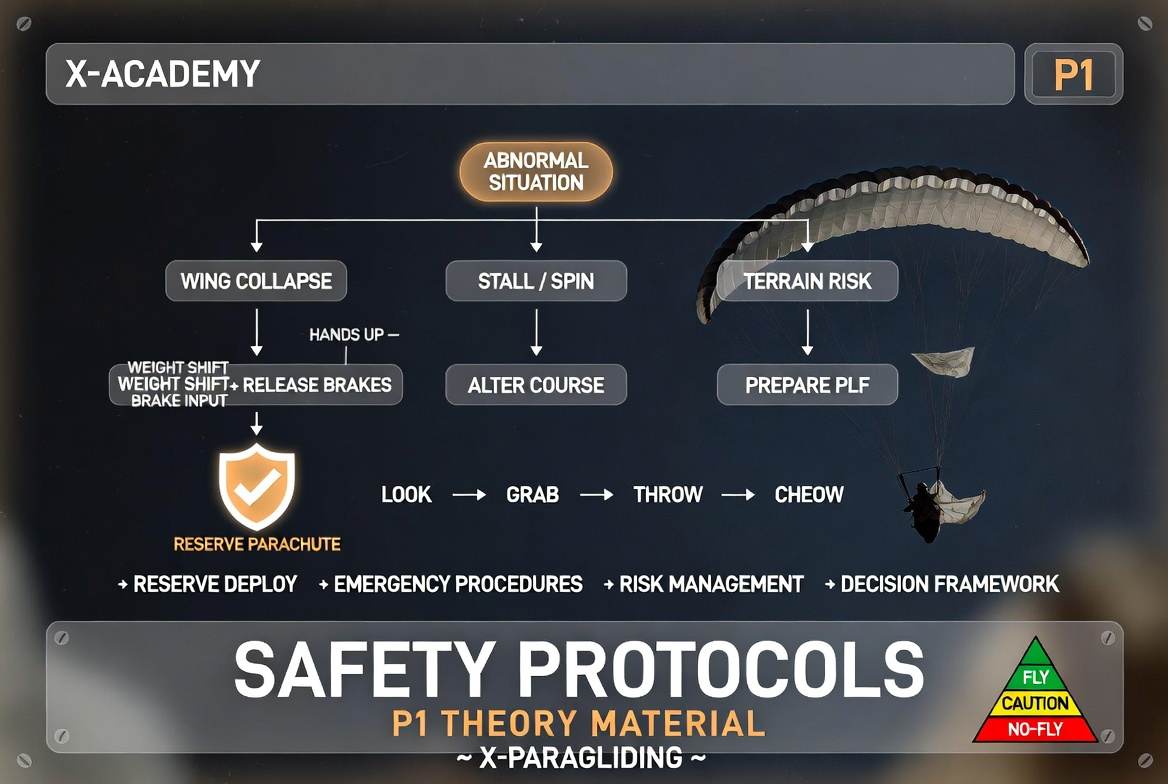
The reserve parachute is life-saving equipment. Every pilot must know:
When to Deploy?
The wing no longer responds to control inputs
An unrecoverable spiral (spin) develops
A major collapse that cannot be recovered
Decision altitude: minimum 100 meters
How to Deploy?
Locate the handle — know where it is at all times
Grab with full force — grip firmly and pull
Throw the reserve away from your body
Wait for deployment and stabilization
Emergency Situations
Wing Collapse
Symmetric Collapse:
Hands down (release brakes)
The wing usually self-recovers
Asymmetric Collapse:
Apply opposite brake to prevent rotation
Then pump the collapsed side to reopen
Stall
Raise both hands evenly
Do not make sudden movements
Spin
Release the opposite brake
Then straighten out
If unrecoverable → Deploy reserve!
Risk Management
5 Golden Rules for P1 Pilots:
Do not fly when wind speed exceeds 20 km/h
Do not fly during thunderstorm risks
Do not fly without instructor permission
Always perform the ABCDE check
Always carry a reserve parachute
Conclusion
"A good pilot is one who knows when not to fly."
Safety is not a choice — it is a way of life. Before every flight, review the protocols, check the equipment, and trust your instructor.