

On this page
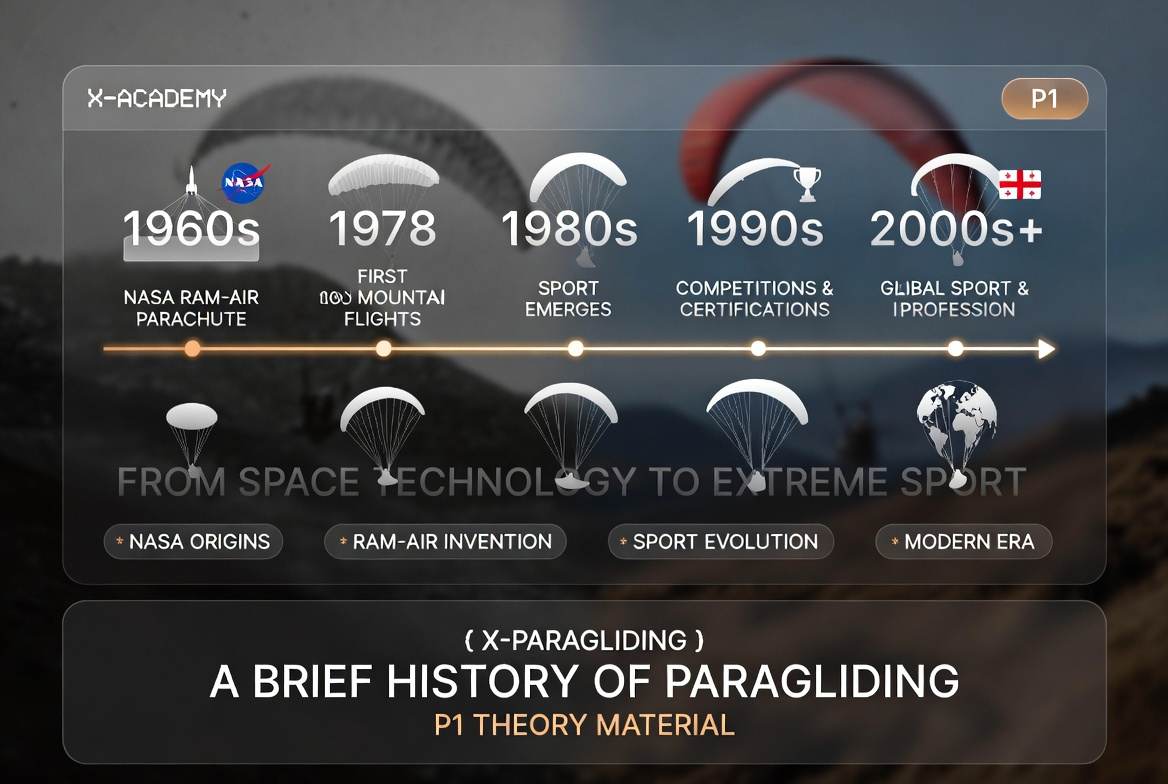
The historical journey of paragliding's development is a fascinating path that began with space technology and evolved into a modern extreme sport, eventually becoming a professional adventure activity.
1. It All Started at NASA (1940s–1960s)
The ancestor of the paraglider is considered to be the American engineer Francis Rogallo, who created the so-called "Flexible Wing" in 1948. Initially, NASA considered this technology for landing space capsules back on Earth.
Later, in 1964, Domina Jalbert invented the Parafoil—a multi-cell parachute that took the shape of a wing when inflated by air. This was the first time a parachute acquired the properties of an aerodynamic wing.
2. First Steps in the Mountains (1978)
Paragliding as a sport was born in the French Alps, in the town of Mieussy. Three parachutists (Jean-Claude Bétemps, André Bohn, and Gérard Bosson) decided to launch from a mountain slope instead of jumping from a plane. They used steerable sports parachutes and successfully took flight. This event is considered the birth date of modern paragliding.
3. The 1980s: Technical Leap
In the 1980s, paragliders finally branched off from traditional parachutes. Engineers began creating wings specifically designed for slope launching:
Wings became longer and narrower (increased Aspect Ratio).
The number of lines was reduced to decrease drag.
The glide ratio improved significantly, allowing pilots not only to descend but also to gain altitude.
4. From the 90s to Today: Safety and Records
The 1990s saw the introduction of strict wing certification systems, as well as the emergence of reserve parachutes and protective harnesses.
In the 2000s, lightweight equipment was developed, giving rise to the Hike & Fly culture.
Modern Era: Today, paragliders are made of high-tech materials (Dyneema/Vectran), have minimal weight, and are capable of covering hundreds of kilometers using only solar-powered thermals.
5. The Future of Paragliding
Modern paragliding is evolving at a rapid pace. Several important trends have emerged:
Electric Motors: The development of electric paramotors will enable pilots to take off from flat terrain as well.
Safety Technologies: Automatic reserve deployment systems, GPS-based warnings, and real-time weather monitoring.
Sustainability: The use of eco-friendly materials in manufacturing and the "leave zero trace" philosophy.
Competition: FAI international competitions, including XC (Cross-Country) records, where covering more than 500 km is already a reality.