On this page
The canopy (wing) is the most critical component of a paragliding system. Its selection must correspond to the pilot's qualification level, as it determines both flight safety and dynamics.
1. Canopy Classification (EN/LTF Standards)
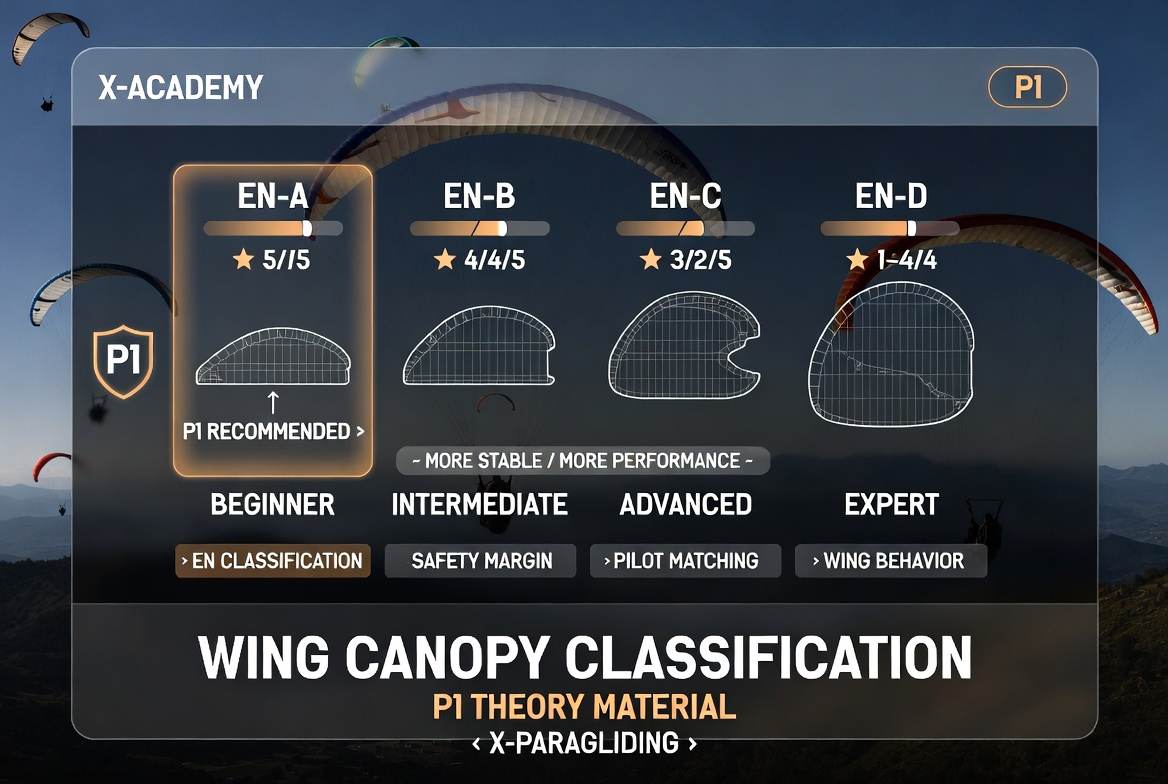
According to international standards, wings are divided into four main classes based on their passive safety:
ClassCategoryPurposeDescriptionEN-ASchool / BeginnerInstructionMaximum safety. High self-recovery capacity in case of pilot error or collapse.EN-BProgression / XCNovice/IntermediateThe most popular class. Designed for skill development and cross-country (XC) flying.EN-CSport / PerformanceExperienced PilotRequires active piloting and rapid, precise reactions to flight incidents.EN-DCompetitionExpert / ProDesigned for high-level competitions. Very sensitive; requires extensive experience.
2. Wing Packing and Storage Methods
Properly storing your wing is directly linked to its operational lifespan. There are two primary folding methods:
A. Traditional Folding
In this method, the wingtips are folded toward the center.
Pros: Simple and fast.
Cons: Risk of damaging the rigid elements (Rigifoils/Nylon rods) located in the leading edge.
B. Concertina Packing (Recommended)
This is the modern and safest method. The wing's cells are stacked on top of each other like an accordion.
Cell-to-Cell: The plastic reinforcements of the leading edge are aligned parallel to one another, preventing deformation.
Significance: Preserves the wing's shape and aerodynamic characteristics over a long period.
3. Maintenance Tips
Moisture: Never store a canopy while it is wet. This can cause fabric degradation and increase porosity (air permeability).
UV Rays: Avoid leaving the wing exposed to the sun for long periods when not flying. Ultraviolet rays weaken the fabric's structural integrity.
Lines: During packing, ensure that the lines are not tangled, knotted, or under excessive tension.
Key Technical Terms Used:
Passive Safety: The wing's ability to recover on its own without pilot input.
Active Piloting: Constant manual control of the wing to prevent collapses.
Leading Edge: The front part of the wing that meets the air first.
Porosity: The measure of how much air can pass through the fabric (lower is better for old wings).
Rigifoils: Plastic or nylon rods that help the wing maintain its shape.