

On this page
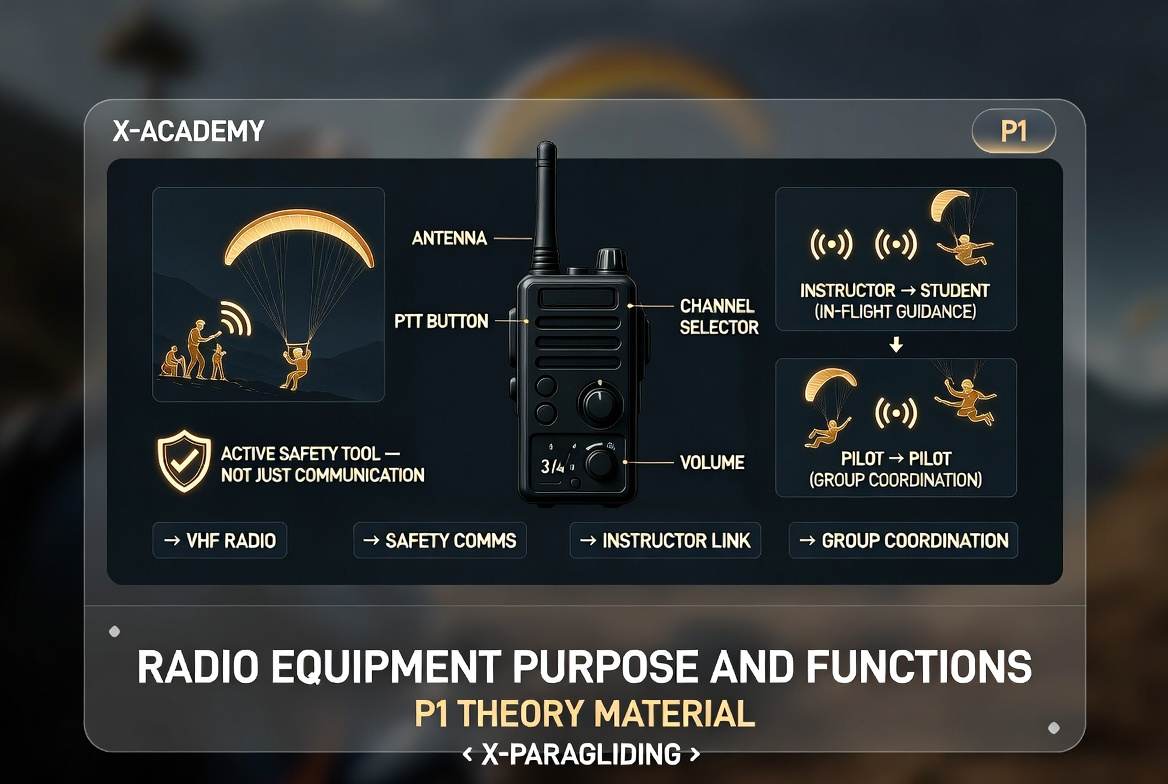
In paragliding, a radio station (transceiver) is not just a communication tool—it is an integral part of active safety. Its proper use is often decisive in preventing incidents, especially during the training process and group flights.
Here is a detailed overview of the purpose, functions, and importance of radio stations in paragliding:
1. Purpose and Functions
The radio provides instant communication between the pilot and the ground (or other pilots). Its primary functions include:
Real-time Instruction: For students, the radio acts as a "remote control," allowing the instructor to provide guidance during takeoff, maneuvering, and landing.
Information Exchange: Relaying updates on weather changes, wind direction, or obstacles within the airspace.
Coordination: Coordinating distances and locations between pilots during group or Cross-Country (XC) flights.
2. Importance for Flight Safety
From a safety perspective, the radio station performs several critical roles:
Emergency Management: If a pilot encounters a problem in the air (e.g., a wing collapse), an experienced instructor can use the radio to prevent panic and provide precise technical instructions for recovering the wing or deploying the reserve parachute.
Local Weather Alerts: Pilots on the ground can more accurately assess wind gusts or directional shifts and timely warn those in the air about the necessity of a safe landing.
Search and Rescue (SAR): In the event of an accident, a radio is the fastest way to call for help, especially in areas where mobile cellular coverage is unavailable.
3. Rules of Use and Ethics (Radio Discipline)
To ensure safety, maintaining "radio hygiene" is essential:
Short and Concise Messages: The frequency should not be overloaded with unnecessary chatter. Information must be clear and brief.
Priority: Communication between a student and an instructor always takes priority over conversations between other pilots.
Radio Check: A "Radio Check" is mandatory before every flight to ensure the battery is charged and the correct frequency is selected.
Hands-free Systems: Headsets and microphones integrated into the helmet (with a PTT - Push-to-Talk button) allow the pilot to speak without releasing the toggles (control handles).
4. Technical Specifications
Paragliding primarily uses 2-meter (VHF) band radios because they offer better signal propagation in mountainous terrain. It is important that the device is:
Shock-resistant (Ruggedized).
Waterproof (or kept in a protective waterproof pouch).
Equipped with a high-capacity battery.
Key Technical Terms:
PTT (Push-to-Talk): A button used to switch the radio from receiver to transmitter mode.
VHF (Very High Frequency): The radio frequency range commonly used in aviation and maritime communication.
Toggles: The handles used by the pilot to steer the paraglider.
Squelch: A circuit that suppresses the audio output of a receiver in the absence of a sufficiently strong desired input signal to reduce noise.