On this page
Paraglider Lines: Importance, Materials, and Maintenance
Paraglider lines constitute the structural framework that connects the canopy to the pilot's harness. Their proper selection and maintenance are crucial for preserving the wing's aerodynamic shape and ensuring flight safety.
1. Importance and Function of Lines
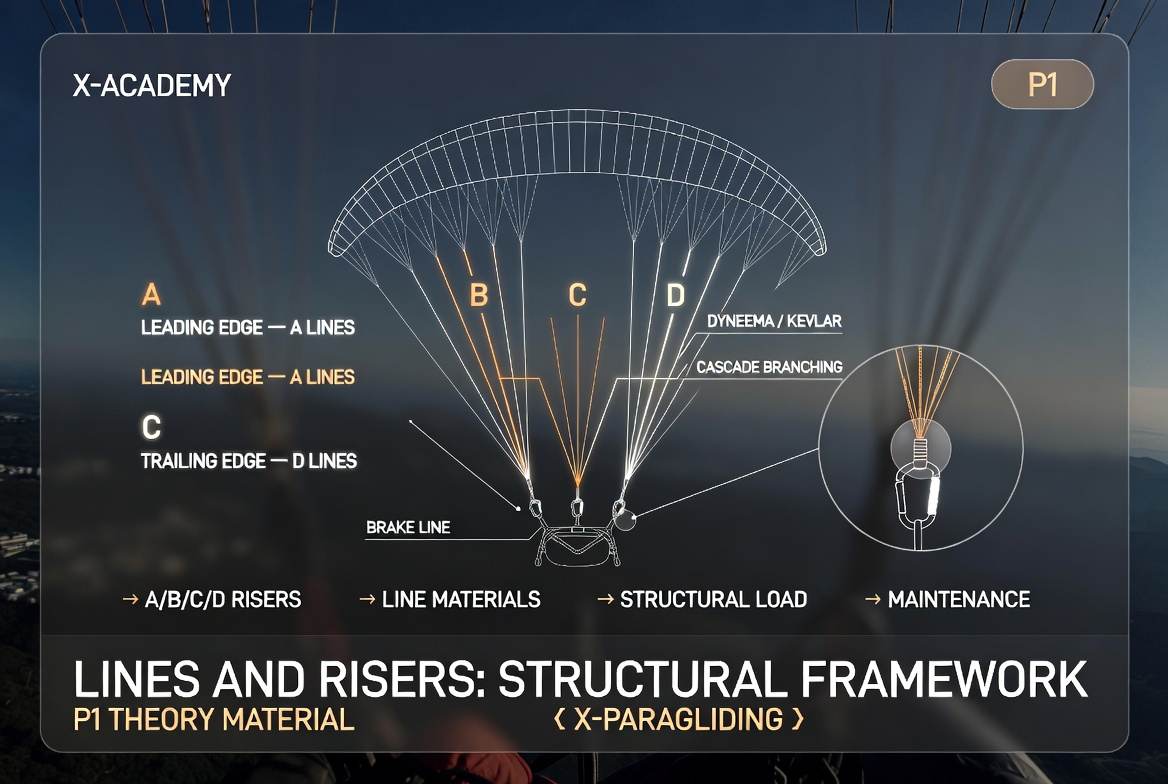
Lines distribute the pilot’s weight across the entire surface of the canopy. They are organized into several levels:
A-Lines (Front): Responsible for the formation of the wing profile and the Angle of Attack (AoA).
B and C Lines: Provide stability to the central and rear sections of the canopy.
Brake Lines (Control Lines): Connected to the Trailing Edge of the wing and used for steering and speed control.
2. Line Differentiation by Material
Modern paragliders primarily utilize two types of materials:
A. Dyneema
Characteristics: Extremely strong and elastic.
Pros: High resistance to bending and mechanical damage.
Cons: Prone to shrinking over time, which alters the wing's flight characteristics (Trimming).
B. Aramid / Kevlar
Characteristics: Almost no stretch or shrinkage.
Pros: Maintains precise length over several years.
Cons: Sensitive to frequent bending and Ultraviolet (UV) radiation.
C. Sheathed vs. Unsheathed Lines
Sheathed: Features a protective outer layer. Used on school (EN-A) and intermediate (EN-B) wings for higher durability.
Unsheathed: Thin and lightweight. Used on performance/competition (EN-C/D) wings to reduce parasitic drag.
3. Line Sorting and Arrangement Methods
Correctly arranging the lines before flight (Line Check) is a guarantee for a safe takeoff:
Sorting: Lines must be spread out so they are not tangled. Typically, sorting begins with the A-lines (which should be on top).
"Fork" Method: Holding the Risers and running the lines between the fingers to eliminate "knots" and "loops."
Storage: During packing, lines should be placed in the center of the canopy to prevent them from hanging out and catching on external objects.
4. Technical Maintenance
Trimming: Periodically (every 100 flight hours or every 2 years), it is essential to verify line lengths using a laser measurement tool.
UV Protection: The inner core of the lines degrades from sun exposure; therefore, the wing should be packed away shortly after landing.
Key Technical Terms:
Angle of Attack (AoA): The angle between the wing's chord line and the oncoming air.
Trailing Edge: The rear edge of the wing.
Risers: The webbing straps that connect the lines to the carabiners.
Parasitic Drag: Resistance created by components that do not contribute to lift (like lines).
Trimming: The process of adjusting line lengths to match original factory specifications.