On this page
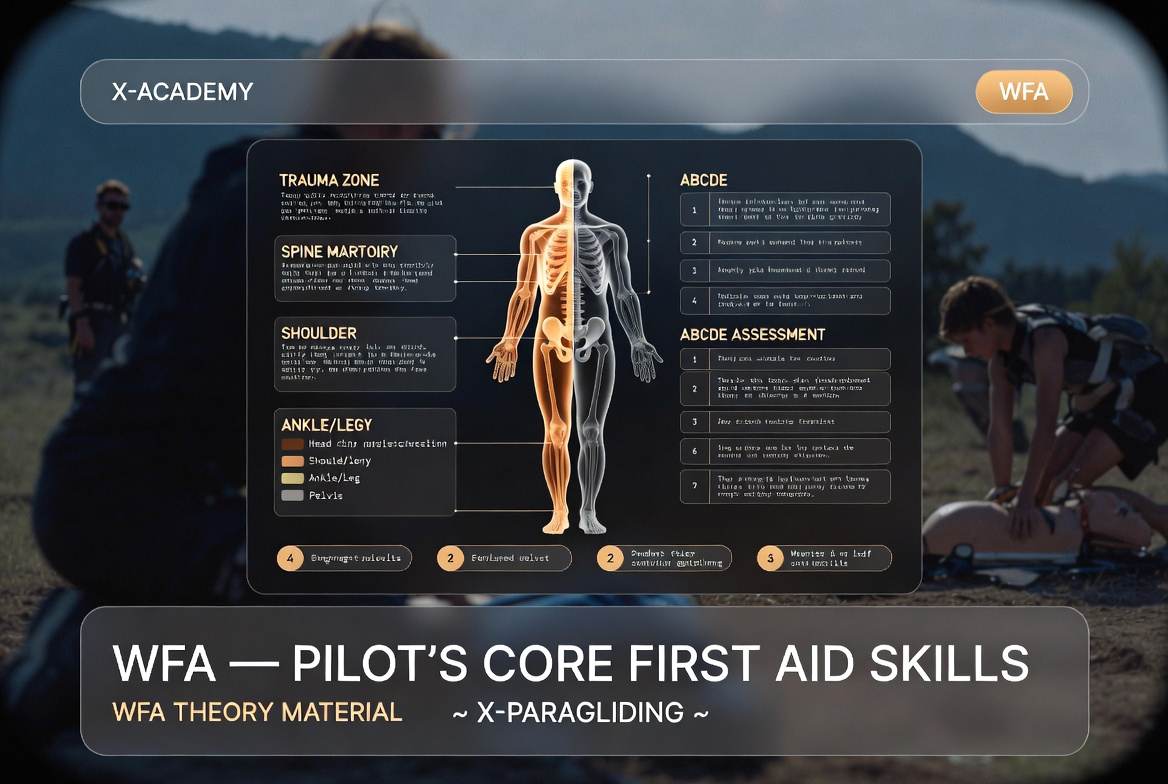
This module of critical competencies for pilots is the foundation of safety. In paragliding, where medical assistance may be delayed, the pilot serves as the first responding officer.
Here is an in-depth breakdown of these vital issues:
A) Traumatology and Spinal Management
In paragliding, the energy of a fall is often vertical, causing Axial Loading. This means the impact force is transmitted directly from the feet or pelvis to the spine.
Spinal Motion Restriction (SMR)
This is no longer just "fixing the neck"; it is the protection of the entire spinal integrity.
Automatic Suspicion: After any significant impact, if the pilot has back pain, bruising, or a loss of consciousness, they are treated as having a spinal injury.
Improvised Stabilization: If you do not have a specialized cervical collar, use the pilot's boots or rolled-up clothing. Place them on both sides of the head and secure them with tape or paraglider lines so the head does not sway.
Log Roll: If the patient is vomiting, they must be turned on their side using the "log principle"—the head, shoulders, and pelvis must rotate simultaneously without any bending.
Triage – The Art of Prioritization
When multiple people are injured, emotion must be replaced by an algorithm:
Red (Immediate): Not breathing or has massive hemorrhaging.
Yellow (Delayed): Stable fractures.
Green (Minor): Walking wounded with slight injuries.
The Golden Rule: You first help the person whose chance of survival is realistic and who is struggling to breathe.
B) ABCDE Protocol in Extreme Conditions
This is an international aviation and military standard that functions effectively under high stress.
A (Airway) – Airway Management
Helmets (especially full-face) often obstruct breathing during a trauma.
Principle: If the patient is breathing, do not remove the helmet (to protect the spine). If they are not breathing, the helmet must be removed by two people: one stabilizes the neck while the other carefully slides off the helmet.
Jaw Thrust: Open the airway by pushing the lower jaw forward rather than tilting the head back.
B (Breathing) – Quality of Respiration
Rib fractures can lead to Pneumothorax (collapsed lung).
Observation: Watch for symmetrical movement of the chest. If one side does not rise, the patient requires emergency medical evacuation.
C (Circulation) – Circulation and Bleeding
In paragliding, open fractures can lead to fatal bleeding.
Tourniquet: If blood is "spurting" from a wound, direct pressure is not enough. A tourniquet is placed above the wound ("High and Tight").
Internal Bleeding: If the patient's abdomen becomes rigid (guarding) and the pulse quickens, these are signs of internal bleeding.
D (Disability/Neurology) – Neurological Status
Use the AVPU scale:
A (Alert): Fully awake.
V (Verbal): Responds to voice.
P (Pain): Responds only to pain.
U (Unresponsive): No response.
This information is critical for rescuers to understand if the trauma is deteriorating.
E (Environment/Exposure) – Environment and Protection
This is the point most frequently forgotten.
Shock and Cold: During traumatic shock, the body loses its ability to generate heat. In the mountains, in windy weather, a patient can die from hypothermia even if it is +15C outside.
Space Blanket (Thermal Blanket): The injured person must be completely wrapped. They should not lie on the cold ground but on an insulator (such as the paraglider wing or a backpack).
Summary
These competencies transform the pilot into an autonomous unit. Your task is not to "cure," but to buy time until professional rescuers arrive.