On this page
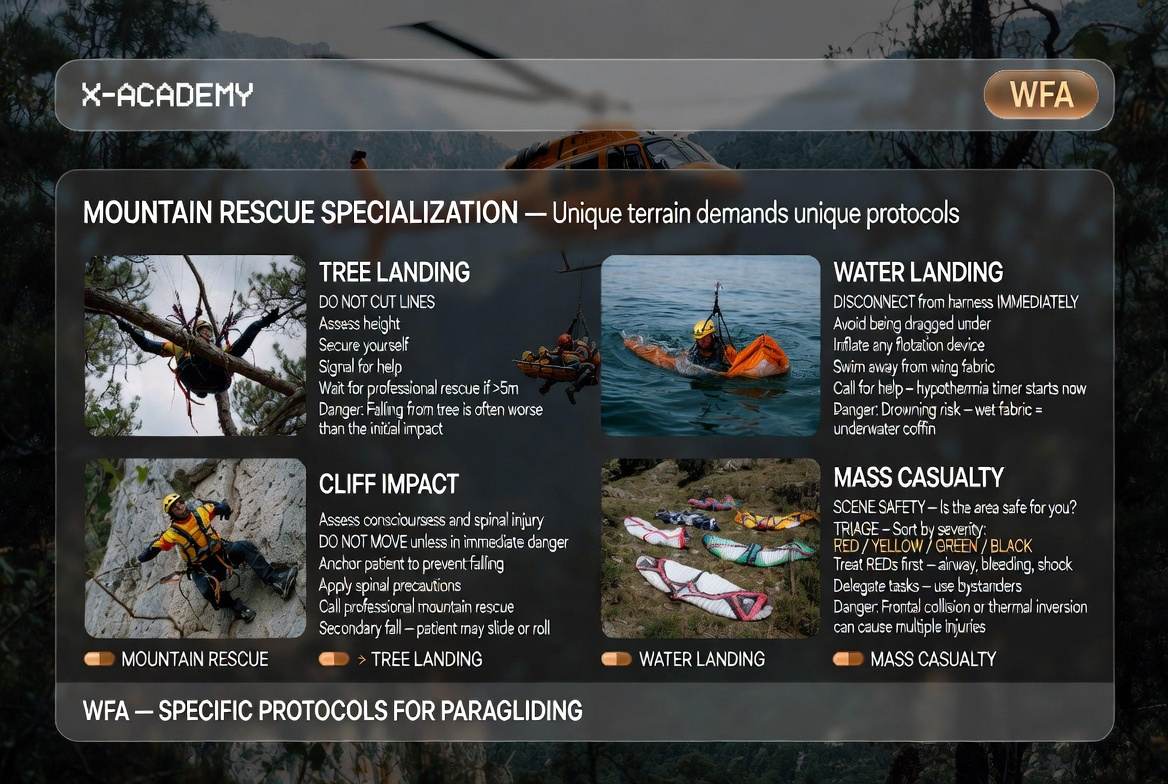
Specific paragliding protocols are a narrow specialization that distinguishes a mountain rescuer from an ordinary paramedic. In this field, medical knowledge must be combined with an understanding of the aviation environment, aerodynamics, and the operational principles of rescue aircraft.
Here is an in-depth and extensive overview of these protocols:
1. Scene Safety – The "Zero Victim" Principle
The first rule of first aid in paragliding is your own safety. In emotional situations, pilots often make the mistake of rushing toward the injured person without assessing the surrounding environment.
Aerial Hazard: Before approaching the victim, look up. Ensure that no other pilots are planning to land in the same spot. Signal to pilots in the air (e.g., by waving your arms) that the area is occupied.
Terrain Stability: If a pilot is hanging from a cliff or a tree, evaluate whether your approach might cause them to fall or trigger a rockfall.
The Wind Factor: Ensure the victim's wing is not in a position where a gust of wind could re-inflate it or drag the victim (and you) along the ground.
2. Equipment Management
After an incident, paragliding equipment can become an additional source of danger.
Deactivating the Wing: If the victim is in strong winds, the wing must be "killed." The best tool for this is a Hook Knife (safety cutter).
Where to cut? Do not cut the fabric; instead, cut the C and D lines (the rear lines). This destroys the wing's aerodynamic lift.
Why a Hook Knife? Using a standard knife under stress increases the risk of accidentally cutting yourself or the victim. The design of a hook knife eliminates this danger.
Harness Management: If spinal trauma is suspected, it is not recommended to remove the pilot from the harness before professional rescuers arrive, unless the location is hazardous. The harness protector itself acts as a spinal guard.
3. Heli-Rescue Signals (Aviation Communication)
When a rescue helicopter approaches, verbal communication is impossible due to the noise. A pilot must know the international visual signals:
Y (Yes) – "I need help": Both arms raised upward, forming the letter Y with your body. This signals the pilot that you are the person requiring assistance.
N (No) – "I do not need help / Everything is okay": One arm raised upward and the other downward (diagonally), forming the letter N. This prevents the helicopter from wasting critical resources.
Additional Signals:
Smoke/Flare: If you have smoke signals, use them to show the wind direction to the pilot.
Wing Spread: If the victim is in a forest, try to expose part of the wing in an open area to make the site visible from above.
4. Safety Around Helicopters
As a helicopter approaches, the instructor must ensure a "Clean Zone":
Loose Items: Clear the area of all light objects (bags, clothing, paraglider stuff sacks). The helicopter's downwash (propeller blast) can suck these items into the air and into the engine.
Approach: Approach the helicopter only when the pilot signals you to do so, and always from the front so the pilot can see you. Never approach from the tail side!
Summary
These protocols act as a bridge between the pilot and professional rescuers. Scene Safety protects us, Equipment Management prevents injuries from worsening, and Heli-Signals ensure rapid evacuation. Without this knowledge, a pilot at the scene is merely an obstacle; with it, they become an integral part of the rescue operation.