

On this page
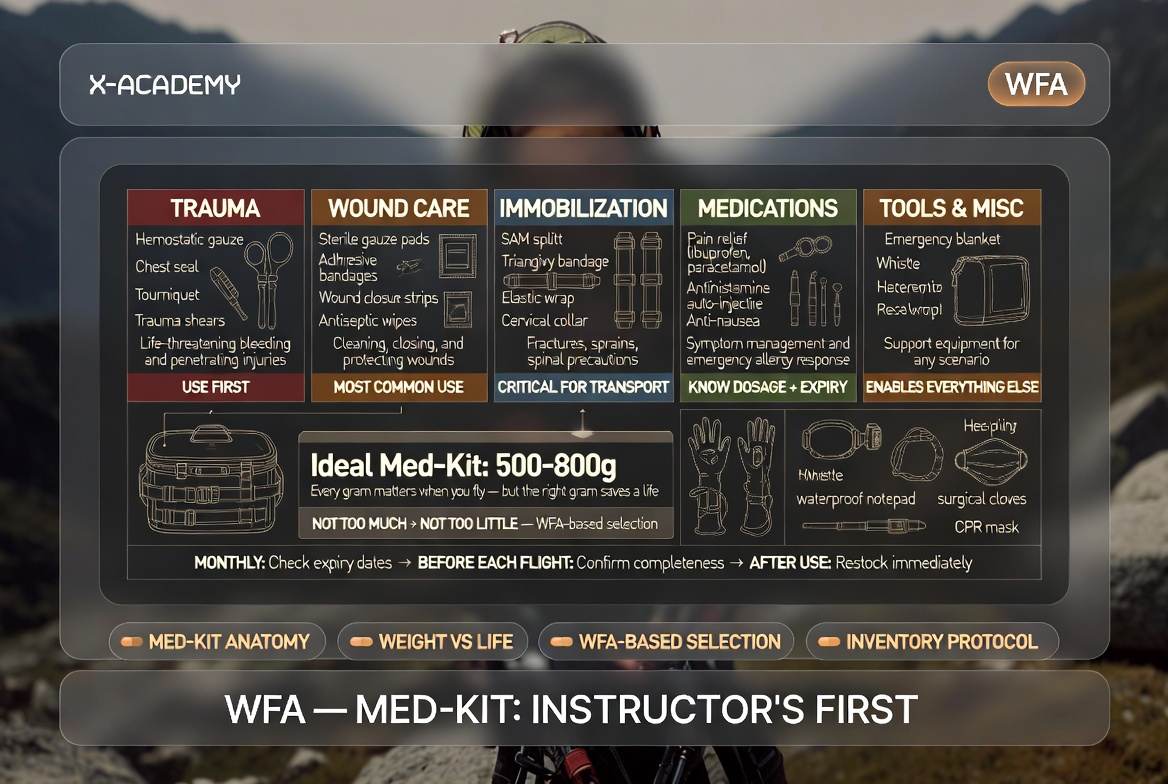
The Instructor's Medical Kit (Med-Kit) is not a standard household first aid kit. In paragliding, its composition is based on Wilderness First Aid (WFA) standards, where the focus is on managing critical trauma and ensuring autonomous survival.
Here is an in-depth and expanded overview of the instructor’s Med-Kit standards:
1. Management of Massive Hemorrhaging (Critical Bleeding)
In paragliding, an open fracture or arterial injury is a matter of minutes.
Tourniquet (CAT - Combat Application Tourniquet): The most critical component of the kit. An instructor should have this in an easily accessible place, not buried deep in a bag. It is used to stop life-threatening bleeding from limbs.
Hemostatic Gauze (e.g., QuikClot / Celox): Gauze treated with a special chemical agent that accelerates blood clotting in seconds. Used where a tourniquet cannot be applied (e.g., shoulder, groin).
Pressure Bandages and Sterile Pads: Large "Abdominal Pads" for covering severe wounds.
2. Immobilization and Traumatology
Stabilizing bones after a vertical impact is the best way to reduce pain and prevent shock.
SAM Splint: A lightweight, soft aluminum sheet that can be molded into any shape. It is used to immobilize the wrist, ankle, or neck (improvised).
Triangular Bandage: A versatile piece of cloth used as an arm sling or to secure a SAM Splint in place.
Medical Tape (Duct Tape / Medical Grade): High-adhesion tape that works even on sweaty or wet skin.
3. Survival and Communication Tools
In the mountains, first aid is only complete when the patient is in a safe evacuation zone.
Space Blanket (Thermal Blanket): A minimum of 2 pieces is mandatory. One goes under the patient (to insulate from the cold ground), and the second goes on top. A patient in shock cannot generate their own heat.
Whistle: In fog or forests, a whistle carries much further than a human shout.
GPS Tracker / Satellite Messenger: (e.g., Garmin inReach) – Critical in areas without mobile signal. It allows you to send an SOS signal with precise coordinates.
Hook Knife (Safety Knife): For the instantaneous cutting of paraglider lines.
4. Pharmacology (Medications)
Note: An instructor only administers medication if the patient is conscious and confirms they have no allergies.
Analgesics (Painkillers): Non-steroidal anti-inflammatory drugs (e.g., Ibuprofen, Dexalgin). Severe pain accelerates the onset of shock.
Antihistamines: (e.g., Epinephrine auto-injector or strong anti-allergy pills). Critical for anaphylactic shock following insect bites.
Aspirin: In case of suspected heart attack (especially relevant for older tandem passengers).
5. Personal Protection and Tools
Nitrile Gloves (Minimum 3 pairs): Your safety is the priority. Contact with another person's blood without protection is unacceptable.
Trauma Shears: Heavy-duty scissors capable of cutting through harness straps, thick clothing, and even boots to reach a wound.
Summary
An instructor’s Med-Kit must be lightweight, waterproof, and organized. Before every season, it is essential to check medication expiration dates and replenish sterile materials. Remember: The kit is useless without the knowledge to use it.