
On this page
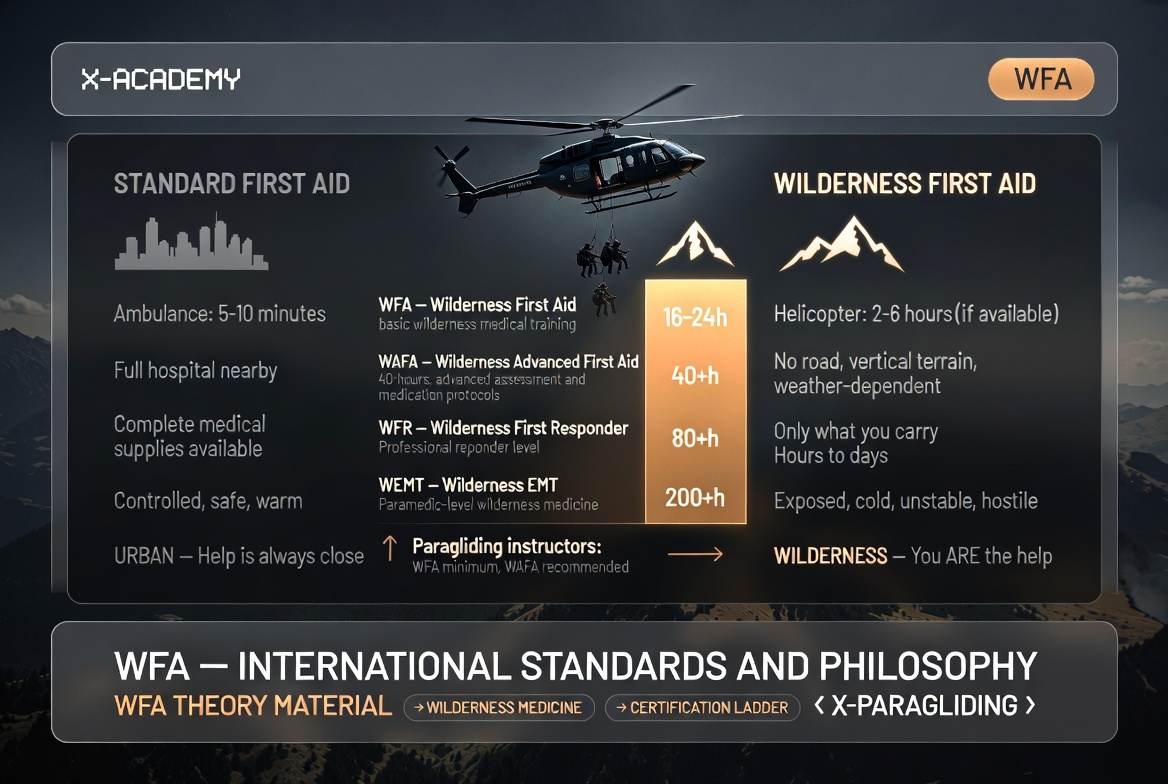
The International Standards and Philosophy of First Aid in paragliding represent the fundamental shift from standard medical training to Wilderness Medicine. When an incident occurs in the mountains, a ravine, or a forested area, the pilot enters an "autonomous mode" where the only chance of survival is their knowledge and a cool head.
Here is an in-depth and extensive overview of this subject:
1. Wilderness First Aid (WFA) – The Philosophical Foundation
Standard "urban" protocols (e.g., a basic Red Cross course) assume that emergency services will arrive within 10-15 minutes. In paragliding, this is an illusion.
The Principle of Self-Sufficiency: WFA teaches that you are not just a first aider; you are the "doctor," "nurse," and "rescuer" for the next several hours.
Battling the Elements: Unlike the city, here the enemies are weather, cold, wind, and difficult terrain. The philosophy dictates that protecting the patient from the environment is as high a priority as treating their wounds.
2. The Time Factor and Long-Term Stabilization
The time factor radically alters medical priorities.
From the "Golden Hour" to "Survival Hours": While stopping bleeding is enough in a city until a doctor arrives, in the mountains, you must manage the patient's thermoregulation. A person in shock is more likely to die from hypothermia (cold) than from the trauma itself.
The Monitoring Cycle: Since help is delayed, it is essential to record the dynamics of the patient's condition (Vital Signs). Checking pulse, respiration, and consciousness every 15-30 minutes provides a picture of whether the patient is improving or deteriorating due to internal bleeding.
3. The Art of Improvisation
This is the most practical and vital part of the training. Paragliding equipment is a "gold mine" of engineering resources during a medical crisis.
Paraglider Fabric and Lines:
Lines: Can be used as strong fasteners for splints or for improvised tourniquets (though a dedicated CAT tourniquet is always superior).
Fabric: The wing material is an excellent thermal insulator. Wrapping the injured person in the wing (the "Burrito Wrap") protects them from hypothermia.
Rigid Structures (Rods & Risers):
The rigid Leading Edge rods or the hard elements of the harness are ideal for stabilizing fractured limbs.
The Harness: The harness itself can be converted into a structure similar to a "vacuum mattress" or a stretcher to limit spinal movement.
Helmet and Clothing: Rolled-up clothing or boots are often used for cervical stabilization (C-Collar), placed on both sides of the patient's head to prevent the movement of neck vertebrae.
4. Psychological Resilience and Leadership
For an instructor, this standard requires Scene Management.
The Leadership Vacuum: Panic often arises in crisis situations. The instructor must take a leadership role, giving specific tasks (e.g., "You, call the rescuers," "You, spread out the reserve wing as a signal") and maintaining calm.
Risk Assessment: The standard prohibits "heroic" self-sacrifice at the expense of one's own safety. If the area is prone to avalanches or a wing hanging from a cliff is moving in the wind, the scene must be stabilized first before approaching the patient.
Summary
According to international standards, first aid in paragliding is the science of resource management. This course teaches the pilot that their equipment is their pharmacy, and their brain is their most powerful medical instrument.