

On this page
First aid in paragliding is not merely medical knowledge; it is the art of extreme survival, where decision-making occurs in isolated environments with limited resources and under high psychological pressure.
Below is a comprehensive and expanded First Aid module specifically tailored for the needs of pilots and instructors:
1. International Standards and Philosophy
Since paragliding often takes place far from inhabited areas, standard "urban" medical protocols do not apply. This course is based on Wilderness First Aid (WFA) principles:
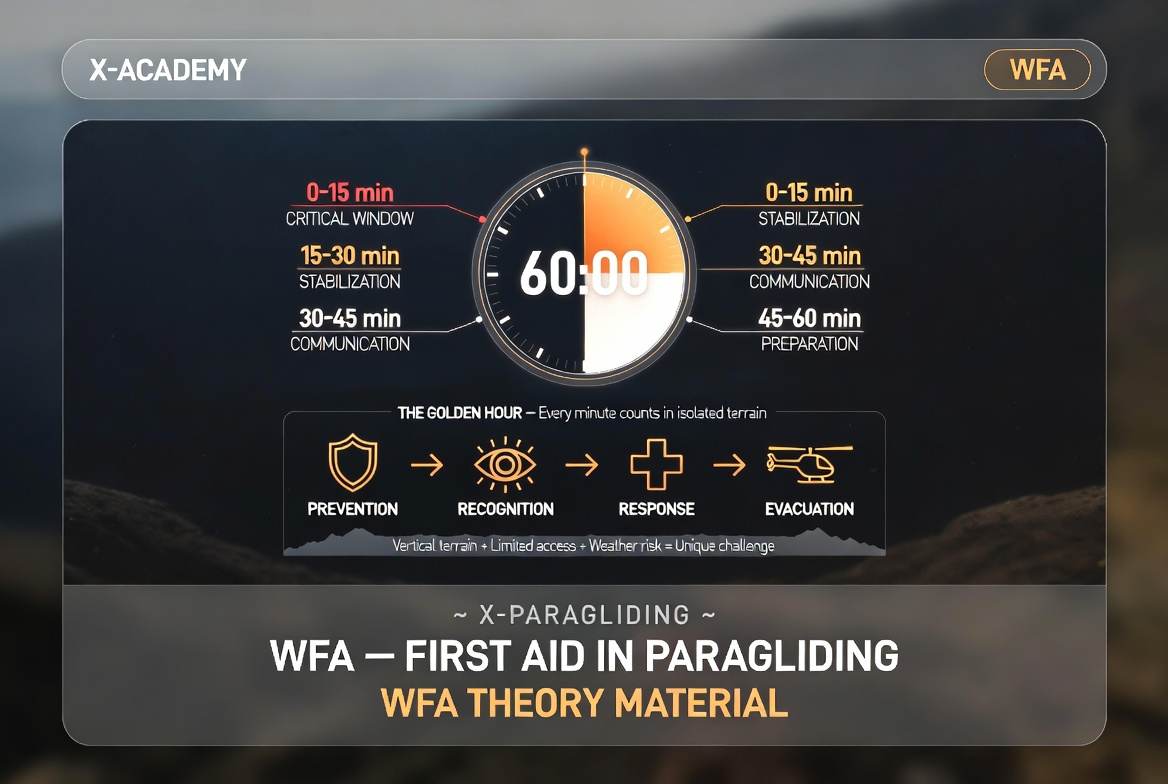
The Time Factor: It may take several hours for professional help to arrive. A pilot must know how to provide long-term patient stabilization.
Improvisation: Using available flight gear (slings/lines, paraglider rods, helmets, and harnesses) for medical purposes.
2. Core Competencies for the Pilot
A) Traumatology and Spinal Management
Most paragliding incidents involve vertical impacts.
Spinal Motion Restriction: After any hard impact, the patient is treated as having a spinal injury until proven otherwise. Fixing the neck and back using helmets or clothing is critical.
Triage: If there are multiple victims, the pilot must prioritize: Breathing > Bleeding > Fractures.
B) The ABCDE Protocol in Extreme Conditions
A (Airway): Clearing the airway without removing the helmet (unless using specific life-saving techniques).
B (Breathing): Identifying chest traumas (e.g., tension pneumothorax from rib fractures).
C (Circulation): Stopping massive hemorrhaging using a Tourniquet (CAT). Mastery of tourniquet application is mandatory.
D (Disability/Neurology): Checking consciousness levels using the AVPU scale.
E (Environment/Exposure): Preventing hypothermia. A patient in shock loses body heat in minutes, especially in the mountains. The use of a Space Blanket is mandatory.
3. Advanced Instructor Guidelines (Management & Leadership)
On the scene, the instructor acts as the Chief Medical Officer. Their task is not just treatment, but overall scene management:
Emergency Action Plan (EAP): For every flying site, the instructor must have an "Emergency Card" containing:
Helicopter landing coordinates (LZ).
Radio frequencies and satellite communication codes.
Contact info for the nearest trauma center.
Psychological Group Management: Preventing panic among other students and ensuring their own safe landing after an incident.
Documentation (SOAP Note): Recording the patient's vitals (pulse, breathing every 15 minutes) to hand over to professional rescuers upon arrival.
4. Paragliding-Specific Protocols
Scene Safety: The first rule is "Do not create a new victim." Ensure the landing zone is safe before approaching the injured person.
Equipment Management: Knowing how to properly cut lines (using a Hook Knife) to prevent the wing from dragging the injured pilot in high winds.
Heli-Rescue Signals: Knowledge of international visual signals (Y — Yes, I need help; N — No, I do not).
5. Med-Kit: The Instructor's Standard
An instructor’s first aid kit should include:
Bleeding Control: Tourniquet (CAT), Hemostatic gauze.
Splinting: SAM Splint (universal splint), triangular bandages.
Survival Gear: Space blanket, whistle, GPS tracker/InReach.
Medications: Pain relief and Antihistamines (for anaphylactic shock).
Summary
First aid knowledge is a core part of an instructor's professional ethics. A Valid First Aid Certificate (renewed every 2 years) is the guarantee that in a critical moment, the instructor will act with a cool head and save lives.