On this page
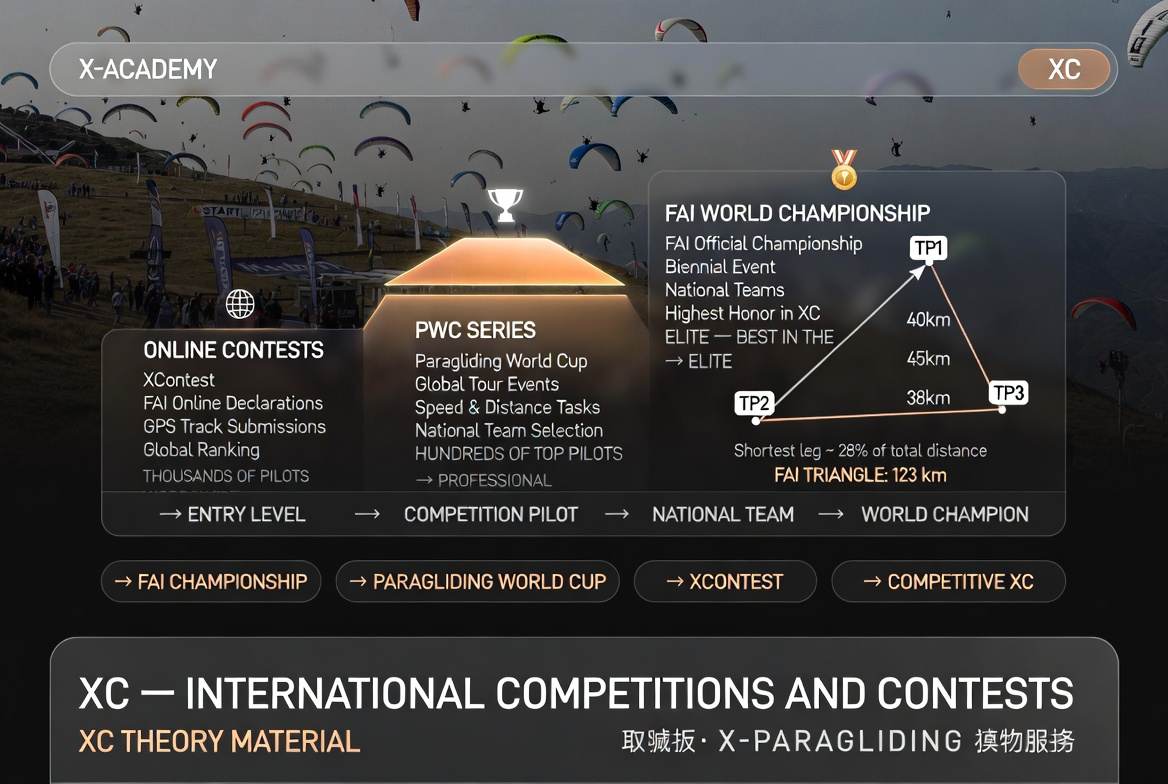
XC (Cross-Country) paragliding is far more than a hobby; it is a high-tech, recognized sporting discipline with its own professional hierarchy. On the international stage, pilots compete not only in courage but in strategic thinking and physical endurance.
Here is an extensive overview of the three main directions of XC competitions:
1. PWC (Paragliding World Cup) – "The Formula 1 of Paragliding"
This is the classic sporting discipline where the primary focus is on speed.
Task Format: Every day, a specific route is set (e.g., 60–120 km) consisting of several Waypoints. Pilots start simultaneously via an "Air Start," and the winner is the one who reaches the Goal in the fastest time.
Strategy: Pilots must decide whether to fly with the group ("The Gaggle") to use collective energy to find thermals or take a risk and choose their own, potentially faster line.
Significance: Participating in the PWC is a symbol of the highest status for a pilot. Participants exclusively use the latest EN-D (CCC) class wings, which are engineered for maximum speed.
2. Red Bull X-Alps – "The Toughest Race in the World"
This is the pinnacle of the Hike-and-Fly format, where the athlete relies solely on their physical strength and their wing.
Concept: Pilots must cross the Alps (approximately 1200 km), typically from Salzburg to Monaco. Movement is allowed in only two ways: flying or hiking while carrying all equipment. All external transportation is strictly prohibited.
The Challenge: This is a two-week marathon. Pilots often run 50–100 km a day in the mountains when the weather is not flyable. Sleep and nutrition are minimal, while stress levels are at their peak.
Significance: The X-Alps has revolutionized the paragliding industry. Ultra-lightweight equipment, now used by XC pilots worldwide, was originally pioneered for this specific race.
3. Online Contests (XContest.org) – "The Virtual World Championship"
While the PWC and X-Alps are for elite athletes, XContest is a platform that allows any pilot to engage in global competition.
How it Works: A pilot uploads their GPS Tracklog to the site. The system automatically calculates points based on distance, route difficulty (e.g., triangles yield more points), and the class of the wing used.
Significance: This is the "Facebook" of the XC community. Here, you can view world records (500–600 km flights in Brazil or Australia) and analyze the trajectories of the world's best pilots.
Local Competition: National rankings exist for every country. For example, you can compete for the title of "Georgia's XC Pilot of the Year."
Why Are These Competitions Important?
Technological Progress: Competitions drive manufacturers to create faster, lighter, and safer wings.
Motivation: Competition pushes a pilot to step outside their comfort zone and refine their skills.
Community: These events serve as a hub for sharing expertise and promoting paragliding as a serious, professional sport.