

On this page
The Role of the Instructor in an XC Course
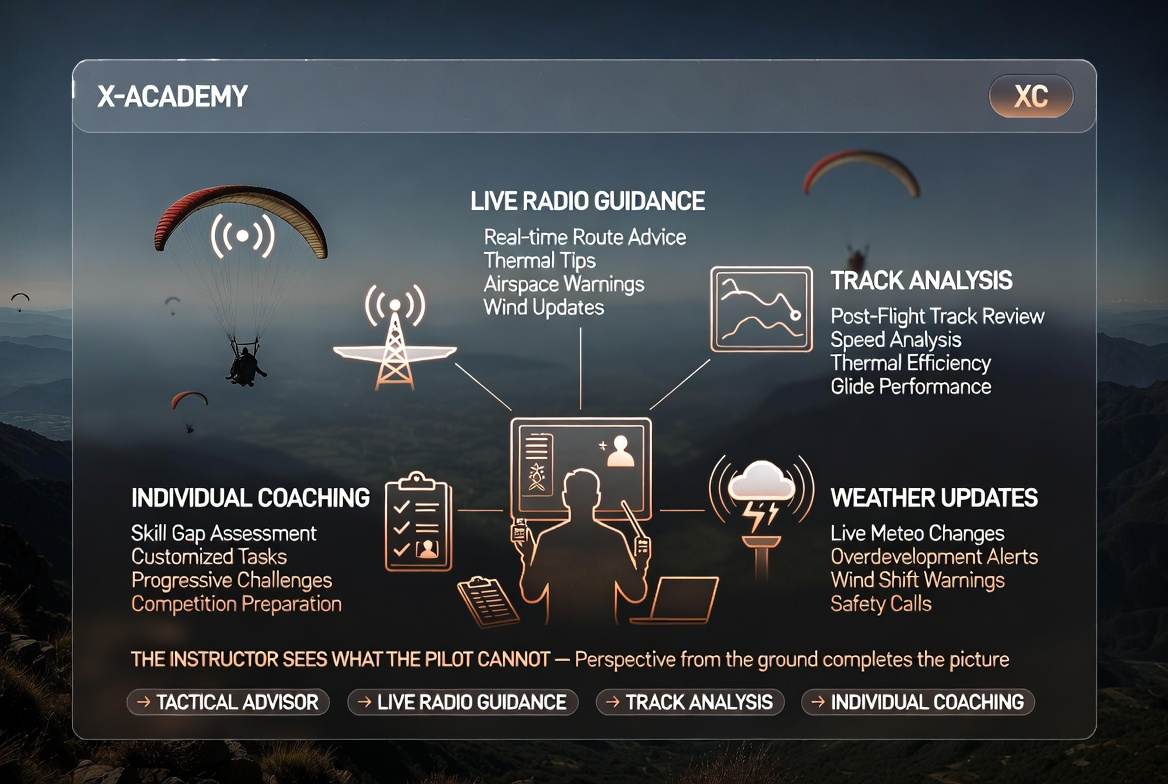
In a Cross-Country (XC) course, the instructor is no longer just a teacher showing you which buttons to press. They become your tactical advisor and "aerial director." XC flying is a continuous chain of decision-making, where a mistake doesn't just mean the end of the flight (landing), but often results in ending up in a challenging or restricted zone.
Here is an in-depth and extensive overview of the instructor’s role:
1. Radio Guidance and "Aerial Coaching"
During an XC flight, a pilot can often get "stuck" and lose sight of the way forward. In these moments, the instructor acts as your external set of eyes.
Thermal Marking: The instructor often flies alongside you. They are usually the first to locate a lift and demonstrate the optimal trajectory. Over the radio, they might guide you: "Turn tighter to the left, the core is stronger here" or "Keep moving forward, this thermal is too weak."
Monitoring Wind Changes: From the air or the ground, the instructor monitors smoke, tree movement, or other pilots. They warn you if valley winds have intensified or shifted direction, which is critical for a safe landing.
Real-Time Route Correction: If the instructor sees a cloud "dying" ahead of you, they suggest an alternative path to ensure you don't lose altitude unnecessarily.
2. Meteo-Analysis: The Art of "Reading the Sky"
The most intellectual part of an XC course is the morning briefing. The instructor teaches you how to become your own meteorologist.
Aerological Diagrams (Skew-T): You learn to read these complex charts to identify inversion layers (which block ascent), predict the altitude of cloud formation, and understand the wind profile at various elevations.
Defining the "Flying Window": You learn to identify the best time for takeoff and recognize when conditions become too aggressive, signaling that it is time to land.
Local Aerology: The instructor explains the specifics of the local terrain—which valleys act as "wind traps" and which slopes work best at different times of the day.
3. Psychological Support and Mental Endurance
XC flight is "solitude in the sky." Over a 4–5 hour flight, a pilot can experience everything from euphoria to intense fear.
Maintaining Concentration: As fatigue sets in, the probability of error increases. The instructor checks in periodically via radio to assess your state and help you regain focus.
Managing Fear in Unknown Environments: Crossing a high mountain valley for the first time can be intimidating. The instructor’s calm voice on the radio—"Everything is fine, you have a safe landing field ahead"—is often the key to pushing forward.
Ego Control: The instructor teaches you that landing is not a failure. They help you make rational decisions—knowing when to push to the goal and when to land safely, even if you are just a few kilometers short.
4. Tracklog Analysis (Post-Flight Review)
This is the stage where the most significant learning occurs.
Diagnosing Mistakes: In the evening, while reviewing your GPS track on a computer, the instructor highlights specific moments: "You left the thermal too early here" or "If you hadn't entered this valley, you could have flown 10km further."
Increasing Efficiency: By analyzing your climb rates and glide transitions, the instructor shows you how to optimize your "tactical line" for the following day.
Why is the Instructor Indispensable?
Safety Buffer: They protect you from meteorological traps that a novice XC pilot might not notice.
Accelerated Progress: Achievements that might take two years of independent trial and error can be reached in a single week with an instructor.
Strategic Thinking: You don't just learn how to fly; you learn how to "play chess" in the sky.