On this page
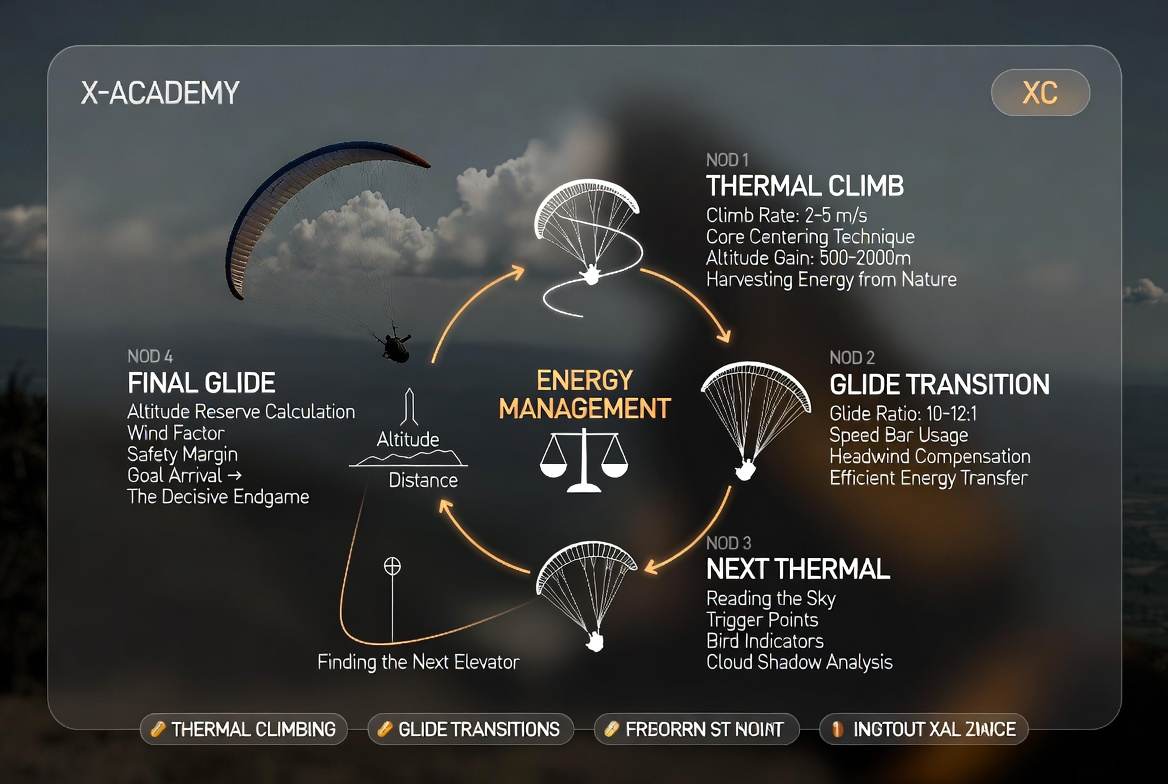
XC (Cross-Country) flight is the most intellectual and strategic dimension of paragliding. While standard flying in a local area is like a "stroll," XC is a true journey where the pilot harnesses the energy of nature to cover hundreds of kilometers.
Here is an in-depth and extensive overview of the core components of XC flight:
1. Thermal Mastery – "Acquiring Fuel"
A thermal is a mass of air warmed by the sun that rises upward. For an XC pilot, this is the "fuel."
Finding Thermals: You learn to analyze the terrain—which slopes heat up more, where the "trigger points" are (the specific spots where air breaks away from the ground), and how to use markers like birds or dust devils to locate rising air.
Centering the Core: A thermal has a core where the climb rate is strongest. On the course, you master $360$-degree turning techniques to stay within this narrow core. Efficient centering means less time spent climbing and more time moving forward.
Cloudbase: This is your target altitude. This is where the thermal ends and the "glide" to the next point begins.
2. Route Planning and Navigation – "Chess in the Sky"
XC flight requires foresight. You must know not only where you are but where you will be $20$ minutes from now.
Reading the Clouds: Cumulus clouds are the "visual markers" of thermals. You learn to determine a cloud’s "life cycle" based on its shape—whether it is actively pulling air or already "dying."
Calculating Wind Drift: Strong winds tilt thermals. A pilot must know how their position changes relative to the terrain to avoid being caught in a "rotor" (dangerous turbulent zones behind ridges).
Valley Crossings: You learn the optimal moment to cross large valleys to ensure you arrive on the other side with enough altitude to find the next lift.
3. Speed Bar Management – "Aerodynamic Efficiency"
In competitive flying, speed is decisive, especially when flying against the wind or through "sink" (sinking air).
Glide Ratio: Using the speed bar allows you to pass through "dead" air zones more quickly. On the course, you learn McCready Theory—determining the optimal speed to fly in various conditions to lose the least amount of altitude.
Active Piloting on Bar: Managing the speed bar in turbulent air can be risky without mastering wing control via the C-risers (the rear lines). This technique allows you to maintain maximum speed without sacrificing safety.
4. Risk Management and "Plan B"
During XC flights, you frequently leave familiar flying sites and venture into unknown territory.
Landing Options: Every second you are scanning the route, your eyes must be searching for a landing field. The golden rule of the XC pilot is: "Never go where you cannot see a safe landing spot."
Meteorological Changes: Weather changes during flight. You learn to recognize symptoms such as increasing wind, Overdevelopment of clouds, or approaching storms. Landing in time is often a sign of greater skill than pushing a dangerous flight.
Hydration and Nutrition: A $4-6$ hour flight exhausts the body. Losing concentration due to fatigue increases risks, so you learn the culture of eating and drinking while actively piloting.
Why are these components critical?
Mastering these elements transforms a pilot into a Strategist.
Confidence: When you understand how nature works, fear is replaced by interest and focus.
Distance: Only a technically proficient pilot can manage to cover $50$, $100$, or more kilometers.
Safety: The primary goal of an XC course is to teach you to fly long distances in a way that ensures you always land safely at the end of the day.