

On this page
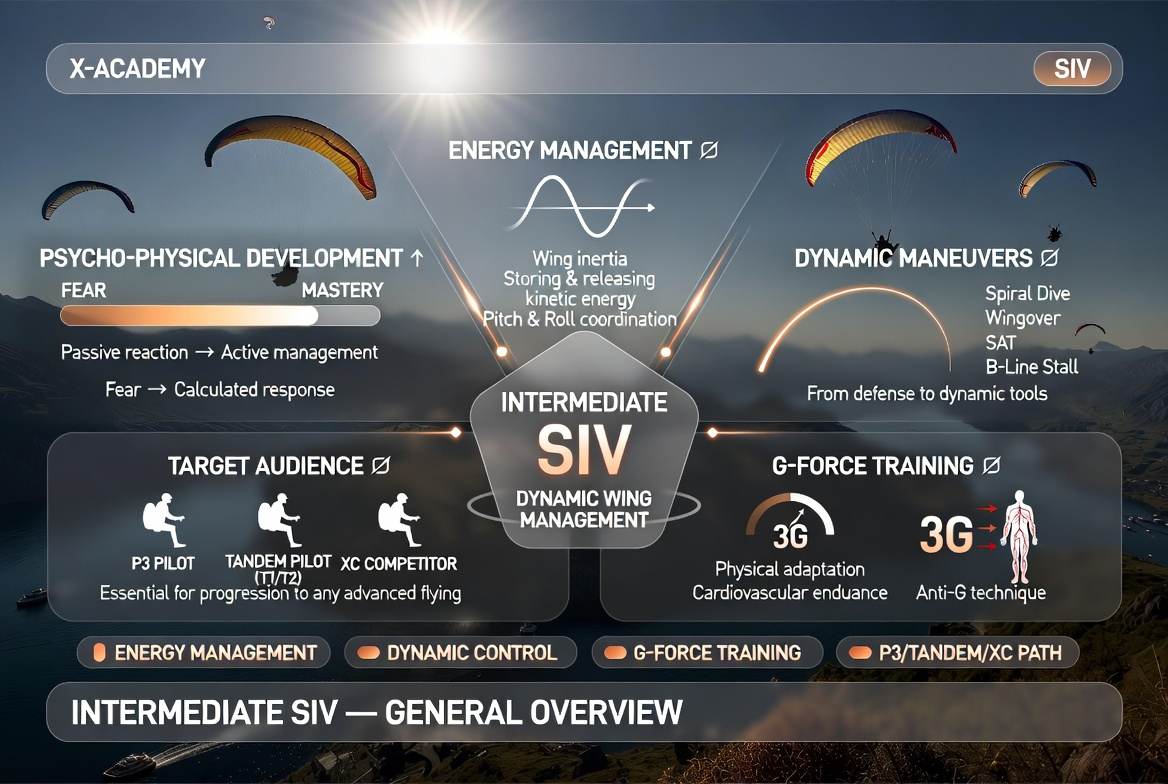
Intermediate SIV (Simulation d'Incidents en Vol) is the stage where a pilot learns to manage the wing's energy. While the introductory level focuses on static collapses, the intermediate level transitions into dynamic maneuvers that require precise timing, high G-force endurance, and a complete "feel" for the wing.
Here is a detailed syllabus and daily plan for the Intermediate SIV course:
1. The Importance of Intermediate SIV
At this stage, the pilot learns how to maintain control when the wing moves with high speed and inertia. This course is essential for those pursuing Thermal Flying (P3) and Tandem Piloting (T1/T2), as the wing often accumulates significant energy in turbulent air.
2. The Instructor’s Role at the Intermediate Level
At this level, the instructor's responsibility increases because the maneuvers are faster:
Energy Control: The instructor dictates the exact moment (timing) to brake or release so that the wing does not surge past the pilot.
G-force Monitoring: During a spiral, the instructor monitors your voice over the radio to ensure you are not experiencing a grey-out or loss of consciousness due to high loads.
Orientation: Helping the pilot maintain spatial awareness while the wing is rotating rapidly.
3. Detailed Description of Maneuvers
A. Spiral Dive
The pilot brings the wing into a steep and deep rotation.
Significance: This is the fastest method of losing altitude (10–20 m/s).
Detail: You learn to "enter" the spiral, stay stable within it, and, most importantly, execute a safe exit (gradually bleeding off energy) so the wing does not produce a violent surge.
B. B-Stall
The pilot pulls down the B-risers, disrupting the wing's profile and stopping horizontal flight.
Significance: A stable vertical descent (6–8 m/s) without forward movement.
Detail: Symmetrical release of the risers is crucial to prevent the wing from entering a negative spin.
C. Wingover
Swinging the wing from side to side to build up energy.
Significance: The ultimate exercise for energy management and timing.
Detail: You learn how to synchronize braking and weight-shifting at peak points. This maneuver prepares pilots for acrobatics.
D. Advanced Asymmetric Collapses (on Bar)
Asymmetric collapses while using 50% and 100% of the Speed Bar.
Significance: Simulating a real-life scenario where the wing collapses during a high-speed glide (transition).
4. SIV Daily Training Plan (Intermediate Level)
This course typically requires 3 days (weather permitting):
Day 1: Energy Foundations
Theory: Physics of the spiral and G-loading.
Flight 1: Deepening Pitch & Roll control; Big Ears with speed bar.
Flight 2: Initial spirals (shallow angles) and exit techniques.
Flight 3: Multiple repetitions of the B-Stall.
Day 2: Dynamic Management
Theory: Wingover timing and rotation management.
Flight 1: First wingovers (low amplitude).
Flight 2: Deep Spiral Dive and maintaining orientation.
Flight 3: Asymmetric collapses at speed (using the accelerator).
Day 3: Complex Maneuvers
Theory: Combinations of incidents.
Flight 1: High wingovers (wing above the horizon).
Flight 2: Simulating rapid exits from a spiral.
Flight 3: Repetition of elective maneuvers and final assessment.
Important Note: During Intermediate SIV, the pilot must already possess a strong sense of the "stall point" to avoid accidentally entering a negative regime during maneuvers (especially during wingovers).